OZ boxers of the past - Discussion

tazzberry
Welterweight
Posts: 1
Joined: 16 May 2016, 22:49

Re: OZ boxers of the past - Discussion

Post by tazzberry »

neomortalgirl wrote:Hi i am looking for information about a boxer named Jimmy O'Dea, a boxer in the 1930's from NSW. He is my great grandfather and we only know his boxing name and was hoping there was information about where he really came from and his really name. He died in 1942 in Singapore during the second world war.
this is the fight information that i found on Boxrec.com but i couldnt contact them. I would appreciate any information as we would love to track down our family. His family would have never known we exist and my grandfather was his only child.

Jimmy O'Dea
Global ID 197102
sex male
division featherweight
country Australia
residence Sydney, New South Wales, Australia
won 15 (KO 8) + lost 15 (KO 5) + drawn 7 = 37 rounds boxed 143 KO% 21.62
http://boxrec.com/forum/posting.php?mod ... fbdfe49069#


Hi, I am doing some family tree stuff and came across this. I don't know if its any relation but my great great gandfather was Jimmy O'Dea. His real name was James Whitcomb. This is the same name as his father. Please contact me for more information. Taryn
hofguy
Cruiserweight
Posts: 64
Joined: 04 Apr 2011, 07:46

Re: OZ boxers of the past - Discussion

Post by hofguy »

There was a Private James O'Dea, Serv. No. NX 77958, of the 2/20 Battalion AIF, died at Singapore, 17th March,1942.
He was born 26th September 1912, at Newcastle, & was from Swan Bay when he enlisted
Chuck1052
Heavyweight
Heavyweight
Posts: 4282
Joined: 11 Dec 2003, 22:08

Re: OZ boxers of the past - Discussion

Post by Chuck1052 »

While trying to find information about Les Darcy during the last month or two, I have come to believe the following:

1. Besides considering Darcy to be a possible opponent for Georges Carpentier in a bout, Tex Rickard didn't seem to have any other interest in the young Australian fighter. After it became clear very early in 1917 that Carpentier, then serving in the French army while World War I was taking place, was not going to come to the United States at the time, Rickard released Darcy from any obligation that the Australian had to him. With Rickard apparently out of his life, Darcy was scheduled to fight in a number of bouts, none of which took place for one reason or another.

2. Darcy probably would have had a better chance to fight in the United States if he decided not to accept any offers to fight in the state of New York. During the early part of 1917, there was a big push to ban professional boxing in the state of New York with the Governor of New York, Charles Whitman, being an anti-boxing advocate. When Whitman banned Darcy shortly before the latter's scheduled bout with Jack Dillon was to take place at Madison Square Garden in New York City, it led to the Australian also being banned in other American locales or states.

- Chuck Johnston
Like a Boss
Light Heavyweight
Posts: 5863
Joined: 01 May 2012, 03:21

Re: OZ boxers of the past - Discussion

Post by Like a Boss »

Image

http://www.mylongestround.com/

I’ve been fighting since the day I was born. No, I’ve been fighting from the time I was curled up inside my mother’s belly. The day my father shot himself in the head, that’s when my fight started.

This is the story of Wally ‘Wait-a-While’ Carr - Australian and Commonwealth champion boxer who held twelve titles in 6 divisions. From featherweight to heavyweight, one of the last of the fifteen-rounders, he fought an astonishing 101 professional bouts in his fifteen-year boxing career.

Growing up in 1950s and ‘60s rural New South Wales, it wasn’t until he moved to Sydney at the age of sixteen that he began to understand what racism was all about.

My Longest Round is an Aboriginal man’s perspective on inner-city life; the two-up games, the gangsters, and the way working-class neighbourhoods looked out for each other. From hunting goannas, Jimmy Sharman’s boxing tents, rugby league, professional boxing and the first Aboriginal Tent Embassy, to present-day struggles and lifestyles, Wally’s story offers a vital snapshot of Aboriginal and Australian history.

Wally Carr ImageRetiring from boxing in 1986, Wally faced a sudden void. The triumphs and glory, the thrill of the roaring crowds, the women and high life were replaced by loneliness and despair. He sank to the lowest point of his life, drunk, homeless and experiencing brain damage.

Wally’s inspiring story is also about his courage in overcoming addiction, of a great love for his children, pride in his Aboriginality and an incredible determination to survive and live with dignity.
Chuck1052
Heavyweight
Heavyweight
Posts: 4282
Joined: 11 Dec 2003, 22:08

Re: OZ boxers of the past - Discussion

Post by Chuck1052 »

According to genealogical records in the Family Tree section of Ancestry.com, Thomas James "Tom" Lees, a one-time Australian heavyweight champion during the 1880s, was born on June 16, 1858 in Tamworth, New South Wales, Australia and died on July 11, 1947 in Brighton, Sussex County, England. In the Family Tree Section of Ancestry.com, Lees' page on Peter's ancestor line ancestryweb 20-nov-2009, which was created by Liz_Pidgeon, has quite a bit of information about his life, backed by 22 attached records and 22 sources. According to the information, Lees was married three times, fathering three English-born children with an English wife while in late his 50s and early 60s during the 1910s. All three children later moved to Australia within a fairly short time after their father's death.

- Chuck Johnston

-
bollox
Heavyweight
Heavyweight
Posts: 2168
Joined: 12 Jan 2003, 07:41

Re: OZ boxers of the past - Discussion

Post by bollox »

Like a Boss wrote:Image

http://www.mylongestround.com/

I’ve been fighting since the day I was born. No, I’ve been fighting from the time I was curled up inside my mother’s belly. The day my father shot himself in the head, that’s when my fight started.

This is the story of Wally ‘Wait-a-While’ Carr - Australian and Commonwealth champion boxer who held twelve titles in 6 divisions. From featherweight to heavyweight, one of the last of the fifteen-rounders, he fought an astonishing 101 professional bouts in his fifteen-year boxing career.

Growing up in 1950s and ‘60s rural New South Wales, it wasn’t until he moved to Sydney at the age of sixteen that he began to understand what racism was all about.

My Longest Round is an Aboriginal man’s perspective on inner-city life; the two-up games, the gangsters, and the way working-class neighbourhoods looked out for each other. From hunting goannas, Jimmy Sharman’s boxing tents, rugby league, professional boxing and the first Aboriginal Tent Embassy, to present-day struggles and lifestyles, Wally’s story offers a vital snapshot of Aboriginal and Australian history.

Wally Carr ImageRetiring from boxing in 1986, Wally faced a sudden void. The triumphs and glory, the thrill of the roaring crowds, the women and high life were replaced by loneliness and despair. He sank to the lowest point of his life, drunk, homeless and experiencing brain damage.

Wally’s inspiring story is also about his courage in overcoming addiction, of a great love for his children, pride in his Aboriginality and an incredible determination to survive and live with dignity.
During a bout Wally was on the receiving end of a pasting. During a clinch someone from the crowd yelled "hit him, Wally". Wally yelled back "I can't, he won't let me"
bollox
Heavyweight
Heavyweight
Posts: 2168
Joined: 12 Jan 2003, 07:41

Re: OZ boxers of the past - Discussion

Post by bollox »

Chuck1052 wrote:While trying to find information about Les Darcy during the last month or two, I have come to believe the following:

1. Besides considering Darcy to be a possible opponent for Georges Carpentier in a bout, Tex Rickard didn't seem to have any other interest in the young Australian fighter. After it became clear very early in 1917 that Carpentier, then serving in the French army while World War I was taking place, was not going to come to the United States at the time, Rickard released Darcy from any obligation that the Australian had to him. With Rickard apparently out of his life, Darcy was scheduled to fight in a number of bouts, none of which took place for one reason or another.

2. Darcy probably would have had a better chance to fight in the United States if he decided not to accept any offers to fight in the state of New York. During the early part of 1917, there was a big push to ban professional boxing in the state of New York with the Governor of New York, Charles Whitman, being an anti-boxing advocate. When Whitman banned Darcy shortly before the latter's scheduled bout with Jack Dillon was to take place at Madison Square Garden in New York City, it led to the Australian also being banned in other American locales or states.

- Chuck Johnston
We in Aus like to think there was a major conspiracy against Les Darcy when he got to the US. But I don't think it existed since there was more money to be made from him fighting rather than not fighting
Like a Boss
Light Heavyweight
Posts: 5863
Joined: 01 May 2012, 03:21

Re: OZ boxers of the past - Discussion

Post by Like a Boss »

bollox wrote:
Like a Boss wrote:Image

http://www.mylongestround.com/

I’ve been fighting since the day I was born. No, I’ve been fighting from the time I was curled up inside my mother’s belly. The day my father shot himself in the head, that’s when my fight started.

This is the story of Wally ‘Wait-a-While’ Carr - Australian and Commonwealth champion boxer who held twelve titles in 6 divisions. From featherweight to heavyweight, one of the last of the fifteen-rounders, he fought an astonishing 101 professional bouts in his fifteen-year boxing career.

Growing up in 1950s and ‘60s rural New South Wales, it wasn’t until he moved to Sydney at the age of sixteen that he began to understand what racism was all about.

My Longest Round is an Aboriginal man’s perspective on inner-city life; the two-up games, the gangsters, and the way working-class neighbourhoods looked out for each other. From hunting goannas, Jimmy Sharman’s boxing tents, rugby league, professional boxing and the first Aboriginal Tent Embassy, to present-day struggles and lifestyles, Wally’s story offers a vital snapshot of Aboriginal and Australian history.

Wally Carr ImageRetiring from boxing in 1986, Wally faced a sudden void. The triumphs and glory, the thrill of the roaring crowds, the women and high life were replaced by loneliness and despair. He sank to the lowest point of his life, drunk, homeless and experiencing brain damage.

Wally’s inspiring story is also about his courage in overcoming addiction, of a great love for his children, pride in his Aboriginality and an incredible determination to survive and live with dignity.
During a bout Wally was on the receiving end of a pasting. During a clinch someone from the crowd yelled "hit him, Wally". Wally yelled back "I can't, he won't let me"
:lol: Priceless!
Like a Boss
Light Heavyweight
Posts: 5863
Joined: 01 May 2012, 03:21

Re: OZ boxers of the past - Discussion

Post by Like a Boss »

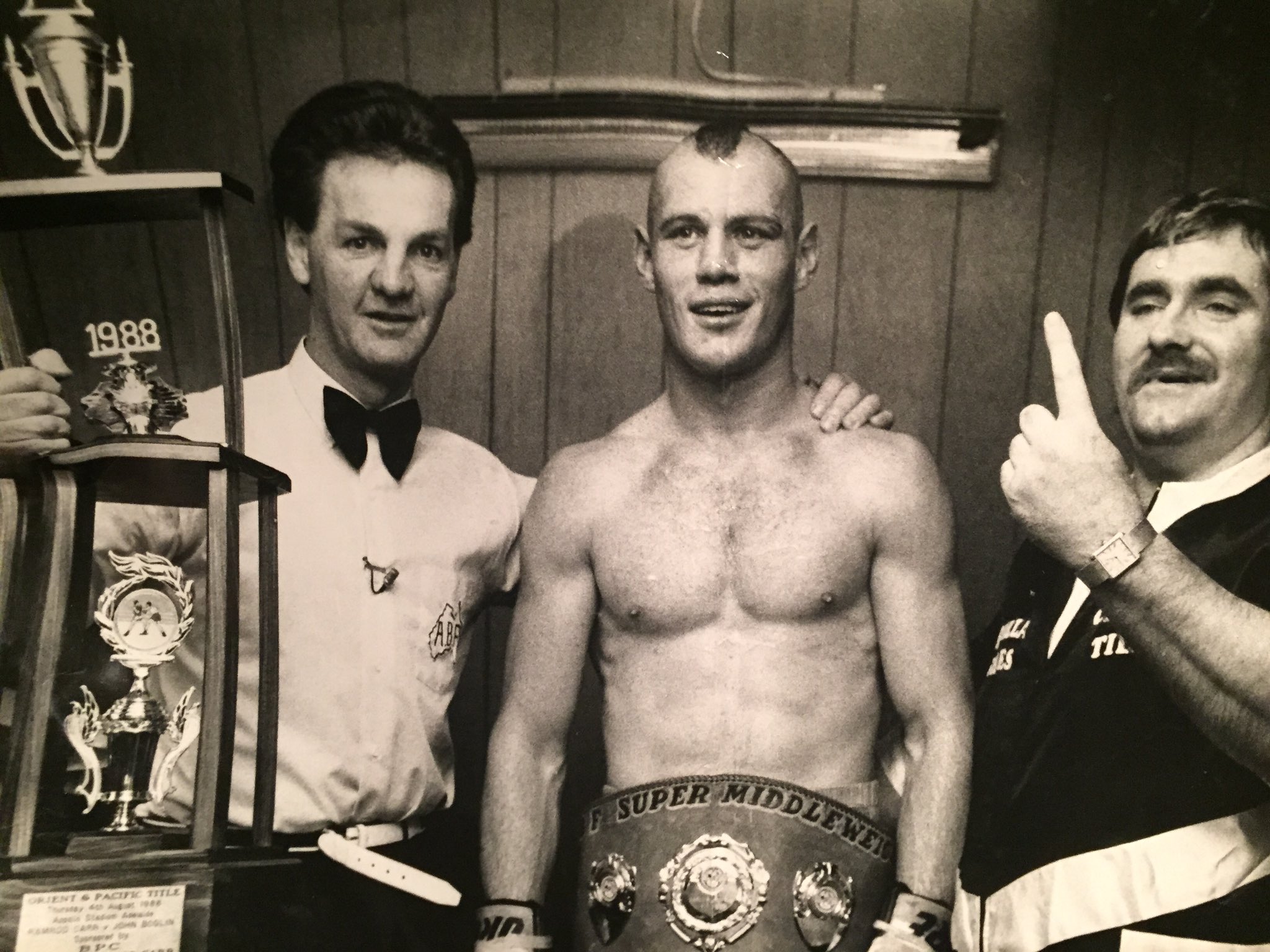
Stumbled on this and thought I just had to post it here :

Image

Rocket and Keefy, and 1988 according to the trophy.
bollox
Heavyweight
Heavyweight
Posts: 2168
Joined: 12 Jan 2003, 07:41

Re: OZ boxers of the past - Discussion

Post by bollox »

Rod started off ok but it all went downhill after a while
Like a Boss
Light Heavyweight
Posts: 5863
Joined: 01 May 2012, 03:21

Re: OZ boxers of the past - Discussion

Post by Like a Boss »

Top article on Graeme “Porky” Brooke :

In 1984 Graeme Brooke acted in the Australian feature film Street Hero, but in real life he was a Flemington boxing hero.

On 2 November 1984, at 21 years old, the then long-term Flemington resident took out the Commonwealth lightweight boxing title at Festival Hall in Melbourne.

Beating former world champion Claude Noel, it was the 19th straight win for Porky since his first match at Dallas Brooks Hall only 3 years earlier. At that time, having barely turned 18, Brooke was voted Victorian Prospect of the Year.

A 1985 article in the Australasian Post describes how, as a child, Porky watched his close relative Lionel Rose train in a fibro-cement shed in an Essendon backyard:

“His eyes glazed as he stood in awe of Lionel Rose – and he dreamed.

He too wanted to be a champion, to travel the world, to do what Lionel Rose had done. They were the dreams of a seven-year old, a chubby little fellow who hadn’t even had a scrap with his mates in the Flemington schoolyard.

One day he would return to Jack Rennie’s backyard gymnasium to begin his boxing career, just as Rose had done a decade before. Perhaps he too would be watched by hundreds as he trained.”

Graeme Brooke did indeed return to be trained by Rennie and watched by kids while he trained. Rennie said, “Look at those moves: he’s got them alright. Look at the way he uses his feet.”

Anyone who talks to Porky would find that, despite his success, he was – and remains – a shy, polite and self-effacing man. “Confident in the ring he may be,” stated one journalist. “But mighty shy when it comes to talking. An Ali he is not.”

Where did his FA_Brooke_Graham_YVBname come from? Brooke says he was a chubby baby. His mother’s aunty grabbed him by the cheeks and called him “Porky”. The name stuck. Everyone called Graeme “Porky”; even his teachers at school.

His father, Graeme Snr, was a labourer and a boxer who fought the prelims on TV Ringside under the name of Graeme Douglas. Porky’s mother Gwen is a Gunditjmara woman, who grew up in Frangliham, near Warrnambool, and worked as a public servant in the Aboriginal Health Service and Commonwealth Employment Service.

Porky’s parents settled in Flemington after they married. Their early days were at 93 Princes Street, which was purchased for about $14,000 when Porky was about ten. The family outgrew this home before moving to 66 Victoria Street.

Porky started school at Flemington Primary. In 1974, along with many others at the time, he transferred to the newly opened Debney Meadows. It was while studying at Debney Park High School that his boxing career took off.

Porky grew up in a Flemington that was changing, with an influx of new migrants and working families into the adjacent high-rise estate. He saw no problems in a young Aboriginal growing up in Flemington with friends from many different backgrounds (recalling in particular new Australians from Turkish, Greek, Spanish and Vietnamese families). He remembers good times with lots of great mates.

He rode his pushbike around the Flemington flats and caught tadpoles and frogs from the Moonee Ponds Creek. “The kids had a ball in those days.”

Porky’s connection with Flemington and Kensington continued with his marriage to a Smith Street resident. In 1981 the young couple also moved into a house in Rankins Road, Kensington.

There was no café culture in Flemington in those days. Porky used to hang out at the old hotels: the Centennial and Bayview (no longer there or pubs) and the Doutta Galla, Hardiman’s and the Palace (now the Quiet Man Irish Pub).

In 1986 Porky moved out of Flemington, like many people at the time to a larger house further afield, but in his case still in the west.

But Porky has maintained a connection with the area. He also continues to keep in touch with many of his neighbours and friends. And to us in Flemington and Kensington, he’ll always be a local hero.
bollox
Heavyweight
Heavyweight
Posts: 2168
Joined: 12 Jan 2003, 07:41

Re: OZ boxers of the past - Discussion

Post by bollox »

Like a Boss wrote:Top article on Graeme “Porky” Brooke :

In 1984 Graeme Brooke acted in the Australian feature film Street Hero, but in real life he was a Flemington boxing hero.

On 2 November 1984, at 21 years old, the then long-term Flemington resident took out the Commonwealth lightweight boxing title at Festival Hall in Melbourne.

Beating former world champion Claude Noel, it was the 19th straight win for Porky since his first match at Dallas Brooks Hall only 3 years earlier. At that time, having barely turned 18, Brooke was voted Victorian Prospect of the Year.

A 1985 article in the Australasian Post describes how, as a child, Porky watched his close relative Lionel Rose train in a fibro-cement shed in an Essendon backyard:

“His eyes glazed as he stood in awe of Lionel Rose – and he dreamed.

He too wanted to be a champion, to travel the world, to do what Lionel Rose had done. They were the dreams of a seven-year old, a chubby little fellow who hadn’t even had a scrap with his mates in the Flemington schoolyard.

One day he would return to Jack Rennie’s backyard gymnasium to begin his boxing career, just as Rose had done a decade before. Perhaps he too would be watched by hundreds as he trained.”

Graeme Brooke did indeed return to be trained by Rennie and watched by kids while he trained. Rennie said, “Look at those moves: he’s got them alright. Look at the way he uses his feet.”

Anyone who talks to Porky would find that, despite his success, he was – and remains – a shy, polite and self-effacing man. “Confident in the ring he may be,” stated one journalist. “But mighty shy when it comes to talking. An Ali he is not.”

Where did his FA_Brooke_Graham_YVBname come from? Brooke says he was a chubby baby. His mother’s aunty grabbed him by the cheeks and called him “Porky”. The name stuck. Everyone called Graeme “Porky”; even his teachers at school.

His father, Graeme Snr, was a labourer and a boxer who fought the prelims on TV Ringside under the name of Graeme Douglas. Porky’s mother Gwen is a Gunditjmara woman, who grew up in Frangliham, near Warrnambool, and worked as a public servant in the Aboriginal Health Service and Commonwealth Employment Service.

Porky’s parents settled in Flemington after they married. Their early days were at 93 Princes Street, which was purchased for about $14,000 when Porky was about ten. The family outgrew this home before moving to 66 Victoria Street.

Porky started school at Flemington Primary. In 1974, along with many others at the time, he transferred to the newly opened Debney Meadows. It was while studying at Debney Park High School that his boxing career took off.

Porky grew up in a Flemington that was changing, with an influx of new migrants and working families into the adjacent high-rise estate. He saw no problems in a young Aboriginal growing up in Flemington with friends from many different backgrounds (recalling in particular new Australians from Turkish, Greek, Spanish and Vietnamese families). He remembers good times with lots of great mates.

He rode his pushbike around the Flemington flats and caught tadpoles and frogs from the Moonee Ponds Creek. “The kids had a ball in those days.”

Porky’s connection with Flemington and Kensington continued with his marriage to a Smith Street resident. In 1981 the young couple also moved into a house in Rankins Road, Kensington.

There was no café culture in Flemington in those days. Porky used to hang out at the old hotels: the Centennial and Bayview (no longer there or pubs) and the Doutta Galla, Hardiman’s and the Palace (now the Quiet Man Irish Pub).

In 1986 Porky moved out of Flemington, like many people at the time to a larger house further afield, but in his case still in the west.

But Porky has maintained a connection with the area. He also continues to keep in touch with many of his neighbours and friends. And to us in Flemington and Kensington, he’ll always be a local hero.
In the early 80's I hoped Brooke would move onto the world stage but it wasn't to be. Barry Michael didn't help things

p s great old footage of Tony Mundine
Like a Boss
Light Heavyweight
Posts: 5863
Joined: 01 May 2012, 03:21

Re: OZ boxers of the past - Discussion

Post by Like a Boss »

bollox wrote:
Like a Boss wrote:Top article on Graeme “Porky” Brooke :

In 1984 Graeme Brooke acted in the Australian feature film Street Hero, but in real life he was a Flemington boxing hero.

On 2 November 1984, at 21 years old, the then long-term Flemington resident took out the Commonwealth lightweight boxing title at Festival Hall in Melbourne.

Beating former world champion Claude Noel, it was the 19th straight win for Porky since his first match at Dallas Brooks Hall only 3 years earlier. At that time, having barely turned 18, Brooke was voted Victorian Prospect of the Year.

A 1985 article in the Australasian Post describes how, as a child, Porky watched his close relative Lionel Rose train in a fibro-cement shed in an Essendon backyard:

“His eyes glazed as he stood in awe of Lionel Rose – and he dreamed.

He too wanted to be a champion, to travel the world, to do what Lionel Rose had done. They were the dreams of a seven-year old, a chubby little fellow who hadn’t even had a scrap with his mates in the Flemington schoolyard.

One day he would return to Jack Rennie’s backyard gymnasium to begin his boxing career, just as Rose had done a decade before. Perhaps he too would be watched by hundreds as he trained.”

Graeme Brooke did indeed return to be trained by Rennie and watched by kids while he trained. Rennie said, “Look at those moves: he’s got them alright. Look at the way he uses his feet.”

Anyone who talks to Porky would find that, despite his success, he was – and remains – a shy, polite and self-effacing man. “Confident in the ring he may be,” stated one journalist. “But mighty shy when it comes to talking. An Ali he is not.”

Where did his FA_Brooke_Graham_YVBname come from? Brooke says he was a chubby baby. His mother’s aunty grabbed him by the cheeks and called him “Porky”. The name stuck. Everyone called Graeme “Porky”; even his teachers at school.

His father, Graeme Snr, was a labourer and a boxer who fought the prelims on TV Ringside under the name of Graeme Douglas. Porky’s mother Gwen is a Gunditjmara woman, who grew up in Frangliham, near Warrnambool, and worked as a public servant in the Aboriginal Health Service and Commonwealth Employment Service.

Porky’s parents settled in Flemington after they married. Their early days were at 93 Princes Street, which was purchased for about $14,000 when Porky was about ten. The family outgrew this home before moving to 66 Victoria Street.

Porky started school at Flemington Primary. In 1974, along with many others at the time, he transferred to the newly opened Debney Meadows. It was while studying at Debney Park High School that his boxing career took off.

Porky grew up in a Flemington that was changing, with an influx of new migrants and working families into the adjacent high-rise estate. He saw no problems in a young Aboriginal growing up in Flemington with friends from many different backgrounds (recalling in particular new Australians from Turkish, Greek, Spanish and Vietnamese families). He remembers good times with lots of great mates.

He rode his pushbike around the Flemington flats and caught tadpoles and frogs from the Moonee Ponds Creek. “The kids had a ball in those days.”

Porky’s connection with Flemington and Kensington continued with his marriage to a Smith Street resident. In 1981 the young couple also moved into a house in Rankins Road, Kensington.

There was no café culture in Flemington in those days. Porky used to hang out at the old hotels: the Centennial and Bayview (no longer there or pubs) and the Doutta Galla, Hardiman’s and the Palace (now the Quiet Man Irish Pub).

In 1986 Porky moved out of Flemington, like many people at the time to a larger house further afield, but in his case still in the west.

But Porky has maintained a connection with the area. He also continues to keep in touch with many of his neighbours and friends. And to us in Flemington and Kensington, he’ll always be a local hero.
In the early 80's I hoped Brooke would move onto the world stage but it wasn't to be. Barry Michael didn't help things

p s great old footage of Tony Mundine
Barry was a good one to avoid for far less experienced fighters. As Porky, Lester and others found out.
bollox
Heavyweight
Heavyweight
Posts: 2168
Joined: 12 Jan 2003, 07:41

Re: OZ boxers of the past - Discussion

Post by bollox »

He did alright against Frank Ropis too :bag:
Like a Boss
Light Heavyweight
Posts: 5863
Joined: 01 May 2012, 03:21

Re: OZ boxers of the past - Discussion

Post by Like a Boss »

bollox wrote:He did alright against Frank Ropis too :bag:
Absolutely. I wasn't trying to put a knock on Michael there. He took them all on.
Like a Boss
Light Heavyweight
Posts: 5863
Joined: 01 May 2012, 03:21

Re: OZ boxers of the past - Discussion

Post by Like a Boss »

In days gone by some fighters just couldn't seem to get enough of each other, fighting each other numerous times.

Just looking through Michael Karpaney's 34 fight record from the early 70s and found :

Karpaney fought Alan Aldenhoven 5 times. Winning the first. Drawing the second, and losing the last 3. Which were the last 3 of his career.

Karpaney fought Terry Grinstead 4 times. The first meeting was a draw. But Grinstead won the following 3.

There were occasions where particular fighters met many more times than that back then. But there is one example, none the less.
Scottb
Middleweight
Posts: 18
Joined: 07 Feb 2014, 00:18

Re: OZ boxers of the past - Discussion

Post by Scottb »

Like a Boss wrote:Stumbled on this and thought I just had to post it here :

Image

Rocket and Keefy, and 1988 according to the trophy.

Isn't the referee in the pic Jim Boland the same referee as Wednesday night Green V Watts?
AntonS
Heavyweight
Heavyweight
Posts: 6406
Joined: 16 Sep 2003, 04:38

Re: OZ boxers of the past - Discussion

Post by AntonS »

I think so. Jim (James) has been around for yonks
Pidgeoncoop
Super Lightweight
Posts: 1
Joined: 16 Aug 2016, 08:17

Re: OZ boxers of the past - Discussion

Post by Pidgeoncoop »

Chuck1052 wrote:According to genealogical records in the Family Tree section of Ancestry.com, Thomas James "Tom" Lees, a one-time Australian heavyweight champion during the 1880s, was born on June 16, 1858 in Tamworth, New South Wales, Australia and died on July 11, 1947 in Brighton, Sussex County, England. In the Family Tree Section of Ancestry.com, Lees' page on Peter's ancestor line ancestryweb 20-nov-2009, which was created by Liz_Pidgeon, has quite a bit of information about his life, backed by 22 attached records and 22 sources. According to the information, Lees was married three times, fathering three English-born children with an English wife while in late his 50s and early 60s during the 1910s. All three children later moved to Australia within a fairly short time after their father's death.

- Chuck Johnston

-
I'm glad that you have acknowledged the source of Big Tom's personal details at least in this forum post. It would be nice however if the boxer's record could show source references for facts quoted; e.g. Big Tom's birth and death details or indeed some of his fights. Tom's death was a mystery until only just recently as there is no apparent connection or evidence establishing the person who died in 1947 was actually the same person who held the Australian Heavyweight championship. It was only established after several years of research by myself and another family researcher plodding through numerous newspaper articles at the National Library of Australia's Trove web site, British Library Newspaper Archive and various US digitised newspaper records. In fact, Tom's death was reported in a Queensland newspaper in 1936. As this could not be verified, the report was discredited as being erroneous. The Tom Lees that died in 1947 was a retired farmer from Kent. It was only as a result of one small newspaper article which had a reference to Big Tom being a farmer in Kent that the potential connection was established. And it was eventually proven after the purchase of various birth and death certificates along with probate records of the various children. It is a little disheartening therefore to see one's efforts freely taken from a subscriber only website and republished without any acknowledgement. But I guess that is the nature of the Internet. Good thing I hadn't made my ancestry tree private, hey?
BTW, I believe Tom was only married twice. The 'wife' in 1901 was probably a defacto as his first wife was still alive at the time.
Cheers
- Peter Pidgeon (Tom Lees was my grandfather Alfie Lees' first cousin)
Chuck1052
Heavyweight
Heavyweight
Posts: 4282
Joined: 11 Dec 2003, 22:08

Re: OZ boxers of the past - Discussion

Post by Chuck1052 »

Pidgeoncoop wrote:
Chuck1052 wrote:According to genealogical records in the Family Tree section of Ancestry.com, Thomas James "Tom" Lees, a one-time Australian heavyweight champion during the 1880s, was born on June 16, 1858 in Tamworth, New South Wales, Australia and died on July 11, 1947 in Brighton, Sussex County, England. In the Family Tree Section of Ancestry.com, Lees' page on Peter's ancestor line ancestryweb 20-nov-2009, which was created by Liz_Pidgeon, has quite a bit of information about his life, backed by 22 attached records and 22 sources. According to the information, Lees was married three times, fathering three English-born children with an English wife while in late his 50s and early 60s during the 1910s. All three children later moved to Australia within a fairly short time after their father's death.

- Chuck Johnston

-
I'm glad that you have acknowledged the source of Big Tom's personal details at least in this forum post. It would be nice however if the boxer's record could show source references for facts quoted; e.g. Big Tom's birth and death details or indeed some of his fights. Tom's death was a mystery until only just recently as there is no apparent connection or evidence establishing the person who died in 1947 was actually the same person who held the Australian Heavyweight championship. It was only established after several years of research by myself and another family researcher plodding through numerous newspaper articles at the National Library of Australia's Trove web site, British Library Newspaper Archive and various US digitised newspaper records. In fact, Tom's death was reported in a Queensland newspaper in 1936. As this could not be verified, the report was discredited as being erroneous. The Tom Lees that died in 1947 was a retired farmer from Kent. It was only as a result of one small newspaper article which had a reference to Big Tom being a farmer in Kent that the potential connection was established. And it was eventually proven after the purchase of various birth and death certificates along with probate records of the various children. It is a little disheartening therefore to see one's efforts freely taken from a subscriber only website and republished without any acknowledgement. But I guess that is the nature of the Internet. Good thing I hadn't made my ancestry tree private, hey?
BTW, I believe Tom was only married twice. The 'wife' in 1901 was probably a defacto as his first wife was still alive at the time.
Cheers
- Peter Pidgeon (Tom Lees was my grandfather Alfie Lees' first cousin)
Mr. Pidgeon- You made some very valid points. I hope to acknowledge all source references on Tom Lees' boxing record on the BoxRec website to your satisfaction.

Tom Lees was one of several fairly important Australian boxing figures from an era in which Australia played such an important and underrated role in the sport of boxing. During the middle 1970s, I first learned about Lees when reading about him in a fairly lengthy biographical sketch about the great Australian black boxer, Peter Jackson, in Nat Fleischer's late 1930s multi-volume Black Dynamite series, which contained other numerous biographical sketches of the best-known black boxers in boxing history up to that time. As I recall, Fleischer spelled Lees' last name as "Leeds." Fleischer was best-known for being the editor and publisher of the American monthly boxing publication, Ring Magazine, from early 1920s until his death during the early 1920s. By the way, I am an American who lives in California.

- Chuck Johnston
Tinnie
Heavyweight
Heavyweight
Posts: 4547
Joined: 05 Jan 2010, 06:31

Re: OZ boxers of the past - Discussion

Post by Tinnie »

Image

Was reading a little the other day about one of Papua New Guinea's finest Martin Beni. He debuted with a KO win over Ceddy McGrady.... also holds wins over Colin Cassidy, Baby Cassius, Wally Carr, Matt Ropis and Spider Phil Davies.... a draw with Frank Ropis and a loss to Hec Thompson while challenging for the Commonwealth title. He certainly sounds like he was a very handy boxer.

http://boxrec.com/boxer/54286
bollox
Heavyweight
Heavyweight
Posts: 2168
Joined: 12 Jan 2003, 07:41

Re: OZ boxers of the past - Discussion

Post by bollox »

Don't know him but he seems to be similar to Sakaraia Ve from Fiji in that he fought and beat quite a few of our fighters
Post Reply