Caractacus wrote:thank goodness for the Marquies of Queensberry Rules.
I wonder if Castor and Pollux ever wrote a book about pugilism back in ancient Greece times ?
If so it it was probably destroyed in the burning of the great Library of Alexandria in Egypt ( 48 BC).
James Figg, generally is called the father of boxing, but this is no altogether correct. When he fought, he demanded that his opponents fight him in "three round bouts" where the first round was boxing and the second round was wrestling and the last round was either fencing or quarterstaffs. Each round was "to the finish", so no time limit, and whoever could beat Figg two out of three rounds was the champion.
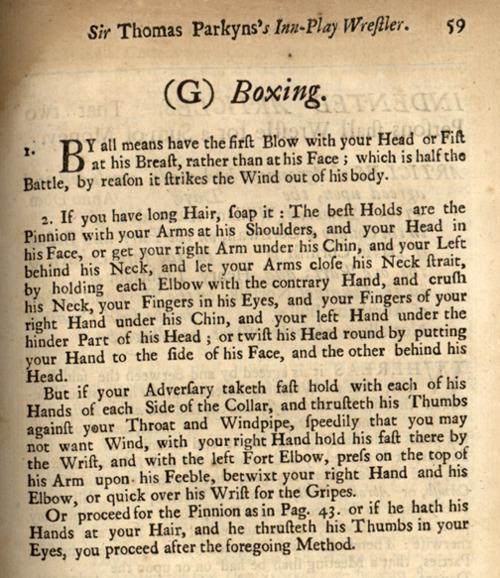
Even with Figg's conditions there was no uniform set of rules in the sport until Broughton came along. In truth, rules changed on a match by match basis with the two combatants having their own "gentleman's agreement" on what was doable and what wasn't. Alot of times fights were "all in" (anything goes) and men acted as their own referees. If a man head butted another man, then the other man had every right to head butt back, etc.
Quite a far cry from Ancient Greece and Rome where there was a clear distinction that only punches were allowed, and that if fights went on too long metal studded gloves would be worn and the enclosure would shrink around them (was a group of men holding reeds and they would take a step forward as the rounds went on) until the two men were literally standing right in front of you.
I seem to recall a boxing match in Greece where a dead man was actually awarded victory because his opponent hit him with the points of his fingers and pulled out the man's guts, and the judge overseeing all of this said that instead of throwing one punch the man threw five (five fingertips) and that violated the rules because in this instance the two men fought under "I hit you, you hit me" rules.

 via Imgflip Meme Generator