

bits and pieces scrapbook

Re: bits and pieces scrapbook
In the small room is a large bed he makes up himself, several record albums he rarely plays, a telephone that seldom rings. The larger room has a kitchen on one side and, on the other, adjacent to a sofa, is a fireplace from which are hung boxing trunks and T-shirts to dry, and a photograph of him when he was the champion, and also a television set. The set is usually on except when Patterson is sleeping, or when he is sparring across the road inside the clubhouse (the ring is rigged over what was once the dance floor), or when, in a rare moment of painful honesty, he reveals to a visitor what it is like to be the loser.
"Oh, I would give up anything to just be able to work with Liston, to box with him somewhere where nobody would see us, and to see if I could get past three minutes with him," Patterson was saying, wiping his face with the towel, pacing slowly around the room near the sofa. "I know I can do better. . . . Oh, I'm not talking about a rematch. Who would pay a nickel for another Patterson-Liston fight? I know I wouldn't. . . . But all I want to do is get past the first round."
Then he said, "You have no idea how it is in the first round. You're out there with all those people around you, and those cameras, and the whole world looking in, and all that movement, that excitement, and 'The Star-Spangled Banner,' and the whole nation hoping you'll win, including the President. And do you know what all this does? It blinds you, just blinds you. And then the bell rings, and you go at Liston and he's coming at you, and you're not even aware that there's a referee in the ring with you.
". . . Then you can't remember much of the rest, because you don't want to. . . . All you recall is, all of a sudden you're getting up, and the referee is saying, 'You all right?' and you say, 'Of course I'm all right,' and he says, 'What's your name?' and you say, 'Patterson.'
"And then, suddenly, with all this screaming around you, you're down again, and you know you have to get up, but you're extremely groggy, and the referee is pushing you back, and your trainer is in there with a towel, and people are all standing up, and your eyes focus directly at no one person—you're sort of floating.
"It is not a bad feeling when you're knocked out," he said. "It's a good feeling, actually. It's not painful, just a sharp grogginess. You don't see angels or start; you're on a pleasant cloud. After Liston hit me in Nevada, I felt, for about four or five seconds, that everybody in the arena was actually in the ring with me, circled around me like a family, and you feel warmth toward all the people in the arena after you're knocked out. You feel lovable to all the people. And you want to reach out and kiss everybody—men and women—and after the Liston fight, somebody told me I actually blew a kiss to the crowd from the ring. I don't remember that. But I guess it's true because that's the way you feel during the four or five seconds after a knockout. . . .
"But then," Patterson went on, still pacing, "this good feeling leaves you. You realize where you are, and what you're doing there, and what has just happened to you. And what follows is a hurt, a confused hurt—not a physical hurt—it's a hurt combined with anger; it's a what-will-people-think hurt; it's an ashamed-of-my-own-ability hurt. . . . And all you want then is a hatch door in the middle of the ring—a hatch door that will open and let you fall through and land in your dressing room instead of having to get out of the ring and face those people. The worst thing about losing is having to walk out of the ring and face those people. . . ."
Then he walked over to the stove and put on the kettle for tea.
(by Gay Talese - 1964)

"Oh, I would give up anything to just be able to work with Liston, to box with him somewhere where nobody would see us, and to see if I could get past three minutes with him," Patterson was saying, wiping his face with the towel, pacing slowly around the room near the sofa. "I know I can do better. . . . Oh, I'm not talking about a rematch. Who would pay a nickel for another Patterson-Liston fight? I know I wouldn't. . . . But all I want to do is get past the first round."
Then he said, "You have no idea how it is in the first round. You're out there with all those people around you, and those cameras, and the whole world looking in, and all that movement, that excitement, and 'The Star-Spangled Banner,' and the whole nation hoping you'll win, including the President. And do you know what all this does? It blinds you, just blinds you. And then the bell rings, and you go at Liston and he's coming at you, and you're not even aware that there's a referee in the ring with you.
". . . Then you can't remember much of the rest, because you don't want to. . . . All you recall is, all of a sudden you're getting up, and the referee is saying, 'You all right?' and you say, 'Of course I'm all right,' and he says, 'What's your name?' and you say, 'Patterson.'
"And then, suddenly, with all this screaming around you, you're down again, and you know you have to get up, but you're extremely groggy, and the referee is pushing you back, and your trainer is in there with a towel, and people are all standing up, and your eyes focus directly at no one person—you're sort of floating.
"It is not a bad feeling when you're knocked out," he said. "It's a good feeling, actually. It's not painful, just a sharp grogginess. You don't see angels or start; you're on a pleasant cloud. After Liston hit me in Nevada, I felt, for about four or five seconds, that everybody in the arena was actually in the ring with me, circled around me like a family, and you feel warmth toward all the people in the arena after you're knocked out. You feel lovable to all the people. And you want to reach out and kiss everybody—men and women—and after the Liston fight, somebody told me I actually blew a kiss to the crowd from the ring. I don't remember that. But I guess it's true because that's the way you feel during the four or five seconds after a knockout. . . .
"But then," Patterson went on, still pacing, "this good feeling leaves you. You realize where you are, and what you're doing there, and what has just happened to you. And what follows is a hurt, a confused hurt—not a physical hurt—it's a hurt combined with anger; it's a what-will-people-think hurt; it's an ashamed-of-my-own-ability hurt. . . . And all you want then is a hatch door in the middle of the ring—a hatch door that will open and let you fall through and land in your dressing room instead of having to get out of the ring and face those people. The worst thing about losing is having to walk out of the ring and face those people. . . ."
Then he walked over to the stove and put on the kettle for tea.
(by Gay Talese - 1964)
Re: bits and pieces scrapbook
January 1945.
Robert Earl is flattened by a young Johnny Bratton in Chicago Stadium. Earl got up to continue fight until his seconds ended the bout.

Robert Earl is flattened by a young Johnny Bratton in Chicago Stadium. Earl got up to continue fight until his seconds ended the bout.
-
el_grande_mauro_mina
- Lightweight
- Posts: 11215
- Joined: 24 Dec 2017, 11:54
Re: bits and pieces scrapbook
Doug, just spent the last two hours reading all your posts, brilliant - and thank you. 
Re: bits and pieces scrapbook
August 1952.
"He (Walcott) is, of course, a far better boxer than Rocky, who still is a virtual beginner in that phase of his career, and he can hit like a ton of bricks when an opening comes. Also, he can take a punch.....It all adds up, as the wise money sees it, to a fairly easy victory for the old pappy guy.."
(Associated Press)

"He (Walcott) is, of course, a far better boxer than Rocky, who still is a virtual beginner in that phase of his career, and he can hit like a ton of bricks when an opening comes. Also, he can take a punch.....It all adds up, as the wise money sees it, to a fairly easy victory for the old pappy guy.."
(Associated Press)
Re: bits and pieces scrapbook
thanksFat Git wrote:Doug, just spent the last two hours reading all your posts, brilliant - and thank you.
Re: bits and pieces scrapbook
"Joe Louis was in my corner...being around a legend like Joe, it’s so hard to show your appreciation. People are always around. People are always interrupting. Joe belonged to everybody. He was a god. Some people are so rude that they would stop him no matter what. Joe didn’t know how to handle it. He was training me but people would just interfere with him."
(Ernie Terrell)
.

(Ernie Terrell)
.
Re: bits and pieces scrapbook
1922.
"....the man sat down to watch the human tide flow on as he watches it daily with an eye that holds not the slightest interest in what it sees....he heaved a sigh..."

Dec. 1927 -


"....the man sat down to watch the human tide flow on as he watches it daily with an eye that holds not the slightest interest in what it sees....he heaved a sigh..."
Dec. 1927 -
Last edited by doug.ie on 13 Feb 2015, 16:33, edited 1 time in total.
Re: bits and pieces scrapbook
In the summer of 1940, a balding New York restaurant owner named Jack Dempsey launched a comeback at the advanced aged of 45.
After his retirement - following a second loss to Gene Tunney in the infamous 'Night of the Long Count' - Dempsey remained a massively popular figure in America. He remained active in boxing, often refereeing matches at the same arenas where he once headlined. He also refereed wrestling matches where the inclusion of Dempsey, in any capacity, boosted sales at the box office.
On one such occasion, in Atlanta in May 1940, Dempsey was refereeing a tag-team match. During the match, one of the participants, Cowboy Luttrell, decided to make a name for himself and change the script. He shoved Dempsey across the ring and beckoned the former champion to take a poke. Dempsey shoved the wrestler back, prompting Luttrell to throw a clumsy punch, but the former champion ducked and the whole thing fizzled out.
Afterwards, a local newspaper claimed Dempsey tried to smooth things out backstage, but Luttrell - over 24lbs heavier than the 45-year-old former champ - refused to shake hands and, after a few hastily chosen words, again went for a punch. The two were separated swiftly, but not before a furious Dempsey challenged the grappler to a real contest, and even offered to donate his purse to charity.
Because of Luttrell's dubious day job, there were fears that the match would be a fix, but Dempsey made sure the record was put straight. Speaking to the New York Times, he said: "No. It's no gag. I'm going to fight a wrestler down in Atlanta on July 1. We're going to fight with gloves, the lightest ones Georgia officials will permit, and under Marquis of Queensbury rules. I ought to knock him out quick because I can still punch, and he doesn't know how to fight."
Concerns immediately turned to the popular former champion's health. He was, after all, a 45-year-old restaurant owner, who had not fought in over a decade. But he told the Times: "Naw, I'm not takin' any chances. This Luttrell must be as old as I am. You know how those wrestlers are - they keep workin' till they're ready for the old men's home. And I know he can't fight. He swings from the floor. He's muscle-bound and slow. I don't like any part of this Luttrell and it will be a pleasure to take care of him."
Luttrell, obviously a seasoned veteran of hyperbole, retorted in the Atlanta Constitution: "I'm going to knock Dempsey's front teeth out. Boy, oh, boy, will people be surprised when I wade into Mr. Dempsey with both these big fists flying."
He added: "Don't you realise that any guy who could go around the rest of his life and say he was the man that knocked out Jack Dempsey would be a big gate attraction as a professional wrestler? I have everything to gain. He's crazy to risk himself in a bout with a man so much younger and in much better physical condition. But that's his business. From now on I am dedicating myself to the task of being the man who licked Jack Dempsey."
A strange phenomenon creeps up on sports fans and writers when a childhood hero returns. It could easily be dismissed as wishful sentimentalism, but it is more powerful than that. Many of those who snapped up tickets to see Dempsey's return, or rushed to write stories about it, grew up during Dempsey's hey-day.
They associated their youth, and the prime of their lives, with him. Now their hero was attempting to turn back the clock and, if he succeeded, they maybe believed the clock would turn back for them, too. These feelings, and genuine excitement at the chance to see the Manassa Mauler in action just one more time, drew an impressive 10,000 fans paying an even more impressive $37,000. The American public and media, who idolised Dempsey, whipped each other into a frenzy in anticipation of their hero's return after his years in the wilderness.
In the days leading up to the fight, perspective - and perhaps reality - seemed to slip away from many writers. Impartiality went out of the window, many of them even wrote that Dempsey would challenge reigning heavyweight champion Joe Louis. But the old fighter did little to ground their flights of fancy, maybe because he didn't want to ruin their fun or admit he was too old.
At the pre-fight press conference, Dempsey said: "That is something I cannot answer. If I prove I can still punch and, if the public demands the match, we will talk about it later. The man who takes Joe Louis' title away must have dynamite in either hand." Then, with a wry grin, he added: "I have been searching for a fighter to beat Louis. Wouldn't it be strange if he turned out to be Jack Dempsey?"
Dempsey received a 10 minute standing ovation when he entered the ring that night. Reporters waxed lyrical about a deafening roar that just wouldn't stop. They also mentioned that Dempsey looked much trimmer than expected. In fact, they noted that he was in better shape than his supposedly fitter opponent.
The fight was a mismatch. Luttrell, despite some boxing experience in his youth, was totally out of his depth and was battered from pillar to post in the first round, where only the bell and a vice-like grip for a defence - saved him.
But in the second, Dempsey - fighting from the memory of what he used to be - seemed to tap into whatever was left of his greatness. He dropped Luttrell three times in round two, finally knocking the Cowboy through the ropes and onto the arena floor, where he was counted out.
Dempsey stood in the ring, his arms aloft in victory for the first time in over 14 years, and one can only guess how he must have felt when the crowd, almost rabid with excitement, chanted his name. He had not disappointed them.
A New York newspaper read: "Dempsey, possessed with all the savagery and relentless fury of the Manassa Mauler of old, last night brought back memories of the days when he ruled the heavyweights of the world with a smashing two-round knockout of Cowboy Luttrell, a 224-pound Texas bull.
"Stalking his prey from the opening gong, the old warrior may have battered his way back into the heavyweight title picture as he turned loose a murderous attack on the huge wrestler that left Luttrell senseless and the crowd gasping in amazement.
"Contrary to pictures painted by crepe hangers before the fight, Dempsey was not fat. And he was not clumsy. Instead, fans saw a trim, tigerish Dempsey, lacking the speed of his golden days, but still perhaps the most dangerous fighter in the business, outside of the Brown Bomber."
Another newspaper was equally carried away: "Dempsey was not the flabby, aged ghost of a former great that some of our self-styled sports experts and humanitarians in this vicinity would have you believe. He was a whirling and slashing killer. Over four rounds, he would be a match for heavyweight champ Joe Louis."
But, deep down, Dempsey knew what would happen to him if he challenged Louis. He fought several more bouts against non-boxers, including a professional American football player, and then retired for good.
Luttrell, his 15 minutes of fame used up, disappeared from history almost immediately after guest referee Nat Fleischer completed the 10 count. His defeat was so crushing, so complete, it is unlikely any wrestling promoter hired him to cash in on his brief notoriety. He remains an obscure footnote in history.
(by Anthony Evans)
picture caption reads - 'View of a crowd of people surrounding professional wrestler Cowboy Luttrell who is receiving medical attention after his exhibition boxing match against heavyweight boxer Jack Dempsey'
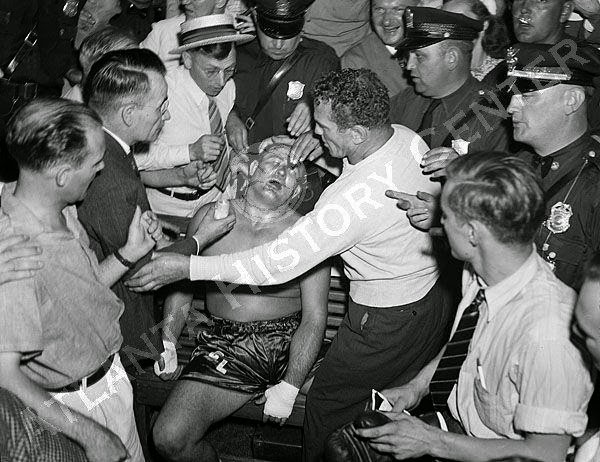
After his retirement - following a second loss to Gene Tunney in the infamous 'Night of the Long Count' - Dempsey remained a massively popular figure in America. He remained active in boxing, often refereeing matches at the same arenas where he once headlined. He also refereed wrestling matches where the inclusion of Dempsey, in any capacity, boosted sales at the box office.
On one such occasion, in Atlanta in May 1940, Dempsey was refereeing a tag-team match. During the match, one of the participants, Cowboy Luttrell, decided to make a name for himself and change the script. He shoved Dempsey across the ring and beckoned the former champion to take a poke. Dempsey shoved the wrestler back, prompting Luttrell to throw a clumsy punch, but the former champion ducked and the whole thing fizzled out.
Afterwards, a local newspaper claimed Dempsey tried to smooth things out backstage, but Luttrell - over 24lbs heavier than the 45-year-old former champ - refused to shake hands and, after a few hastily chosen words, again went for a punch. The two were separated swiftly, but not before a furious Dempsey challenged the grappler to a real contest, and even offered to donate his purse to charity.
Because of Luttrell's dubious day job, there were fears that the match would be a fix, but Dempsey made sure the record was put straight. Speaking to the New York Times, he said: "No. It's no gag. I'm going to fight a wrestler down in Atlanta on July 1. We're going to fight with gloves, the lightest ones Georgia officials will permit, and under Marquis of Queensbury rules. I ought to knock him out quick because I can still punch, and he doesn't know how to fight."
Concerns immediately turned to the popular former champion's health. He was, after all, a 45-year-old restaurant owner, who had not fought in over a decade. But he told the Times: "Naw, I'm not takin' any chances. This Luttrell must be as old as I am. You know how those wrestlers are - they keep workin' till they're ready for the old men's home. And I know he can't fight. He swings from the floor. He's muscle-bound and slow. I don't like any part of this Luttrell and it will be a pleasure to take care of him."
Luttrell, obviously a seasoned veteran of hyperbole, retorted in the Atlanta Constitution: "I'm going to knock Dempsey's front teeth out. Boy, oh, boy, will people be surprised when I wade into Mr. Dempsey with both these big fists flying."
He added: "Don't you realise that any guy who could go around the rest of his life and say he was the man that knocked out Jack Dempsey would be a big gate attraction as a professional wrestler? I have everything to gain. He's crazy to risk himself in a bout with a man so much younger and in much better physical condition. But that's his business. From now on I am dedicating myself to the task of being the man who licked Jack Dempsey."
A strange phenomenon creeps up on sports fans and writers when a childhood hero returns. It could easily be dismissed as wishful sentimentalism, but it is more powerful than that. Many of those who snapped up tickets to see Dempsey's return, or rushed to write stories about it, grew up during Dempsey's hey-day.
They associated their youth, and the prime of their lives, with him. Now their hero was attempting to turn back the clock and, if he succeeded, they maybe believed the clock would turn back for them, too. These feelings, and genuine excitement at the chance to see the Manassa Mauler in action just one more time, drew an impressive 10,000 fans paying an even more impressive $37,000. The American public and media, who idolised Dempsey, whipped each other into a frenzy in anticipation of their hero's return after his years in the wilderness.
In the days leading up to the fight, perspective - and perhaps reality - seemed to slip away from many writers. Impartiality went out of the window, many of them even wrote that Dempsey would challenge reigning heavyweight champion Joe Louis. But the old fighter did little to ground their flights of fancy, maybe because he didn't want to ruin their fun or admit he was too old.
At the pre-fight press conference, Dempsey said: "That is something I cannot answer. If I prove I can still punch and, if the public demands the match, we will talk about it later. The man who takes Joe Louis' title away must have dynamite in either hand." Then, with a wry grin, he added: "I have been searching for a fighter to beat Louis. Wouldn't it be strange if he turned out to be Jack Dempsey?"
Dempsey received a 10 minute standing ovation when he entered the ring that night. Reporters waxed lyrical about a deafening roar that just wouldn't stop. They also mentioned that Dempsey looked much trimmer than expected. In fact, they noted that he was in better shape than his supposedly fitter opponent.
The fight was a mismatch. Luttrell, despite some boxing experience in his youth, was totally out of his depth and was battered from pillar to post in the first round, where only the bell and a vice-like grip for a defence - saved him.
But in the second, Dempsey - fighting from the memory of what he used to be - seemed to tap into whatever was left of his greatness. He dropped Luttrell three times in round two, finally knocking the Cowboy through the ropes and onto the arena floor, where he was counted out.
Dempsey stood in the ring, his arms aloft in victory for the first time in over 14 years, and one can only guess how he must have felt when the crowd, almost rabid with excitement, chanted his name. He had not disappointed them.
A New York newspaper read: "Dempsey, possessed with all the savagery and relentless fury of the Manassa Mauler of old, last night brought back memories of the days when he ruled the heavyweights of the world with a smashing two-round knockout of Cowboy Luttrell, a 224-pound Texas bull.
"Stalking his prey from the opening gong, the old warrior may have battered his way back into the heavyweight title picture as he turned loose a murderous attack on the huge wrestler that left Luttrell senseless and the crowd gasping in amazement.
"Contrary to pictures painted by crepe hangers before the fight, Dempsey was not fat. And he was not clumsy. Instead, fans saw a trim, tigerish Dempsey, lacking the speed of his golden days, but still perhaps the most dangerous fighter in the business, outside of the Brown Bomber."
Another newspaper was equally carried away: "Dempsey was not the flabby, aged ghost of a former great that some of our self-styled sports experts and humanitarians in this vicinity would have you believe. He was a whirling and slashing killer. Over four rounds, he would be a match for heavyweight champ Joe Louis."
But, deep down, Dempsey knew what would happen to him if he challenged Louis. He fought several more bouts against non-boxers, including a professional American football player, and then retired for good.
Luttrell, his 15 minutes of fame used up, disappeared from history almost immediately after guest referee Nat Fleischer completed the 10 count. His defeat was so crushing, so complete, it is unlikely any wrestling promoter hired him to cash in on his brief notoriety. He remains an obscure footnote in history.
(by Anthony Evans)
picture caption reads - 'View of a crowd of people surrounding professional wrestler Cowboy Luttrell who is receiving medical attention after his exhibition boxing match against heavyweight boxer Jack Dempsey'
Last edited by doug.ie on 13 Feb 2015, 16:34, edited 1 time in total.
-
el_grande_mauro_mina
- Lightweight
- Posts: 11215
- Joined: 24 Dec 2017, 11:54
Re: bits and pieces scrapbook
I don't know how true this is but here it goes:
Cowboy Luttrell Demolishes Jack Dempsey
June 11, 2013
Editorial note: Descendents of rugged wrestler Cowboy Luttrell recently published this startling letter, which two handwriting experts have verified the Cowboy authored. We’re searching Jack Dempsey’s archives and will publish anything on this subject certifiably written by the Manassa Mauler.
To Whom It May Concern:
After he poorly refereed my tag team match in 1940 I pushed Jack Dempsey and challenged him to wrestle but he insisted we put on gloves and have a regular match several weeks later. I’d done some boxing as a kid and was twenty pounds heavier and ten years younger than Dempsey so figured I could rough him up but at opening bell he charged and hit me with left hooks and a rabbit right and more lefts and I covered up before eating many combinations including some nasty uppercuts. Pretty soon I couldn’t move much and another left staggered me into the ropes at end of round one.
I’m a tough cowboy and attacked Dempsey to start the second round but caught a right cross to the jaw and more of those damn lefts to the head. Go ahead, keep hitting, I told Dempsey. You can’t hurt Cowboy Luttrell. Dempsey replied with more two-fisted head shots and knocked me down once, twice, three times. Referee Nat Fleischer, the boxing editor who was a worse referee than Dempsey, must have enjoyed the slaughter and didn’t stop it, and I was too game to ask and too dumb to stay down. I was slumped against the ropes – where was Fleischer? – when Dempsey stepped in and uncorked a left uppercut that launched me out of the ring. Okay, I got my face taped up in the dressing room and acknowledged boxing was Dempsey’s game.
Several months later, when most of the damn bruises had healed or lightened, I drove to New York City and stormed into Jack Dempsey’s restaurant. He walked up, hand extended, and I ducked and drove my head into his balls, wrapped my arms around his knees, and bulled him onto the floor where I sat on him and punched down a lot harder than he could punch up and was busting him pretty good when some of his goons pounced and hit me from behind and drug me outside. Come on, I motioned to Dempsey, let’s finish this on the sidewalk. He waved me off. In a real fight, he knew Cowboy Luttrell was tougher.
Sincerely,
Cowboy Luttrell
http://www.georgethomasclark.com/?p=5301
Cowboy Luttrell Demolishes Jack Dempsey
June 11, 2013
Editorial note: Descendents of rugged wrestler Cowboy Luttrell recently published this startling letter, which two handwriting experts have verified the Cowboy authored. We’re searching Jack Dempsey’s archives and will publish anything on this subject certifiably written by the Manassa Mauler.
To Whom It May Concern:
After he poorly refereed my tag team match in 1940 I pushed Jack Dempsey and challenged him to wrestle but he insisted we put on gloves and have a regular match several weeks later. I’d done some boxing as a kid and was twenty pounds heavier and ten years younger than Dempsey so figured I could rough him up but at opening bell he charged and hit me with left hooks and a rabbit right and more lefts and I covered up before eating many combinations including some nasty uppercuts. Pretty soon I couldn’t move much and another left staggered me into the ropes at end of round one.
I’m a tough cowboy and attacked Dempsey to start the second round but caught a right cross to the jaw and more of those damn lefts to the head. Go ahead, keep hitting, I told Dempsey. You can’t hurt Cowboy Luttrell. Dempsey replied with more two-fisted head shots and knocked me down once, twice, three times. Referee Nat Fleischer, the boxing editor who was a worse referee than Dempsey, must have enjoyed the slaughter and didn’t stop it, and I was too game to ask and too dumb to stay down. I was slumped against the ropes – where was Fleischer? – when Dempsey stepped in and uncorked a left uppercut that launched me out of the ring. Okay, I got my face taped up in the dressing room and acknowledged boxing was Dempsey’s game.
Several months later, when most of the damn bruises had healed or lightened, I drove to New York City and stormed into Jack Dempsey’s restaurant. He walked up, hand extended, and I ducked and drove my head into his balls, wrapped my arms around his knees, and bulled him onto the floor where I sat on him and punched down a lot harder than he could punch up and was busting him pretty good when some of his goons pounced and hit me from behind and drug me outside. Come on, I motioned to Dempsey, let’s finish this on the sidewalk. He waved me off. In a real fight, he knew Cowboy Luttrell was tougher.
Sincerely,
Cowboy Luttrell
http://www.georgethomasclark.com/?p=5301
Re: bits and pieces scrapbook
thats great...ok if i use that ?.....boxing folkore is great :)
-
el_grande_mauro_mina
- Lightweight
- Posts: 11215
- Joined: 24 Dec 2017, 11:54
Re: bits and pieces scrapbook
Of course, glad you liked it.doug.ie wrote:thats great...ok if i use that ?.....boxing folkore is great :)

Re: bits and pieces scrapbook
March 31, 1980.
Mike Weaver wins the WBA Heavyweight Title by knocking out defending belt holder John Tate in the 15th round.
Weaver knocked Tate out with a left hook. Tate laid unconscious, face down and spread eagle on the canvas as he was counted out.
"The crowd cost Tate the fight," Weaver said afterwards. "He made the mistake of trying to come out and slug with me. He was boxing before that. He was responding to the crowd."
Weaver v Tate produced one of the divisions finest knock outs ever. The giant taller Tate dominated Weaver for all the first 10 rounds. But then with sheer determination a battered Weaver suddenly turned it around, pushing Tate backward. But he'd left it 'too late?' noted the commentator, as only 5 rounds remained and Tate was expected to resume his lead. However with only 40 seconds left in the 15th round, Weaver caught Tate bouncing off the ropes towards him with a truly lethal left hook. It dropped Tate to the canvas out cold for well over a minute. Press pictures showed Tate sound asleep whilst Weaver did a handstand alongside to celebrate.

Mike Weaver wins the WBA Heavyweight Title by knocking out defending belt holder John Tate in the 15th round.
Weaver knocked Tate out with a left hook. Tate laid unconscious, face down and spread eagle on the canvas as he was counted out.
"The crowd cost Tate the fight," Weaver said afterwards. "He made the mistake of trying to come out and slug with me. He was boxing before that. He was responding to the crowd."
Weaver v Tate produced one of the divisions finest knock outs ever. The giant taller Tate dominated Weaver for all the first 10 rounds. But then with sheer determination a battered Weaver suddenly turned it around, pushing Tate backward. But he'd left it 'too late?' noted the commentator, as only 5 rounds remained and Tate was expected to resume his lead. However with only 40 seconds left in the 15th round, Weaver caught Tate bouncing off the ropes towards him with a truly lethal left hook. It dropped Tate to the canvas out cold for well over a minute. Press pictures showed Tate sound asleep whilst Weaver did a handstand alongside to celebrate.

-
Caractacus
- Middleweight
- Posts: 18837
- Joined: 13 Jun 2014, 16:47
Re: bits and pieces scrapbook
regarding the text of that article of Dempsey and Cowboy Luttrel.
Jack Dempsey was never"balding'.
He had a full head of hair till the day he died.
(I have notice in watching films that Joe Louis on the other hand started gettin a bald spot
at age 33 y in his first fight with Billy Conn in 1941 .
Or as Fred G. Sanford use to say
he was gettin a" hole in his natural".
Jack Dempsey was never"balding'.
He had a full head of hair till the day he died.
(I have notice in watching films that Joe Louis on the other hand started gettin a bald spot
at age 33 y in his first fight with Billy Conn in 1941 .
Or as Fred G. Sanford use to say
he was gettin a" hole in his natural".
Re: bits and pieces scrapbook
Dec 16, 1962 - Milan, Italy.
Veteran Dulio Loi of Italy regained the world junior welterweight boxing championship by outpointing Eddie Perkins of Chicago over 15 rounds.
The pint-sized, 33 year old Italian, thus avenged his decision defeat at the hands of the 25 year old American in this same city last September.
It was their third meeting and evened the series for the 140-pound division title. They drew in their first fight in Milan in October 1961.
After losing the crown to Perkins three months ago, Loi said at first he was through with the junior welterweights because he found it too difficult to make the weight limit. He said then he intended to campaign only as a welterweight and defend his European welterweight (147 pounds) crown.
Loi then decided to make one more try for the 140-pound title. It paid off.
The title fight was a fast, spirited and close battle all the way. At the finish, referee Georges Goudre of France, the sole official, proclaimed Loi the winner without any hesitation after the final bell.
For a man who has struggled to make the division limit in the past, Loi was surprisingly light. He weighed 137 and 3/4 pounds to Perkins 138 and 3/4.
(The Palm Beach Post)

.......................................................
An extraordinarily busy and durable fighter, Duilio Loi
reigned in Europe at lightweight and welterweight for eight
years from 1954, and in 1961 added the, then recently
resurrected, world light-welterweight title to his
collection, with a points victory over the formidable Puerto
Rican Carlos Ortiz. Loi fought 129 contests, losing only
three, in each case getting his revenge in rematches. He was
never knocked down.
Loi possessed great ringcraft but he was also tough and
relentlessly aggressive, and many other top boxers at his
weight were happy to give him a wide berth. He fought one of
his European lightweight title defences only two days after
he had been involved in a car crash.
Born in 1929 in Trieste, where he grew up during the war,
Duilio Loi started boxing in Genoa, where he went to school
for a period. He turned professional as a lightweight in
1948. By 1951 he had won the Italian title from Gianni
Uboldi and went on to defend it many times. A first tilt at
the European lightweight title held by Jorgen Johansen, in
Copenhagen in August 1952, was not successful, but in
February 1954 he had his revenge against the classy Dane
when he took his title from him in Milan on points over 15
rounds.
He was to defend it numerous times over the next few years,
notably against the Spaniard Jos? Hernandez, with whom he
managed a draw - and retained his title - in Milan in May
1956 notwithstanding that he had been badly bruised in a car
accident two days earlier. His second defence against
Hernandez in December that year was a more emphatic affair,
a points victory over 15 rounds. The hectic nature of his
schedule is indicated by the fact that in between these two
defences Loi fought no fewer than eight non-title bouts. But
a shot at the world lightweight championship eluded him.
Then, in April 1959, Loi stepped up a weight to go in quest
of the newly crowned European welterweight champion Emilio
Marconi, in Milan, and relieved him of his title over 15
rounds. He was to continue to defend this title against
all-comers, even after he had won the world light-welter
crown, re-established in 1959 after having been in abeyance
since the war.
This he first tried to wrest from Ortiz in San Francisco on
June 16, 1960. He lost the decision on points over 15
rounds, but even Ortiz's large army of fans realised that it
had been a desperately close thing. At a rematch in Milan
that September, it was a different story with no one at
ringside in any doubt that Loi was the winner over 15
rounds. A third contest between this superbly matched pair
was another victory for Loi, and he even had Ortiz down in
the 6th round.
The only other man to beat him, the tough American Eddie
Perkins, who was also nine years his junior, was now to
enter the world light-welter lists. He fought a draw with
Loi in Milan in May 1961, and went back in September 1962 to
outpoint him over 15 rounds and take his title, despite the
fact that he had been put down in the 1st and 14th rounds.
But, as with Johansen and Ortiz, the last word was to be
Loi's. On December 15, 1962, again in Milan, he won his
title back from Perkins over 15 rounds. Immediately after
the bout he announced his retirement.
He left the ring both as world light-welter and European
welterweight champion, having defended the latter title
against the very tough Sardinian Fortunato Manca, in
Cagliari in May that year. It was a satisfactory end to a
highly meritorious career. Indeed, with such a record, Loi's
name deserves to be more familiar; undoubtedly greater
exposure in the US would have made it so.
His induction into the International Boxing Hall of Fame in
2005 was a fitting acknowledgement of his, until then,
underrated achievements. By that time Loi was suffering from
Alzheimer's and his daughter, Bonaria, travelled to the US
to accept the award on his behalf.
Duilio Loi, boxer, was born on April 19, 1929. He died on
January 20, 2008, aged 78
(The Times Obituary)
Veteran Dulio Loi of Italy regained the world junior welterweight boxing championship by outpointing Eddie Perkins of Chicago over 15 rounds.
The pint-sized, 33 year old Italian, thus avenged his decision defeat at the hands of the 25 year old American in this same city last September.
It was their third meeting and evened the series for the 140-pound division title. They drew in their first fight in Milan in October 1961.
After losing the crown to Perkins three months ago, Loi said at first he was through with the junior welterweights because he found it too difficult to make the weight limit. He said then he intended to campaign only as a welterweight and defend his European welterweight (147 pounds) crown.
Loi then decided to make one more try for the 140-pound title. It paid off.
The title fight was a fast, spirited and close battle all the way. At the finish, referee Georges Goudre of France, the sole official, proclaimed Loi the winner without any hesitation after the final bell.
For a man who has struggled to make the division limit in the past, Loi was surprisingly light. He weighed 137 and 3/4 pounds to Perkins 138 and 3/4.
(The Palm Beach Post)
.......................................................
An extraordinarily busy and durable fighter, Duilio Loi
reigned in Europe at lightweight and welterweight for eight
years from 1954, and in 1961 added the, then recently
resurrected, world light-welterweight title to his
collection, with a points victory over the formidable Puerto
Rican Carlos Ortiz. Loi fought 129 contests, losing only
three, in each case getting his revenge in rematches. He was
never knocked down.
Loi possessed great ringcraft but he was also tough and
relentlessly aggressive, and many other top boxers at his
weight were happy to give him a wide berth. He fought one of
his European lightweight title defences only two days after
he had been involved in a car crash.
Born in 1929 in Trieste, where he grew up during the war,
Duilio Loi started boxing in Genoa, where he went to school
for a period. He turned professional as a lightweight in
1948. By 1951 he had won the Italian title from Gianni
Uboldi and went on to defend it many times. A first tilt at
the European lightweight title held by Jorgen Johansen, in
Copenhagen in August 1952, was not successful, but in
February 1954 he had his revenge against the classy Dane
when he took his title from him in Milan on points over 15
rounds.
He was to defend it numerous times over the next few years,
notably against the Spaniard Jos? Hernandez, with whom he
managed a draw - and retained his title - in Milan in May
1956 notwithstanding that he had been badly bruised in a car
accident two days earlier. His second defence against
Hernandez in December that year was a more emphatic affair,
a points victory over 15 rounds. The hectic nature of his
schedule is indicated by the fact that in between these two
defences Loi fought no fewer than eight non-title bouts. But
a shot at the world lightweight championship eluded him.
Then, in April 1959, Loi stepped up a weight to go in quest
of the newly crowned European welterweight champion Emilio
Marconi, in Milan, and relieved him of his title over 15
rounds. He was to continue to defend this title against
all-comers, even after he had won the world light-welter
crown, re-established in 1959 after having been in abeyance
since the war.
This he first tried to wrest from Ortiz in San Francisco on
June 16, 1960. He lost the decision on points over 15
rounds, but even Ortiz's large army of fans realised that it
had been a desperately close thing. At a rematch in Milan
that September, it was a different story with no one at
ringside in any doubt that Loi was the winner over 15
rounds. A third contest between this superbly matched pair
was another victory for Loi, and he even had Ortiz down in
the 6th round.
The only other man to beat him, the tough American Eddie
Perkins, who was also nine years his junior, was now to
enter the world light-welter lists. He fought a draw with
Loi in Milan in May 1961, and went back in September 1962 to
outpoint him over 15 rounds and take his title, despite the
fact that he had been put down in the 1st and 14th rounds.
But, as with Johansen and Ortiz, the last word was to be
Loi's. On December 15, 1962, again in Milan, he won his
title back from Perkins over 15 rounds. Immediately after
the bout he announced his retirement.
He left the ring both as world light-welter and European
welterweight champion, having defended the latter title
against the very tough Sardinian Fortunato Manca, in
Cagliari in May that year. It was a satisfactory end to a
highly meritorious career. Indeed, with such a record, Loi's
name deserves to be more familiar; undoubtedly greater
exposure in the US would have made it so.
His induction into the International Boxing Hall of Fame in
2005 was a fitting acknowledgement of his, until then,
underrated achievements. By that time Loi was suffering from
Alzheimer's and his daughter, Bonaria, travelled to the US
to accept the award on his behalf.
Duilio Loi, boxer, was born on April 19, 1929. He died on
January 20, 2008, aged 78
(The Times Obituary)
Last edited by doug.ie on 13 Feb 2015, 16:38, edited 1 time in total.
Re: bits and pieces scrapbook
1961.
( open this link and click on image for a slightly higher resolution / more readable image -
http://1.bp.blogspot.com/-Yv3MC27rKms/V ... 961%2B.jpg )

( open this link and click on image for a slightly higher resolution / more readable image -
http://1.bp.blogspot.com/-Yv3MC27rKms/V ... 961%2B.jpg )
Last edited by doug.ie on 13 Feb 2015, 16:38, edited 1 time in total.
Re: bits and pieces scrapbook
(Modern Classic Era)
Jan 19, 2013.
Gennady Golovkin defends his WBA World Middleweight title via a 7th round TKO victory over Gabriel Rosado .
" ... When he hit me in the first round, I just felt straight, solid wraps. It wasn't like it was just the impact of the glove. It felt like a little bat hitting the top of my head. So Triple-G's gloves, Grant definitely makes custom gloves for [him]. So Stevens definitely has to look out for that. ... I've never got cut in a fight. Only by a head-butt, which was four years ago. I got cut twice [over] the same eye in the second round [against Golovkin]. [Matthew] Macklin got cut early in their fight as well. It's just kind of suspect about them gloves." - Gabriel Rosado
...........................
Golovkin -- who was sick in bed two days beforehand considered pulling out of the fight -- dominated even though Rosado, 26, was game.
"This is true, this is true," Golovkin said of being ill. "I'm a little bit sick, but I feel great. I feel my power. I know that Gabriel, I can knock him out. I can do much more better. This chance for me, this was for the public."
As good as Golovkin looked, he admitted he was not at his best.
"No, no, no, no. I wanted to show the public my technique and my tactic," he said.
He cut Rosado in the corner of his left eye in the second round. He rocked him with a right hand in the third round. By the fourth round, Rosado's face was a bloody mess after also being cut over his left eye and bleeding from the nose.
Rosado (21-6, 13 KOs) must have landed something solid in the fifth round, because Golovkin (25-0, 22 KOs) suddenly had a bruise around his right eye. But Golovkin was dishing out way more than he was taking.
Rosado's left eye was in very bad shape and the ringside doctor took a good look at it before both the sixth and seventh rounds as Rosado pleaded to be allowed to continue.
Both fighters were covered in Rosado's blood in the seventh round as Rosado continued to bleed badly until his trainer, Billy Briscoe, climbed the steps and threw in the towel. When referee Steve Smoger saw the towel, he intervened and stopped the fight at 2 minutes, 46 seconds.
(by Dan Rafael)

Jan 19, 2013.
Gennady Golovkin defends his WBA World Middleweight title via a 7th round TKO victory over Gabriel Rosado .
" ... When he hit me in the first round, I just felt straight, solid wraps. It wasn't like it was just the impact of the glove. It felt like a little bat hitting the top of my head. So Triple-G's gloves, Grant definitely makes custom gloves for [him]. So Stevens definitely has to look out for that. ... I've never got cut in a fight. Only by a head-butt, which was four years ago. I got cut twice [over] the same eye in the second round [against Golovkin]. [Matthew] Macklin got cut early in their fight as well. It's just kind of suspect about them gloves." - Gabriel Rosado
...........................
Golovkin -- who was sick in bed two days beforehand considered pulling out of the fight -- dominated even though Rosado, 26, was game.
"This is true, this is true," Golovkin said of being ill. "I'm a little bit sick, but I feel great. I feel my power. I know that Gabriel, I can knock him out. I can do much more better. This chance for me, this was for the public."
As good as Golovkin looked, he admitted he was not at his best.
"No, no, no, no. I wanted to show the public my technique and my tactic," he said.
He cut Rosado in the corner of his left eye in the second round. He rocked him with a right hand in the third round. By the fourth round, Rosado's face was a bloody mess after also being cut over his left eye and bleeding from the nose.
Rosado (21-6, 13 KOs) must have landed something solid in the fifth round, because Golovkin (25-0, 22 KOs) suddenly had a bruise around his right eye. But Golovkin was dishing out way more than he was taking.
Rosado's left eye was in very bad shape and the ringside doctor took a good look at it before both the sixth and seventh rounds as Rosado pleaded to be allowed to continue.
Both fighters were covered in Rosado's blood in the seventh round as Rosado continued to bleed badly until his trainer, Billy Briscoe, climbed the steps and threw in the towel. When referee Steve Smoger saw the towel, he intervened and stopped the fight at 2 minutes, 46 seconds.
(by Dan Rafael)
Re: bits and pieces scrapbook
"He believes that, if he had felt as well as he did on any of his ordinary training days, he could have licked Johnson. He has been taking good care of himself - has been training quietly in fact - and he is going to bring about another fight if it can be done."
(The Toronto World - March 1912)


(The Toronto World - March 1912)
Re: bits and pieces scrapbook
Prison inmate No. 57735, accused of murder and serving a 30-40 year stretch inside Rahway State Prison for armed robbery, introduced himself in a letter to reporter Beth Schenerman at The New York Times on Dec. 17, 1978, writing, in a rare moment of understatement, "This is a unique story." After returning to prison three years earlier, the former professional boxer had long since been recognized as one of the most feared and dangerous of the 1,150 inmates then living behind the walls of New Jersey's most notorious maximum-security prison, a place journalist Ralph Wiley described "as if the world had dropped the sum of its sores into one of New Jersey's gritty smokestacks, then chose not to watch as the results of the experiment filtered down into place."
Scott was one result of that experiment. But he had even bigger plans for his legacy. The message in a bottle Scott wished to wash ashore to everyone living outside those walls was simple: wearing leather gloves over the hands he'd been accused of using to murder someone, he just might be the most dangerous man everywhere else on earth, too. "The rise of a champion from prison house to the light heavyweight championship of the world. Has it ever been done before? No. I'll die if I don't get that title shot," he wrote. "I'm pregnant. I've got to deliver this child."
The Times and everybody else immediately recognized the story. This savvy, self-educated, self-described career criminal found an audience eager to believe him. Only two years before, a little Cinderella-story film about the American Dream, shot over 28 days with a budget of little more than $1 million, "Rocky," had won three Academy Awards and made $225 million at the box office. An unknown actor named Sylvester Stallone, with a pregnant wife and $106 in the bank, had written the script in three-and-a-half days about an over-the-hill Philadelphia club fighter who got a title shot.
But "Rocky" was just a movie. Scott was real, and his far more improbable story, of the American Dream turned into a fantastic fairytale, was already being written. All he needed was the happy ending. In only a few short years, Scott, who had spent over half his 30-year-life behind bars, had already parlayed his story into a career. A week before he wrote The Times, it had already started to come true when he had successfully challenged Eddie Gregory (later known today as Eddie Mustafa Muhammad) from inside Rahway's walls.
The notion was so obscenely preposterous that the feisty new network on the block, HBO Sports, eager to stand out, bought the whole thing. They sent film crews and announcers (including hiring the legendary "voice of boxing" Don Dunphy) to Woodbridge, N.J., and broadcast the fight live before a select crowd of civilians from the prison's auditorium. They touted the fight as "Boxing Behind Bars."
Outside Rahway, the betting line was 4-1 on Gregory, who had a record of 29-3-1 and was coming off two straight first round KOs. The bout was considered a tune-up, a colorful sideshow in Gregory's own march to the title, and in his own story of the ex-con-turned-champion. Boxing a lightly regarded inmate hailed as the New Jersey prison system light heavyweight champion made good copy and attracted curious viewers, but no one thought it would be much of a fight. Even inside Rahway, Scott was an underdog, Gregory the favorite at three cartons of cigarettes to one.
"They say Scott is tough," Gregory told Sports Illustrated before the fight, "but how tough can he be? So he fought a couple of stiffs inside the walls and he knocked them out. He hasn't had a real pro fight in almost four years. And now he wants to fight the top contender. You know he's got to be crazy. He's been in here too long. It happens when you stay in these places too long. I'll carry him for 11 rounds and knock him out in the twelfth. It'll be a good work out."
Gregory was in the best shape of his life, already looking forward to the biggest payday of his career against the newly crowned World Boxing Association champion, Mike Rossman. Fighting a delusional convict with a hopelessly misplaced pipe dream in prison was just a way to pocket an easy $15,000...
(by Brin-Jonathan Butler)

https://www.youtube.com/watch?v=3y5qZUSF244
"James Scott was in the same lockup as the “Hurricane”, Rubin Carter. Carter was said to have sparred and worked with Scott some, but he was less interested in showcasing boxing skill than he was in being released from prison, which he was in 1985, after serving over 20 years.
In 1988, Rahway State Prison was renamed East Jersey State Prison, and Scott was finally released from there in 2005. It was reported that Scott pursued a comeback to boxing shortly after his release - at almost 60 years old!"
"In 2012, Scott was inducted into the New Jersey Boxing Hall of Fame. He currently resides in a New Jersey nursing home, suffering from dementia, with less and less awareness of his surroundings."
Scott was one result of that experiment. But he had even bigger plans for his legacy. The message in a bottle Scott wished to wash ashore to everyone living outside those walls was simple: wearing leather gloves over the hands he'd been accused of using to murder someone, he just might be the most dangerous man everywhere else on earth, too. "The rise of a champion from prison house to the light heavyweight championship of the world. Has it ever been done before? No. I'll die if I don't get that title shot," he wrote. "I'm pregnant. I've got to deliver this child."
The Times and everybody else immediately recognized the story. This savvy, self-educated, self-described career criminal found an audience eager to believe him. Only two years before, a little Cinderella-story film about the American Dream, shot over 28 days with a budget of little more than $1 million, "Rocky," had won three Academy Awards and made $225 million at the box office. An unknown actor named Sylvester Stallone, with a pregnant wife and $106 in the bank, had written the script in three-and-a-half days about an over-the-hill Philadelphia club fighter who got a title shot.
But "Rocky" was just a movie. Scott was real, and his far more improbable story, of the American Dream turned into a fantastic fairytale, was already being written. All he needed was the happy ending. In only a few short years, Scott, who had spent over half his 30-year-life behind bars, had already parlayed his story into a career. A week before he wrote The Times, it had already started to come true when he had successfully challenged Eddie Gregory (later known today as Eddie Mustafa Muhammad) from inside Rahway's walls.
The notion was so obscenely preposterous that the feisty new network on the block, HBO Sports, eager to stand out, bought the whole thing. They sent film crews and announcers (including hiring the legendary "voice of boxing" Don Dunphy) to Woodbridge, N.J., and broadcast the fight live before a select crowd of civilians from the prison's auditorium. They touted the fight as "Boxing Behind Bars."
Outside Rahway, the betting line was 4-1 on Gregory, who had a record of 29-3-1 and was coming off two straight first round KOs. The bout was considered a tune-up, a colorful sideshow in Gregory's own march to the title, and in his own story of the ex-con-turned-champion. Boxing a lightly regarded inmate hailed as the New Jersey prison system light heavyweight champion made good copy and attracted curious viewers, but no one thought it would be much of a fight. Even inside Rahway, Scott was an underdog, Gregory the favorite at three cartons of cigarettes to one.
"They say Scott is tough," Gregory told Sports Illustrated before the fight, "but how tough can he be? So he fought a couple of stiffs inside the walls and he knocked them out. He hasn't had a real pro fight in almost four years. And now he wants to fight the top contender. You know he's got to be crazy. He's been in here too long. It happens when you stay in these places too long. I'll carry him for 11 rounds and knock him out in the twelfth. It'll be a good work out."
Gregory was in the best shape of his life, already looking forward to the biggest payday of his career against the newly crowned World Boxing Association champion, Mike Rossman. Fighting a delusional convict with a hopelessly misplaced pipe dream in prison was just a way to pocket an easy $15,000...
(by Brin-Jonathan Butler)
https://www.youtube.com/watch?v=3y5qZUSF244
"James Scott was in the same lockup as the “Hurricane”, Rubin Carter. Carter was said to have sparred and worked with Scott some, but he was less interested in showcasing boxing skill than he was in being released from prison, which he was in 1985, after serving over 20 years.
In 1988, Rahway State Prison was renamed East Jersey State Prison, and Scott was finally released from there in 2005. It was reported that Scott pursued a comeback to boxing shortly after his release - at almost 60 years old!"
"In 2012, Scott was inducted into the New Jersey Boxing Hall of Fame. He currently resides in a New Jersey nursing home, suffering from dementia, with less and less awareness of his surroundings."
Re: bits and pieces scrapbook
Presented to Harry Greb for contributing his services for free on a milk and ice fund program in Atlantic City.
Greb fought Pat Walsh in a scheduled ten-rounder, stopping Walsh in the second round, knocking him down four times before Walsh's cornermen threw in the towel.

Greb fought Pat Walsh in a scheduled ten-rounder, stopping Walsh in the second round, knocking him down four times before Walsh's cornermen threw in the towel.
Last edited by doug.ie on 13 Feb 2015, 16:42, edited 1 time in total.
Re: bits and pieces scrapbook
April 26, 1949
Middleweight Steve Belloise of New York displayed a strong two-fisted attack as he pounded Jean Stock of France into an eight-round technical knockout last night at the Palais des Sport.
Stock tumbled to the canvas early in the fatal eight after catching a powerful right hook. When the balding american sent Stock flying with another right to the jaw seconds later, referee Rene Scheman stopped the fight.
It was the opener of a series of bouts on French soil for Belloise, who is aiming at a title fight with frenchman Marcel Cerdan.
(The Pittsburgh Press)

https://www.youtube.com/watch?v=f2CX1KXy5Dg
Middleweight Steve Belloise of New York displayed a strong two-fisted attack as he pounded Jean Stock of France into an eight-round technical knockout last night at the Palais des Sport.
Stock tumbled to the canvas early in the fatal eight after catching a powerful right hook. When the balding american sent Stock flying with another right to the jaw seconds later, referee Rene Scheman stopped the fight.
It was the opener of a series of bouts on French soil for Belloise, who is aiming at a title fight with frenchman Marcel Cerdan.
(The Pittsburgh Press)
https://www.youtube.com/watch?v=f2CX1KXy5Dg
Re: bits and pieces scrapbook
1971 Miami Beach
Muhammad Ali is training for Joe Frazier. Ali's friend, and D'amato pupil, former Light Heavyweight Champion Jose Torres gives him some rounds. Jose is retired and has not fought in two years. (Steve Lott)
This video includes a short clip of the session..
https://www.youtube.com/watch?v=6eMB-S6dj9g
Muhammad Ali is training for Joe Frazier. Ali's friend, and D'amato pupil, former Light Heavyweight Champion Jose Torres gives him some rounds. Jose is retired and has not fought in two years. (Steve Lott)
This video includes a short clip of the session..
https://www.youtube.com/watch?v=6eMB-S6dj9g
Re: bits and pieces scrapbook
November 11, 1935 - Berlin, Germany.
In the 'Sportpalast' in front of an audience of 10.000 people, Gustav Eder wins over his challenger, the Belgian Felix Wouters, in the 9th round with a K.O.
The European welterweight Champion was defending the title for the 6th time. Eder stands in the corner while Woulter lies on his back and gets counted out by referee Henry Patris.

In the 'Sportpalast' in front of an audience of 10.000 people, Gustav Eder wins over his challenger, the Belgian Felix Wouters, in the 9th round with a K.O.
The European welterweight Champion was defending the title for the 6th time. Eder stands in the corner while Woulter lies on his back and gets counted out by referee Henry Patris.