Enlightened-One wrote: ↑05 Jun 2018, 04:23
Let’s consider the stats relating to George Foreman’s best opponent prior to the end of 1973…
From the start of his career until he reached his physical prime during 1971, Joe Frazier’s average weight for his first 32 bouts (up to the point he defeated Muhammad Ali), was 204¾lbs, with his average opponent weighing only 203¾lbs.
Now let’s compare these numbers to “Big” George’s…
George Foreman’s mathematical average weight was 217lbs from the start of his career through until the end of 1973. He was 217½lbs when he faced Joe Frazier in 1973. He was also only 6’ 3.5” in height.
From the start of his career through until 1973, the average George Foreman opponent was typically 6’ 0” in height, weighing around the 206lbs mark.
And here are the conclusions that I’ve drawn after analysing such information…
When you consider how much of a size advantage “Big” George had over his opponents, then it detracts from the impressiveness of his highlight-reel KO’s.
When you also consider the above height and weight statistics, which proves that the 1973 version of Foreman was simply a rehydrated cruiserweight by modern standards, coupled with the primitive training methods and approaches to diet regimens used 45 years ago, then I feel that George would have probably tasted defeat to many of today’s current crop of heavyweights.
Foreman and Tyson were never cruiserweights.
They both cut weight (Foreman early version) to get down to those fighting weights.
I think Foreman talked about how he used to deny himself water when
training during the first part of his career.
There's no reason for any heavyweight fighter to dehydrate themselves (i.e. lose water) for a fight.
They might try to slim down (reduce body fat) from any weight gained between bouts, due to inactivity and poor lifestyle, during their training camps, but they won't be dehydrated during the official day-of-the-fight weigh-in's, hence the reason why both men could have technically fought as cruiserweights.
If a lot of welterweight fighters can often rehydrate 17lbs or so between the official weigh-in's and fight night, then any heavyweight could achieve the same feat much easier.
Re: Young George Foreman (1973) against current top level HWs ?
Posted: 06 Jun 2018, 10:24
by armageto
EO really fails to still realize that his opinion and fact are two completely different things. Sure you can provide stats on average weights, etc, but the simple fact remains there have been plenty of HW's around Foreman's height/weight that have done well, even great, in the HW division. Most of them had nowhere near the power of Foreman either. In today's division, Wilder (considered #2) is close to the same weight as Foreman and only a few inches taller. Povetkin (considered # 3-5) is shorter and only a little more in weight.
Providing stats is great, however there are plenty of examples that prove the stats don't matter. Just like the posters, myself included, who think Foreman could do great today (using past HW's as prime examples), maybe the size would indeed be too much. I think when you add everything up, the only people I could honestly see beating him in today's division is AJ and Wilder.
Re: Young George Foreman (1973) against current top level HWs ?
Posted: 06 Jun 2018, 10:36
by Enlightened-One
armageto wrote: ↑06 Jun 2018, 10:24
EO really fails to still realize that his opinion and fact are two completely different things. Sure you can provide stats on average weights, etc, but the simple fact remains there have been plenty of HW's around Foreman's height/weight that have done well, even great, in the HW division. Most of them had nowhere near the power of Foreman either. In today's division, Wilder (considered #2) is close to the same weight as Foreman and only a few inches taller. Povetkin (considered # 3-5) is shorter and only a little more in weight.
Providing stats is great, however there are plenty of examples that prove the stats don't matter. Just like the posters, myself included, who think Foreman could do great today (using past HW's as prime examples), maybe the size would indeed be too much. I think when you add everything up, the only people I could honestly see beating him in today's division is AJ and Wilder.
Whilst there are inevitably exceptions to almost every general rule that human beings will encounter during their lifetimes, they don’t undermine the factual-accuracy of the rule itself.
Read the last few posts I’ve submitted in this thread and actually pay attention to what I’m claiming, since it seems that you’ve assumed that I hold a stance that I do not possess.
First of all, if someone tries to embellish their claims by quoting so-called “facts” that are either blatantly untrue or embellished, then I’ll challenge them, even if I vaguely agree with their sentiments.
Second, I carefully articulate my thoughts and always stand by what I’ve wrote. So I get offended when people pretend that I’m claiming something that is not reflected by any of my written words.
In terms of the other claims you’ve made in this post, I’ve already expressed my thoughts on them and disproved them and cited cold hard facts that undermine what you've written.
Re: Young George Foreman (1973) against current top level HWs ?
Enlightened-One wrote: ↑05 Jun 2018, 20:26
You're a great cheerleader, but before you congratulated this gentleman on his so-called "facts", did you even bother to check any of them? Such as the second sentence!
I could have a field day with some of these alleged "facts".
Second sentence is about Povetkin's height and weight. He's fought over 230, what once? So you're going to take some fights at 226-229, and those three extra pounds will be your basis to why Foreman can't beat today's current HW's?!? You got your ass handed to you. You stating Foreman couldn't beat current HW's today because of his size is your opinion, not a fact. A fact is, people call you a troll who ruins debates. Fact is you were banned at least once from this site, no? Why come back?!?
I supplied MANY examples of guys right around Foreman's height/weight that have done just fine at HW, and none of them, aside Wilder, had Foreman's power. Foreman had no problem stopping bigger, albeit not the greatest HW's, when he fought them.
You’re being applauded by other based on your ballpark recollection of the numbers, which are being claimed as “facts”, when they’re simply not accurate. The numbers haven’t been calculated. You’ve embellished the figures slightly to present your argument in a more favourable way.
For example: Alexander Povetkin has competed in 35 fights, but he only weighed 225lbs or less in 15 of them. He was lighter than 225lbs for ten of his first 12 fights. In fact the Russian’s average weight is closer to 230lbs and it seems you finally admit this.
In terms of your comparison between Foreman and Wilder, where you claim there’s only a few inches difference in height and that they're both around the same weight, ‘The Bronze Bomber’ is physically much taller than ‘Big’ George.
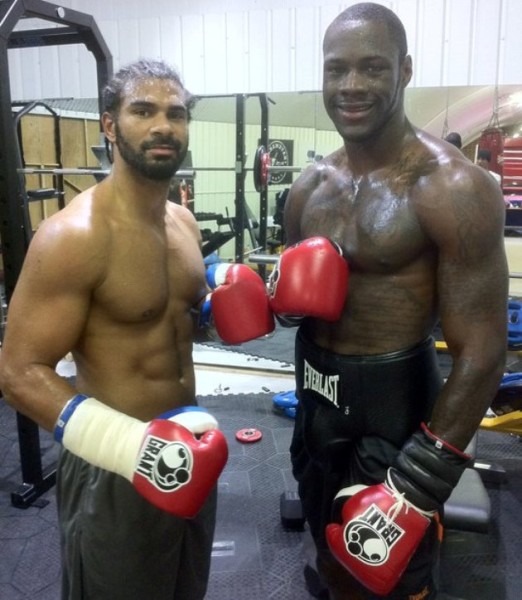
You only need to look at the height of men standing next to Wilder that are about the same size as Foreman to comprehend the sort of difference we're actually talking about:
Excluding his bouts against Ortiz & Stiverne, Wilder’s average weight during his title reign is 227lbs, which is clearly heavier than what the 217lbs 1973 version of George Foreman weighed.
Only 17½% of Wilder’s opponents weighed less than himself. ‘The Bronze Bomber’ was the smaller man in 33 of his bouts by an average of 29lbs. In terms of weight, he’s an anomaly to the general rule, but his extraordinary height still allows him to be classed as a much “bigger” heavy than Foreman!
Also, you claim that “Foreman had no issue dispatching bigger HW's”, but he weighed more than 92% of his opponents, with only three of the heavier fighters being taller him (i.e. in terms of the other four, a much smaller heavy, like Joe Frazier in the rematch, was overweight).
In fact, I think you’ll struggle to find any credible world-rated heavyweight opponents generally considered “bigger” than Foreman. He was known as “Big” George for a fairly obvious reason!
The above points I’ve raised are easily verifiable facts – they aren’t ballpark estimates to present my argument in a favourable light.
Finally, I never claimed that the 1973 version of Foreman was physically incapable of gaining any sort of success if he competed against the current crop of heavies.
Instead, I was simply suggesting that George would be less successful, due to his size disadvantage, since many of people that have posted to this thread are pretending that he’d destroy all current world-rated heavyweights with consummate ease and that size doesn't matter, which are clearly totally absurd claims to make!
Wilder is listed at 6'7, Foreman is listed as 6'3 1/2. Wilder just beat Ortiz at 214. Wilder won the belt from Stiverne at 219. Wilder started his career at 207. Around half of Wilder's fights have been at under 220. He's never fought about 230. So weight wise, he's proven that a fighter can be successful and not weigh a lot. He has a few inches on Foreman, 3 1/2, but if height is the only indicator on a great HW, Julius Long is one of the best of all time, no?
I said Foreman had no issue getting rid of the bigger guys he fought. Which I said wasn't the best of the HW division or a lot, but I named them and listed their weight. Did he face a lot of bigger guys, no, which I stated. Neither did Holyfield when he moved up. You could have easily said Tyson was too small when his career started. Or Byrd. Plenty of examples in the past.
Povetkin weighed in the 220-225 range for around half his fights.
Povetkin's CAREER weight fight average is right around 225. Wilder's CAREER average weight is right around 220. For a career, both weighed very close to Foreman's 217 weight. Foreman was also taller than Povetkin. You pick and choose what weights you want to use. Exclude these wights, or these look at a title run weight. A fighters career weight is just that, his career average weight.....
I think you really caught feelings because somebody agreed with what I was saying. It's the internet man and boxing opinion's. It's not that serious.....
Re: Young George Foreman (1973) against current top level HWs ?
Posted: 06 Jun 2018, 11:14
by Enlightened-One
armageto wrote: ↑06 Jun 2018, 11:06I think you really caught feelings because somebody agreed with what I was saying. It's the internet man and boxing opinion's. It's not that serious.....
You're right. It's not that serious. We have a difference of opinion.
Even though the stats I supplied are technically more accurate than what you've stated, I don't expect them to compel you to change your mind.
You cite exceptions to the general rule to justify your belief that size doesn't matter, whereas I feel that it does.
We'll agree to disagree.
Re: Young George Foreman (1973) against current top level HWs ?
armageto wrote: ↑06 Jun 2018, 11:06I think you really caught feelings because somebody agreed with what I was saying. It's the internet man and boxing opinion's. It's not that serious.....
You're right. It's not that serious. We have a difference of opinion.
Even though the stats I supplied are technically more accurate than what you've stated, I don't expect them to compel you to change your mind.
You cite exceptions to the general rule to justify your belief that size doesn't matter, whereas I feel that it does.
We'll agree to disagree.
Although I disagree on the stat mention, when you tabulate the career weights of Wilder/Povetkin. We just agree to disagree again, I guess.....
I think I'll get a Foreman vs Fury matchup ran in title bout, to see what a computer simulation would feel on how Foreman would do against a bigger foe....
Re: Young George Foreman (1973) against current top level HWs ?
MrGuy wrote: ↑06 Jun 2018, 04:37The average ranked heavy in 1986 was 6'3" weighed 224 with a 79" inch reach. Three decades later 6'4" weighed 238 with an 80 inch reach. Basically no difference except fatter. Never said their wasn't a size difference. Just not to the level you think noting from that era fighters drained themselves.
Two obvious points:
1) We're discussing the 1973 version of George Foreman. What occurred in 1986 has no bearing on our discussion? I mentioned Larry Holmes because he's the same age as Foreman and was also an active heavyweight in 1973, but to also to prove a point that fighters get bigger over time. I also provided stats relating to the 1973 version of Foreman and the size of his opponents he fought during that timeframe.
2) Even though it doesn't relate to the topic of this thread, where did you get your height/weight stats from when comparing the 1986 heavies to those competing today? Provide the source, but if you can't, then I'll assume you made these numbers up.
And here's the reason why I think that you've made up these numbers:
When ‘Iron’ Mike was at his destructive best (prior to his defeat to ‘Buster’ Douglas) for the first 37 bouts of his career, his opponents typically weighed 212lbs (excl. four anomalous fighters) and should be considered as being the equivalent of today's rehydrated cruiserweights.
Mike Tyson’s average ring weight during the same period was only 217¼lbs, which means he was also the physical equivalent of a rehydrated cruiserweight.
By the way, Tyson was the world heavyweight champion from 1986 to 1990 and the above averages I've supplied include the bouts that he competed in during his first title reign.
Another unrelated fact that supports my argument that fighters get much bigger over time...
The 6’ 3” Larry Holmes’ average weight at his physical prime, for the first 39 bouts of his career, was 207½lbs. Over the equivalent time period, his opponents typically weighed 210½lbs. He was the world heavyweight champion until 1985. The stats for both Holmes and his opponents during his title reign are very similar.
True. But the point was they haven't reached some gigantic proportions over those on the recent past. As far as the 70s, it was pointed out those guys drained themselves to come in at those weights. Yes, you proved they've gotten bigger. But it's a failed argument to act like they've gotten better. Doesn't matter you think he was a rehydrated cruiser. Wouldve been the same result today. Those numbers came from Rings year end rankings, and the weights supplied on this site.
Re: Young George Foreman (1973) against current top level HWs ?
MrGuy wrote: ↑06 Jun 2018, 04:37The average ranked heavy in 1986 was 6'3" weighed 224 with a 79" inch reach. Three decades later 6'4" weighed 238 with an 80 inch reach. Basically no difference except fatter. Never said their wasn't a size difference. Just not to the level you think noting from that era fighters drained themselves.
Two obvious points:
1) We're discussing the 1973 version of George Foreman. What occurred in 1986 has no bearing on our discussion? I mentioned Larry Holmes because he's the same age as Foreman and was also an active heavyweight in 1973, but to also to prove a point that fighters get bigger over time. I also provided stats relating to the 1973 version of Foreman and the size of his opponents he fought during that timeframe.
2) Even though it doesn't relate to the topic of this thread, where did you get your height/weight stats from when comparing the 1986 heavies to those competing today? Provide the source, but if you can't, then I'll assume you made these numbers up.
And here's the reason why I think that you've made up these numbers:
When ‘Iron’ Mike was at his destructive best (prior to his defeat to ‘Buster’ Douglas) for the first 37 bouts of his career, his opponents typically weighed 212lbs (excl. four anomalous fighters) and should be considered as being the equivalent of today's rehydrated cruiserweights.
Mike Tyson’s average ring weight during the same period was only 217¼lbs, which means he was also the physical equivalent of a rehydrated cruiserweight.
By the way, Tyson was the world heavyweight champion from 1986 to 1990 and the above averages I've supplied include the bouts that he competed in during his first title reign.
Another unrelated fact that supports my argument that fighters get much bigger over time...
The 6’ 3” Larry Holmes’ average weight at his physical prime, for the first 39 bouts of his career, was 207½lbs. Over the equivalent time period, his opponents typically weighed 210½lbs. He was the world heavyweight champion until 1985. The stats for both Holmes and his opponents during his title reign are very similar.
True. But the point was they haven't reached some gigantic proportions over those on the recent past. As far as the 70s, it was pointed out those guys drained themselves to come in at those weights. Yes, you proved they've gotten bigger. But it's a failed argument to act like they've gotten better. Doesn't matter you think he was a rehydrated cruiser. Wouldve been the same result today. Those numbers came from Rings year end rankings, and the weights supplied on this site.
OK, so you've calculated the figures based on info. obtained from two sources.
Can you please provide the details of your data, such as names, weights and heights, rankings etc. and also your calculations? I can easily supply mine.
Re: Young George Foreman (1973) against current top level HWs ?
1) We're discussing the 1973 version of George Foreman. What occurred in 1986 has no bearing on our discussion? I mentioned Larry Holmes because he's the same age as Foreman and was also an active heavyweight in 1973, but to also to prove a point that fighters get bigger over time. I also provided stats relating to the 1973 version of Foreman and the size of his opponents he fought during that timeframe.
2) Even though it doesn't relate to the topic of this thread, where did you get your height/weight stats from when comparing the 1986 heavies to those competing today? Provide the source, but if you can't, then I'll assume you made these numbers up.
And here's the reason why I think that you've made up these numbers:
When ‘Iron’ Mike was at his destructive best (prior to his defeat to ‘Buster’ Douglas) for the first 37 bouts of his career, his opponents typically weighed 212lbs (excl. four anomalous fighters) and should be considered as being the equivalent of today's rehydrated cruiserweights.
Mike Tyson’s average ring weight during the same period was only 217¼lbs, which means he was also the physical equivalent of a rehydrated cruiserweight.
By the way, Tyson was the world heavyweight champion from 1986 to 1990 and the above averages I've supplied include the bouts that he competed in during his first title reign.
Another unrelated fact that supports my argument that fighters get much bigger over time...
The 6’ 3” Larry Holmes’ average weight at his physical prime, for the first 39 bouts of his career, was 207½lbs. Over the equivalent time period, his opponents typically weighed 210½lbs. He was the world heavyweight champion until 1985. The stats for both Holmes and his opponents during his title reign are very similar.
True. But the point was they haven't reached some gigantic proportions over those on the recent past. As far as the 70s, it was pointed out those guys drained themselves to come in at those weights. Yes, you proved they've gotten bigger. But it's a failed argument to act like they've gotten better. Doesn't matter you think he was a rehydrated cruiser. Wouldve been the same result today. Those numbers came from Rings year end rankings, and the weights supplied on this site.
OK, so you've calculated the figures based on info. obtained from two sources.
Can you please provide the details of your data, such as names, weights and heights, rankings etc. and also your calculations? I can easily supply mine.
Yeah it's called Rings year end rankings. Find the fighters names, then look up their info here.
Re: Young George Foreman (1973) against current top level HWs ?
Posted: 06 Jun 2018, 20:11
by ElJefe
tigermoth87 wrote: ↑04 Jun 2018, 21:59In 15-20 years time, the next crop of heavyweights would be bigger, stronger, better trained, better conditioned etc than today's crop of heavies.
While this would seem logical, my eyes tell me it just isn't true. Aside from just heavyweights, old school fighters in general were better conditioned for long, difficult, gruelling boxing matches. Not to mention they'd do it more regularly. These guys fight less often, fight less rounds (15 vs 12) and still struggle to keep a high pace. They might be more explosive, but I disagree that they're better conditioned. No doubt the science behind their training has improved, but a lot more than science goes into conditioning a boxer for a fight.
Re: Young George Foreman (1973) against current top level HWs ?
Enlightened-One wrote: ↑05 Jun 2018, 20:26
You're a great cheerleader, but before you congratulated this gentleman on his so-called "facts", did you even bother to check any of them? Such as the second sentence!
I could have a field day with some of these alleged "facts".
Second sentence is about Povetkin's height and weight. He's fought over 230, what once? So you're going to take some fights at 226-229, and those three extra pounds will be your basis to why Foreman can't beat today's current HW's?!? You got your ass handed to you. You stating Foreman couldn't beat current HW's today because of his size is your opinion, not a fact. A fact is, people call you a troll who ruins debates. Fact is you were banned at least once from this site, no? Why come back?!?
I supplied MANY examples of guys right around Foreman's height/weight that have done just fine at HW, and none of them, aside Wilder, had Foreman's power. Foreman had no problem stopping bigger, albeit not the greatest HW's, when he fought them.
You’re being applauded by other based on your ballpark recollection of the numbers, which are being claimed as “facts”, when they’re simply not accurate. The numbers haven’t been calculated. You’ve embellished the figures slightly to present your argument in a more favourable way.
For example: Alexander Povetkin has competed in 35 fights, but he only weighed 225lbs or less in 15 of them. He was lighter than 225lbs for ten of his first 12 fights. In fact the Russian’s average weight is closer to 230lbs and it seems you finally admit this.
In terms of your comparison between Foreman and Wilder, where you claim there’s only a few inches difference in height and that they're both around the same weight, ‘The Bronze Bomber’ is physically much taller than ‘Big’ George.
You only need to look at the height of men standing next to Wilder that are about the same size as Foreman to comprehend the sort of difference we're actually talking about:
Excluding his bouts against Ortiz & Stiverne, Wilder’s average weight during his title reign is 227lbs, which is clearly heavier than what the 217lbs 1973 version of George Foreman weighed.
Only 17½% of Wilder’s opponents weighed less than himself. ‘The Bronze Bomber’ was the smaller man in 33 of his bouts by an average of 29lbs. In terms of weight, he’s an anomaly to the general rule, but his extraordinary height still allows him to be classed as a much “bigger” heavy than Foreman!
Also, you claim that “Foreman had no issue dispatching bigger HW's”, but he weighed more than 92% of his opponents, with only three of the heavier fighters being taller him (i.e. in terms of the other four, a much smaller heavy, like Joe Frazier in the rematch, was overweight).
In fact, I think you’ll struggle to find any credible world-rated heavyweight opponents generally considered “bigger” than Foreman. He was known as “Big” George for a fairly obvious reason!
The above points I’ve raised are easily verifiable facts – they aren’t ballpark estimates to present my argument in a favourable light.
Finally, I never claimed that the 1973 version of Foreman was physically incapable of gaining any sort of success if he competed against the current crop of heavies.
Instead, I was simply suggesting that George would be less successful, due to his size disadvantage, since many of people that have posted to this thread are pretending that he’d destroy all current world-rated heavyweights with consummate ease and that size doesn't matter, which are clearly totally absurd claims to make!
Wilder is a good bit taller than Foreman. 10 pounds heavier isn't significantly bigger. In fact in 20 of his fights he weighed less than 220. And in quite a few others was barely over that mark. But it's irrelevant especially since Foreman looked a good deal more muscled than the string bean.
Re: Young George Foreman (1973) against current top level HWs ?
Posted: 07 Jun 2018, 04:40
by Thomastearns
When comparing boxers from different eras with each other for a one off fight there are more than a few factors to consider. Size and weight are obvious ones because they can be measured whereas stamina and speed can only be guessed because of film speed and conversion rate anomalies etc.
I remember when Mike Tyson thought that Rocky Marciano was too small to defeat him, now some people consider Tyson too small to defeat Joshua etc.
With George Foreman however we had a first class opportunity to compare two or even three entirely different eras because he fought from the late 1960s up to the late 1990s with that incredible 10 year sabbatical from 77 to 87!
It was his success in the 90s that threw the entire concept of ever improving standards onto the fire. If a fat, slow George Foreman could shake up the division in that manner then what would the younger faster Foreman have done in the 1990s?
It's only in recent eras that we have seen giant heavyweights dominate eg Lewis, Klitschkos, Wilder, Joshua, Fury etc. I wonder if this is permanent now or are we just waiting for another superfast 220lbs 6" 2/3' heavyweight talent to emerge and demonstrate once more that size still comes at a cost of speed and stamina?
Re: Young George Foreman (1973) against current top level HWs ?
Posted: 07 Jun 2018, 05:00
by Enlightened-One
Thomastearns wrote: ↑07 Jun 2018, 04:40
It's only in recent eras that we have seen giant heavyweights dominate eg Lewis, Klitschkos, Wilder, Joshua, Fury etc. I wonder if this is permanent now or are we just waiting for another superfast 220lbs 6" 2/3' heavyweight talent to emerge and demonstrate once more that size still comes at a cost of speed and stamina?
I’d personally like to see a controversial, charismatic, destructive and dominant heavyweight with an anomalous physique take over the heavyweight division, similar to Mike Tyson during the second half of the eighties.
Whilst it’s entirely possible, it seems be unlikely (unless they possess Lomachenko-esque skills or Julian Jackson-like knockout-prowess), due to the current PED protocols, coupled with the enormous size of the behemoths currently competing today.
Re: Young George Foreman (1973) against current top level HWs ?
Thomastearns wrote: ↑07 Jun 2018, 04:40
It's only in recent eras that we have seen giant heavyweights dominate eg Lewis, Klitschkos, Wilder, Joshua, Fury etc. I wonder if this is permanent now or are we just waiting for another superfast 220lbs 6" 2/3' heavyweight talent to emerge and demonstrate once more that size still comes at a cost of speed and stamina?
I’d personally like to see a controversial, charismatic, destructive and dominant heavyweight with an anomalous physique take over the heavyweight division, similar to Mike Tyson during the second half of the eighties.
Whilst it’s entirely possible, it seems be unlikely (unless they possess Lomachenko-esque skills or Julian Jackson-like knockout-prowess), due to the current PED protocols, coupled with the enormous size of the behemoths currently competing today.
Me too, but I think that probability to see this kind of HW champion (in next ten years) is under 1%.
Personally, I think David Haye had the quite solid potential, but he wasted it, regarding HW (his career at CW is a different story).
Re: Young George Foreman (1973) against current top level HWs ?
Posted: 07 Jun 2018, 13:39
by Bard of Boxrec
haven't read EO's latest bible obviously, but I presume it was the usual nonsense about how heavyweights have got bigger and better and not at all that they've just got fatter and shittier
Re: Young George Foreman (1973) against current top level HWs ?
Posted: 07 Jun 2018, 14:34
by Heretic
Riddick Blowe wrote: ↑07 Jun 2018, 13:39
haven't read EO's latest bible obviously, but I presume it was the usual nonsense about how heavyweights have got bigger and better and not at all that they've just got fatter and shittier
It was also about how the track and field records have staid the same from sixties and how the athletes today train and eat way worse than they used to.
I can't believe that I am actually defending the guy
Re: Young George Foreman (1973) against current top level HWs ?
Enlightened-One wrote: ↑05 Jun 2018, 04:23
Let’s consider the stats relating to George Foreman’s best opponent prior to the end of 1973…
From the start of his career until he reached his physical prime during 1971, Joe Frazier’s average weight for his first 32 bouts (up to the point he defeated Muhammad Ali), was 204¾lbs, with his average opponent weighing only 203¾lbs.
Now let’s compare these numbers to “Big” George’s…
George Foreman’s mathematical average weight was 217lbs from the start of his career through until the end of 1973. He was 217½lbs when he faced Joe Frazier in 1973. He was also only 6’ 3.5” in height.
From the start of his career through until 1973, the average George Foreman opponent was typically 6’ 0” in height, weighing around the 206lbs mark.
And here are the conclusions that I’ve drawn after analysing such information…
When you consider how much of a size advantage “Big” George had over his opponents, then it detracts from the impressiveness of his highlight-reel KO’s.
When you also consider the above height and weight statistics, which proves that the 1973 version of Foreman was simply a rehydrated cruiserweight by modern standards, coupled with the primitive training methods and approaches to diet regimens used 45 years ago, then I feel that George would have probably tasted defeat to many of today’s current crop of heavyweights.
Foreman and Tyson were never cruiserweights.
They both cut weight (Foreman early version) to get down to those fighting weights.
I think Foreman talked about how he used to deny himself water when
training during the first part of his career.
There's no reason for any heavyweight fighter to dehydrate themselves (i.e. lose water) for a fight.
They might try to slim down (reduce body fat) from any weight gained between bouts, due to inactivity and poor lifestyle, during their training camps, but they won't be dehydrated during the official day-of-the-fight weigh-in's, hence the reason why both men could have technically fought as cruiserweights.
If a lot of welterweight fighters can often rehydrate 17lbs or so between the official weigh-in's and fight night, then any heavyweight could achieve the same feat much easier.
Foreman walked around between fights at 240 in his prime. No cruiser.
Re: Young George Foreman (1973) against current top level HWs ?
They both cut weight (Foreman early version) to get down to those fighting weights.
I think Foreman talked about how he used to deny himself water when
training during the first part of his career.
There's no reason for any heavyweight fighter to dehydrate themselves (i.e. lose water) for a fight.
They might try to slim down (reduce body fat) from any weight gained between bouts, due to inactivity and poor lifestyle, during their training camps, but they won't be dehydrated during the official day-of-the-fight weigh-in's, hence the reason why both men could have technically fought as cruiserweights.
If a lot of welterweight fighters can often rehydrate 17lbs or so between the official weigh-in's and fight night, then any heavyweight could achieve the same feat much easier.
Foreman walked around between fights at 240 in his prime. No cruiser.
George Foreman fought every five weeks on average between the start of his career in 1969 and the first Joe Frazier bout of 1973. His average official ballpark weight was consistently 217lbs. On some occasions he fought as regularly as every few days, or once per week or every fortnight, but he still consistently weighed around the 217lbs mark.
First of all, he was a heavyweight fighter, so he didn’t have to weight drain himself via dehydration to avoid liquids and artificially lose a significant amount of weight within 24 hours or so. Also, when George was competing, the official weigh-ins took place on the day of the fight.
Second, for a lot of his bouts, it would have been physically impossible to lose and regain that amount of weight so frequently in such short time periods anyway. Check his resume via BoxRec and then consider the absurd nature of your claim.
Therefore, you’re talking utter bðllðcks and our discussion in regards to this particular manner is now terminated, since you cannot be trusted to make a sensible comment!
Re: Young George Foreman (1973) against current top level HWs ?
Enlightened-One wrote: ↑06 Jun 2018, 10:12
There's no reason for any heavyweight fighter to dehydrate themselves (i.e. lose water) for a fight.
They might try to slim down (reduce body fat) from any weight gained between bouts, due to inactivity and poor lifestyle, during their training camps, but they won't be dehydrated during the official day-of-the-fight weigh-in's, hence the reason why both men could have technically fought as cruiserweights.
If a lot of welterweight fighters can often rehydrate 17lbs or so between the official weigh-in's and fight night, then any heavyweight could achieve the same feat much easier.
Foreman walked around between fights at 240 in his prime. No cruiser.
George Foreman fought every five weeks on average between the start of his career in 1969 and the first Joe Frazier bout of 1973. His average official ballpark weight was consistently 217lbs. On some occasions he fought as regularly as every few days, or once per week or every fortnight, but he still consistently weighed around the 217lbs mark.
First of all, he was a heavyweight fighter, so he didn’t have to weight drain himself via dehydration to avoid liquids and artificially lose a significant amount of weight within 24 hours or so. Also, when George was competing, the official weigh-ins took place on the day of the fight.
Second, for a lot of his bouts, it would have been physically impossible to lose and regain that amount of weight so frequently in such short time periods anyway. Check his resume via BoxRec and then consider the absurd nature of your claim.
Therefore, you’re talking utter bðllðcks and our discussion in regards to this particular manner is now terminated, since you cannot be trusted to make a sensible comment!
All because logic offends you. It doesn't matter what he came in weighing fight night, his walk around weight was more than that without staying busy. Obviously he felt the need to keep his weight down., He fought a ton of bums in the early stages of his career. The regular work kept his weight where he wanted.
Re: Young George Foreman (1973) against current top level HWs ?
Foreman walked around between fights at 240 in his prime. No cruiser.
George Foreman fought every five weeks on average between the start of his career in 1969 and the first Joe Frazier bout of 1973. His average official ballpark weight was consistently 217lbs. On some occasions he fought as regularly as every few days, or once per week or every fortnight, but he still consistently weighed around the 217lbs mark.
First of all, he was a heavyweight fighter, so he didn’t have to weight drain himself via dehydration to avoid liquids and artificially lose a significant amount of weight within 24 hours or so. Also, when George was competing, the official weigh-ins took place on the day of the fight.
Second, for a lot of his bouts, it would have been physically impossible to lose and regain that amount of weight so frequently in such short time periods anyway. Check his resume via BoxRec and then consider the absurd nature of your claim.
Therefore, you’re talking utter bðllðcks and our discussion in regards to this particular manner is now terminated, since you cannot be trusted to make a sensible comment!
All because logic offends you. It doesn't matter what he came in weighing fight night, his walk around weight was more than that without staying busy. Obviously he felt the need to keep his weight down., He fought a ton of bums in the early stages of his career. The regular work kept his weight where he wanted.
Logic and the powers of deduction are redundant in the context of historical facts that cannot possibly be refuted, since none of us can rewrite history to suit our preferred narrative as you keep attempting to do.
I gave you the actual numbers, whereas you made yours up. Deal with it!
Re: Young George Foreman (1973) against current top level HWs ?
Posted: 08 Jun 2018, 15:56
by candyslim
It seems to me that one point is being overlooked in this discussion about relative size and weight. There are boxers shorter and smaller than George who have done very well at Heavyweight during the modern era ... however:
Povetkin may have been heavier by an insignificant amount but he was at least an inch, maybe two, shorter than George. Sasha's style relies on power, toughness, stamina and superior technique to overcome his opponent. His style was built around being the shorter man.
Foreman's style was built around being a hulking intimidating ring presence who could bludgeon his opposition into oblivion - unless they were highly mobile and accomplished technicians. Like Wlad he was accustomed to having all the physical advantages. Look what happened to Wlad confronted by someone bigger, more mobile, who could box.
George beat really good fighters and really big fighters, but did he beat any really good, really big fighters? Cooney shared the same advantages but was not nearly as good as George.
Many of Foreman's opponents were beaten before the first bell, having been intimidated by his size and/or reputation.
I think George would have been a force to be reckoned with in any era, but when you take away his ability to physically, and because of that psychologically, dominate his opponent, then you take away a good deal of his effectiveness. I know many of you do not share my enthusiasm for Jarrell Miller, but I'm sure when it comes to physical dominance, George wouldn't be manhandling him like he did Frazier, and I don't think Foreman's big punches have an effect on Big Baby like they had on Ken Norton for example.
Of course if George were born in 1990 he might very well be 6' 8" and nearly 300lbs which would make this thread even more academic than it presently is
Re: Young George Foreman (1973) against current top level HWs ?
Posted: 08 Jun 2018, 16:03
by Enlightened-One
candyslim wrote: ↑08 Jun 2018, 15:56
It seems to me that one point is being overlooked in this discussion about relative size and weight. There are boxers shorter and smaller than George who have done very well at Heavyweight during the modern era ... however:
Povetkin may have been heavier by an insignificant amount but he was at least an inch, maybe two, shorter than George. Sasha's style relies on power, toughness, stamina and superior technique to overcome his opponent. His style was built around being the shorter man.
Foreman's style was built around being a hulking intimidating ring presence who could bludgeon his opposition into oblivion - unless they were highly mobile and accomplished technicians. Like Wlad he was accustomed to having all the physical advantages. Look what happened to Wlad confronted by someone bigger, more mobile, who could box.
George beat really good fighters and really big fighters, but did he beat any really good, really big fighters? Cooney shared the same advantages but was not nearly as good as George.
Many of Foreman's opponents were beaten before the first bell, having been intimidated by his size and/or reputation.
I think George would have been a force to be reckoned with in any era, but when you take away his ability to physically, and because of that psychologically, dominate his opponent, then you take away a good deal of his effectiveness. I know many of you do not share my enthusiasm for Jarrell Miller, but I'm sure when it comes to physical dominance, George wouldn't be manhandling him like he did Frazier, and I don't think Foreman's big punches have an effect on Big Baby like they had on Ken Norton for example.
Of course if George were born in 1990 he might very well be 6' 8" and nearly 300lbs which would make this thread even more academic than it presently is
So what you're basically saying it that height and weight is irrelevant in the context of the sport of boxing, so weight classes should be removed from our beloved sport and fight fans should be clamouring for AJ to defend his titles against Vasyl Lomachenko?
I know it's an extreme stance to take, but those pretending that fighters competing half a century ago don't have a significant size disadvantage against today's massive behemoths are fûckîng moronic!
Just because people are seemingly determined to beat me in an argument in this forum, doesn't necessarily mean that my claims are factually incorrect.
Re: Young George Foreman (1973) against current top level HWs ?
Posted: 08 Jun 2018, 16:46
by Thomastearns
Looking from an historical perspective we can argue that the current proliferation of 'giant' heavyweights indicates that either the bigger heavyweights have improved or that there is a lack of real talent in the division.
In previous eras both Jess Willard (6"6'/235lbs) and Primo Carnera (6" 6' and up to 278lbs) were great champions and no doubt would had even more illustrious careers had they not gone up against Jack Dempsey or Joe Louis.
Is the real difference due to America's inability to produce heavyweights of the highest rank? Let's face it, they carried the division for over 100 years but have nothing special since Tyson. Maybe the would-be Marciano's, Liston's, Frazier's, Foreman's, Holmes's etc just don't go into boxing today. These are great times for non-US heavyweights, but naming any of the great ones isn't easy.
On the other hand, if the giant heavyweights of today are genuinely faster than their historical predecessors then we should ask how and why.
And we can also forget about historical comparisons - a 6" 7' Joe Louis with all the speed and agility of the original would simply destroy his historical counterpart.
Re: Young George Foreman (1973) against current top level HWs ?
Posted: 08 Jun 2018, 17:08
by ValMar
candyslim wrote: ↑08 Jun 2018, 15:56
It seems to me that one point is being overlooked in this discussion about relative size and weight. There are boxers shorter and smaller than George who have done very well at Heavyweight during the modern era ... however:
Povetkin may have been heavier by an insignificant amount but he was at least an inch, maybe two, shorter than George. Sasha's style relies on power, toughness, stamina and superior technique to overcome his opponent. His style was built around being the shorter man.
Foreman's style was built around being a hulking intimidating ring presence who could bludgeon his opposition into oblivion - unless they were highly mobile and accomplished technicians. Like Wlad he was accustomed to having all the physical advantages. Look what happened to Wlad confronted by someone bigger, more mobile, who could box.
George beat really good fighters and really big fighters, but did he beat any really good, really big fighters? Cooney shared the same advantages but was not nearly as good as George.
Many of Foreman's opponents were beaten before the first bell, having been intimidated by his size and/or reputation.
I think George would have been a force to be reckoned with in any era, but when you take away his ability to physically, and because of that psychologically, dominate his opponent, then you take away a good deal of his effectiveness. I know many of you do not share my enthusiasm for Jarrell Miller, but I'm sure when it comes to physical dominance, George wouldn't be manhandling him like he did Frazier, and I don't think Foreman's big punches have an effect on Big Baby like they had on Ken Norton for example.
Of course if George were born in 1990 he might very well be 6' 8" and nearly 300lbs which would make this thread even more academic than it presently is
Candyslim...."really good, really big fighters" ? I can not list a lot of them (in last 50 years)....Let me attempt - Lewis, Klitschko brothers, Joshua, definitely............Bowe (in his short prime) maybe....The end.............