freddie Steele
Posted: 26 Sep 2009, 08:55
Name: Freddie Steele
Career Record: click
Alias: Tacoma Assassin
Birth Name: Frederick Earl Burgett
Nationality: US American
Hometown: Tacoma, Washington, USA
Born: 1912-12-18
Died: 1984-08-22
Age at Death: 71
Stance: Orthodox
Height: 5′ 10″
Reach: 183
Division: Middleweight
Trainers: Jack Connor, Johnny Babnick, and Ray Arcel (while on the East Coast)
Managers: George McAllister, Dave Miller, Eddie Miller
Lincoln Sunday Journal and Star
6 June 1937
Freddie Steele, American middleweight champion and claimant of the world title, is no slouch as a fighter. In fact, Steele, is very likely to be classed with gentlemen like Tommy Ryan, Harry Greb, Mickey Walker and the dashing Stanley Ketchel. He has a lot of their stuff, and some of his own.
I don't compare him with Bob Fitzsimmons because it's just a waste of time and space to try to compare the incomparable. There was only one Fitzsimmons and there hasn't been another or anyone remotely like him since Bob, middleweight Champion weighing 156 pounds, knocked out Jim Corbett to win the heavyweight championship. During the rest of Fitzsimmons career he never fought another middleweight, and there was no middleweight who wanted to get into a ring with him, or that the public wanted to see in a ring with him.
Kid McCoy, the adventurous middleweight who cheerfully traded punches with most of the heavies, and beat or knocked out a lot of them, said when I asked him why he didn't fight Fitz "I wouldn't fight him if he was 80 years old and had whiskers down to his waist. He's the one man I ever met whose mind I can't measure. He'd make me feel like a fool. I'd rather fight Jeffries."
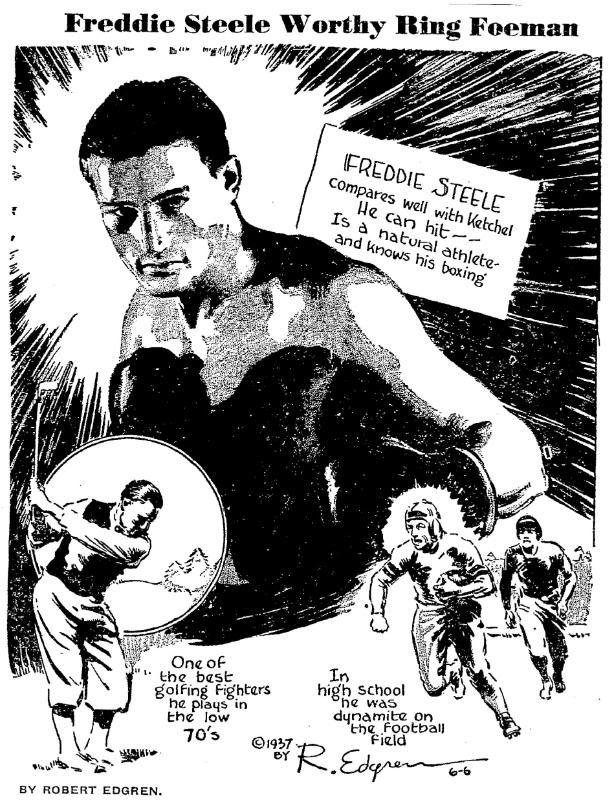
Freddie Steele, however, compares well with Ketchel, and that means that he can fight. He has a perfect build for fighting, six feet of height, good reach, and is quick, smart, aggressive, and packs a wicked punch. He can box the clever fellows and. Only needs to find his opening to put over a kayo. As for the sluggers, he outwallops them the the way Ketchal used to.
Steele usually has his man sized up exactly before he goes into the ring. In his latest fight, with Frank Battaglia at Seattle May 11, Freddy showed his stuff. Hearing that Battaglia had promised to knock him out he said "I'll knock him out within five rounds." He dropped Batt in the first round, in the second, and in the third he finished him with a terrific left that dropped him flat on his face.
Broke Dundee's Jaw.
Starting in '32, Steele has gone thru a long list of fights and has lost only one—a four round decision in his first year. He has knocked out a lot of good men. Most of his encounters have been in his own town, where he has a big following, but he was just a much a sensation when he shifted to New York, where the fight fans look on every stranger as a dud until he proves he isn't. Freddie doesn't care how tough or how clever they are. He can meet them at any style and take care of himself. Like all hard hitters, he had a hard time cornering a title holder.
Vince Dundee, clever American middle weight champion, wouldn't listen to any offer to fight Steele while holding the title. Vince met him after losing a decision to Teddy Yarosz, and perhaps Steel was a little sore because he didn't get his chance at Dundee in time to grab the title. Or perhaps Freddie was very anxious to show the world how he could fight. In any case, Steele broke Dundee's jaw and knocked him out in the third round, practically ending Dundee's ring career.
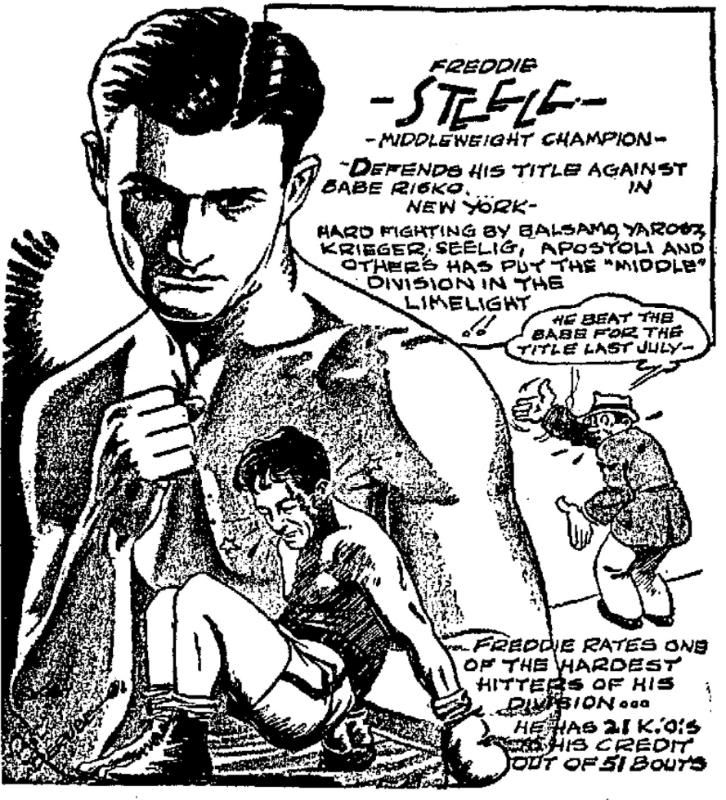
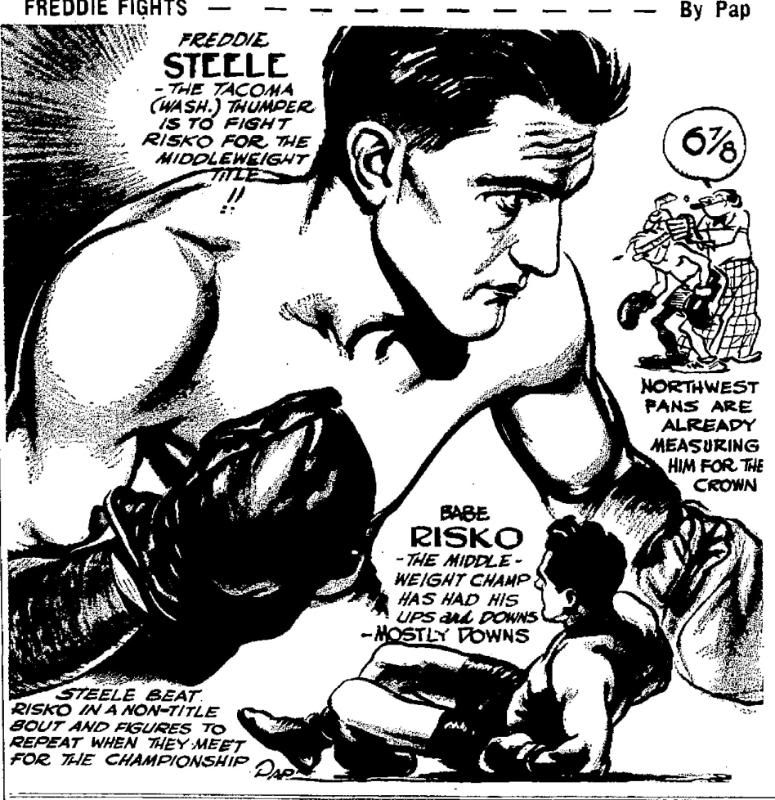
Babe Risko beat Yarosz, and Steele went to the top by giving Risko a sound trouncing in 15 rounds. Incidentally, Steele knocked out Apostoli in San Francisco, tenth round, in '35. Apostoli was rushed along too fast when he was matched with the Tacoma Terror. His sensational fighting in the east since then marks him as a fit opponent for Steele now. A good fight for New York, where Steele made himself popular by the masterly style in which he handed Babe Risko a beating three months ago. Or Philadelphia, where he jarred Pirrone to a technical knockout in round one less than two weeks later. Freddy gave Gorilla Jones, former N. B. A. selection as
champion, a bad eight round beating on Jan. l to start this year, but he had beaten Jones before.
Since titles are won by direct combat in the ring, and not by comparing records, Marcel Thil of France is still world's- middleweight champion. Thil had a good record. He beat Vince Dundee in 31 before Dundee had beaten Brouillard for the American title. He beat Gorilla Jones in '32, when Jones had won the N. B. A. tournament and had been recognized as American champion. He beat English champion Jock McAvoy in 15 rounds. He licked Brouillard a couple of times in France. And he is still unbeaten. As Thil will not come to America it might be a good scheme for Steele to go to France. Thil is a tough veteran, but he had been fighting seven years when Steele began, and there's little doubt that the American champion would bring that title back.
An Athlete and Competitor.
There are several interesting things about Freddie Steele beside his long, string of winning fights. He has everything to make a champion. The heart and punch to be another Ketchel, as far as ring ability goes. And other qualities that promise to list him with the most famous wearers of the crown. He is a natural athlete. In high school he was a fine football player, altho then weighing only 135 pounds. He keeps fit at all times. When not training for a fight he plays golf and is said to be the best golfer among the fighters, shooting in the low 70s." Ketchel was a hard trainer when preparing for a fight, but lived recklessly at other times.
Steele takes fighting so seriously that he trained five weeks for the recent bout in which he knocked out Battaglia. He'll never be caught off form on a fight date. He's only 24. He hasn't yet taken a heavy punching in any fight. In spite of his height and his powerful build he is lean and light, his favorite fighting weight being 156 pounds. He has an extraordinary heart.
Battling Nelson, the Durable Dane, when lightweight champion had a heart beat of only 44 per minute, which doctors said accounted for his amazing endurance. Steel's normal heart beat the same. Like Nelson's, his heart does not go above 82 beats while fighting, and returns to normal in a few minutes.
Battling Nelson was examined once before and after fighting a a tough 20 rounds with Jimmie Britt. His heart beat was 44 before entering the ring in Jim Coffroth's tent arena, and Bat was so interested in the test that he jumped from the ring the instant the fight was over and ran about 100 yards to his dressing room across the street, where the examiners found his heart little above the average heart's normal beat. In ten minutes it was back in the 40s. After that Nelson boasted that he "wasn't human," that he never felt arm weary or leg tired, and that he couldn't be knocked out. And he wasn't, until years of heavy fighting at last wore him down.
Steele, who is smart, and takes care of himself, and has a heart like that, ought to last a long time
up among the champions.
Career Record: click
Alias: Tacoma Assassin
Birth Name: Frederick Earl Burgett
Nationality: US American
Hometown: Tacoma, Washington, USA
Born: 1912-12-18
Died: 1984-08-22
Age at Death: 71
Stance: Orthodox
Height: 5′ 10″
Reach: 183
Division: Middleweight
Trainers: Jack Connor, Johnny Babnick, and Ray Arcel (while on the East Coast)
Managers: George McAllister, Dave Miller, Eddie Miller
Lincoln Sunday Journal and Star
6 June 1937
Freddie Steele, American middleweight champion and claimant of the world title, is no slouch as a fighter. In fact, Steele, is very likely to be classed with gentlemen like Tommy Ryan, Harry Greb, Mickey Walker and the dashing Stanley Ketchel. He has a lot of their stuff, and some of his own.
I don't compare him with Bob Fitzsimmons because it's just a waste of time and space to try to compare the incomparable. There was only one Fitzsimmons and there hasn't been another or anyone remotely like him since Bob, middleweight Champion weighing 156 pounds, knocked out Jim Corbett to win the heavyweight championship. During the rest of Fitzsimmons career he never fought another middleweight, and there was no middleweight who wanted to get into a ring with him, or that the public wanted to see in a ring with him.
Kid McCoy, the adventurous middleweight who cheerfully traded punches with most of the heavies, and beat or knocked out a lot of them, said when I asked him why he didn't fight Fitz "I wouldn't fight him if he was 80 years old and had whiskers down to his waist. He's the one man I ever met whose mind I can't measure. He'd make me feel like a fool. I'd rather fight Jeffries."
Freddie Steele, however, compares well with Ketchel, and that means that he can fight. He has a perfect build for fighting, six feet of height, good reach, and is quick, smart, aggressive, and packs a wicked punch. He can box the clever fellows and. Only needs to find his opening to put over a kayo. As for the sluggers, he outwallops them the the way Ketchal used to.
Steele usually has his man sized up exactly before he goes into the ring. In his latest fight, with Frank Battaglia at Seattle May 11, Freddy showed his stuff. Hearing that Battaglia had promised to knock him out he said "I'll knock him out within five rounds." He dropped Batt in the first round, in the second, and in the third he finished him with a terrific left that dropped him flat on his face.
Broke Dundee's Jaw.
Starting in '32, Steele has gone thru a long list of fights and has lost only one—a four round decision in his first year. He has knocked out a lot of good men. Most of his encounters have been in his own town, where he has a big following, but he was just a much a sensation when he shifted to New York, where the fight fans look on every stranger as a dud until he proves he isn't. Freddie doesn't care how tough or how clever they are. He can meet them at any style and take care of himself. Like all hard hitters, he had a hard time cornering a title holder.
Vince Dundee, clever American middle weight champion, wouldn't listen to any offer to fight Steele while holding the title. Vince met him after losing a decision to Teddy Yarosz, and perhaps Steel was a little sore because he didn't get his chance at Dundee in time to grab the title. Or perhaps Freddie was very anxious to show the world how he could fight. In any case, Steele broke Dundee's jaw and knocked him out in the third round, practically ending Dundee's ring career.
Babe Risko beat Yarosz, and Steele went to the top by giving Risko a sound trouncing in 15 rounds. Incidentally, Steele knocked out Apostoli in San Francisco, tenth round, in '35. Apostoli was rushed along too fast when he was matched with the Tacoma Terror. His sensational fighting in the east since then marks him as a fit opponent for Steele now. A good fight for New York, where Steele made himself popular by the masterly style in which he handed Babe Risko a beating three months ago. Or Philadelphia, where he jarred Pirrone to a technical knockout in round one less than two weeks later. Freddy gave Gorilla Jones, former N. B. A. selection as
champion, a bad eight round beating on Jan. l to start this year, but he had beaten Jones before.
Since titles are won by direct combat in the ring, and not by comparing records, Marcel Thil of France is still world's- middleweight champion. Thil had a good record. He beat Vince Dundee in 31 before Dundee had beaten Brouillard for the American title. He beat Gorilla Jones in '32, when Jones had won the N. B. A. tournament and had been recognized as American champion. He beat English champion Jock McAvoy in 15 rounds. He licked Brouillard a couple of times in France. And he is still unbeaten. As Thil will not come to America it might be a good scheme for Steele to go to France. Thil is a tough veteran, but he had been fighting seven years when Steele began, and there's little doubt that the American champion would bring that title back.
An Athlete and Competitor.
There are several interesting things about Freddie Steele beside his long, string of winning fights. He has everything to make a champion. The heart and punch to be another Ketchel, as far as ring ability goes. And other qualities that promise to list him with the most famous wearers of the crown. He is a natural athlete. In high school he was a fine football player, altho then weighing only 135 pounds. He keeps fit at all times. When not training for a fight he plays golf and is said to be the best golfer among the fighters, shooting in the low 70s." Ketchel was a hard trainer when preparing for a fight, but lived recklessly at other times.
Steele takes fighting so seriously that he trained five weeks for the recent bout in which he knocked out Battaglia. He'll never be caught off form on a fight date. He's only 24. He hasn't yet taken a heavy punching in any fight. In spite of his height and his powerful build he is lean and light, his favorite fighting weight being 156 pounds. He has an extraordinary heart.
Battling Nelson, the Durable Dane, when lightweight champion had a heart beat of only 44 per minute, which doctors said accounted for his amazing endurance. Steel's normal heart beat the same. Like Nelson's, his heart does not go above 82 beats while fighting, and returns to normal in a few minutes.
Battling Nelson was examined once before and after fighting a a tough 20 rounds with Jimmie Britt. His heart beat was 44 before entering the ring in Jim Coffroth's tent arena, and Bat was so interested in the test that he jumped from the ring the instant the fight was over and ran about 100 yards to his dressing room across the street, where the examiners found his heart little above the average heart's normal beat. In ten minutes it was back in the 40s. After that Nelson boasted that he "wasn't human," that he never felt arm weary or leg tired, and that he couldn't be knocked out. And he wasn't, until years of heavy fighting at last wore him down.
Steele, who is smart, and takes care of himself, and has a heart like that, ought to last a long time
up among the champions.