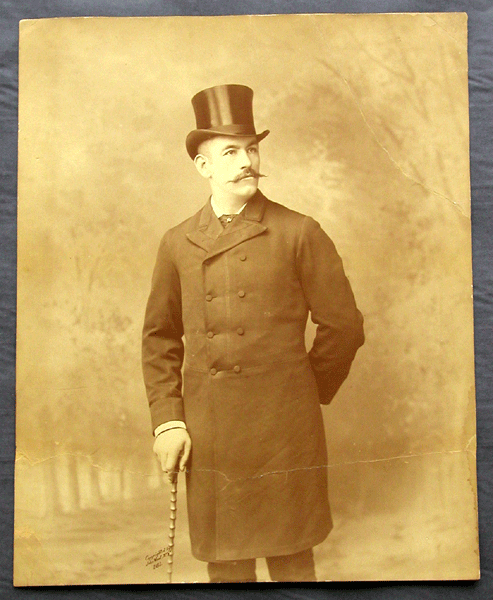
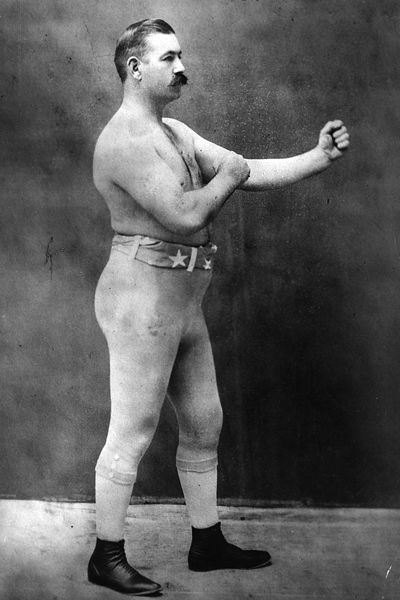
Page 1 of 4
JOHN L. SULLIVAN, THE EARLY YEARS
Posted: 20 Mar 2013, 12:59
by HomicideHenry
Long before Sullivan was introduced to the sport of pugilism, he was already known as "The Boston Strongboy" for his prodigous strength. At age 17 he could lift overhead a barrell of nails. In his time, pugilism was considered a less than desirable profession where no serious money was involved. Even champions such as Mike McCoole worked full time as a boatman because fights were scarce, and the money wasn't enough to sustain someone as a career. Professional baseball was more Sullivan's forte, where he played for such teams as the Egleston's, Tremonts, Etnas, and Our Boys Club earning $20 a game. While as a rising contender, Sullivan would play with the Cincinnati Red Stockings for $1,300 dollars during the 1879-1880 season. However, this thread is about his meteoric rise to the top of the sport, from 1878 to the conclusion of his first American 'Knock Out' tour.
1878, Dudley Street Opera House
Sullivan and his friends went to the opera house to watch a series of exhibition boxing matches, as well as listen to popular music of the times; and Sullivan was intrigued by the challenge of facing the once great professional JACK SCANNELL, and if he went the scheduled distance he would receive a small sum of money. As Sullivan himself later recalled of the event: "I did not know the first thing about boxing back then, but I went at him for all I was worth and I licked him quick. It wasn't much of a fight, and I done him up in about two minutes."
1879
Sullivan beat in succession Dan Dwyer, Tommy Chandler, and Patsy Hogan in exhibitions; March 14th, he easily defeated John 'Cocky' Woods, and was the first match of note covered in newspapers (Boston Daily Globe). November 1879 publically challenged Jack Hogan to a $250 prize fight with gloves in Providence or Boston but the fight went unaccepted (Boston Daily Globe).
1880
February Sullivan fought MIKE DONOVAN in an exhibition with gloves at the Howard Street Athenaeum, "Sullivan brought his sledgehammer right down on the back of my neck so hard I thought it was broken. As it was, I was knocked flat on the stage and my nose crushed. Never in my life did I have to do such clever ducking and side stepping. I had just fought the coming champion of the prize ring," recalled Donovan in later years. March of that year he boxed yet another exhibition against a man named Jerry Murphy, whom he also defeated. April boxes former champion JOE GOSS in a three round exhibition with gloves (which made Boston Globe front page news) and Sullivan dropped Goss in the second round, and Goss barely survives the third and final round. June he defeats George Rooke at the Howard Anthenaeum, dropping Rooke three times in the first, and police stop the bout during the third round. December 20th, Sullivan fights JOHN DONALDSON badly beating him over four rounds, Donaldson claimed he was ill and demanded a 'real fight' (under London Prize Ring rules) at a later date; December 24th, at the Pacific Garden in Cincinnati, Ohio Sullivan kayos Donaldson under London Prize Ring rules in ten rounds; Donaldson only landed one punch of consequence throughout the bout, and the match made front page headlines on the New York Times. Afterwards Sullivan challenges ANY man in the world for $1,000-2,500 a side.
NOTE: May 1880 Sullivan was NOT mentioned in the National Police Gazette overview, which outraged the public, June of 1880 he was mentioned in an article, "SULLIVAN GREAT PUGILIST OF BOSTON WOULD LIKE TO MEET JACK DONALDSON WITH OR WITHOUT GLOVES FOR $500", later that month Sullivan challenges ANYONE in America for $500.
1881
Sullivan kayos Jack Stewart, the champion of Canada, in two rounds for a purse of $1,300 though it was an exhibition match. March 21st, Sullivan rematched Mike Donovan, and it went the distance with Sullivan unable to score any knockdowns, Sullivan wins the decision however. Sullivan meets the man who would become his first manager Billy Madden, and conceive the idea of doing a tour of the country to help get Sullivan a match with then champion Paddy Ryan. Sullivan (on the tour) defeats Fred Crossley (6'1" 200lbs) in Philadelphia on July 11th, via first round knockout. Ten days later in Baltimore he kayos (another first rounder) Dan McCarthy; August 13th kayos CAPTAIN JAMES DALTON in four rounds. September 3rd he kayos Jack Burns in the first round, Burns was the champion of the state of Michigan, it must be noted Sullivan dropped Burns in the first 20 seconds, and again later in the round before the knockout. Stops on the tour included Chicago, Buffalo, Pittsburgh, Cleveland, Cincinnati, and Louisville. He made $7,000 off this tour, and was proclaimed the number one contender for Ryan's crown. Oddly enough, these were all considered exhibition matches (as were all gloved bouts in that era) so Sullivan was only 2-0-0 (2) in the most technical of senses. Sullivan was then challenged by the 41 year old former world's champion TOM ALLEN whose last prize fight was in 1861, Sullivan turns down the offer saying he wouldn't fight an old man.
Since February of 1881 Sullivan had been challenging Ryan, but it wouldn't be until May of that year that Ryan would say he would fight anyone under London Prize Ring rules for $2500-5000 a side; September of that year Richard Kyle Fox put up the $5,000 but Ryan claimed he weighed 230 pounds and would not fight in such poor condition, or on such short notice. February 7th of 1882, it was announced Sullivan/Ryan would take place within 100 miles of New Orleans under London Prize Ring Rules. It must be noted, that in May Sullivan had his biggest fight to that date, as far as publicity is concerned (May 16th, 1881) and that Ryan was present at this fight. After Sullivan's decision victory over Mike Donovan, the famed promoter HARRY HILL arranged the famous Sullivan/Flood match to take place. John Flood, who was known as both the 'Bull's Head Terror' and the 'Bully of The Five Points' was not considered the best heavyweight in all of Gotham, but his reputation as a gang member and doorman for Hill's establishment was known throughout the eastern seaboard. Flood was 6'0" and 190lbs, and the bout would be contested for $750, which was the equal of half a year's wages for the average laborer in America. Prior to the contest, on the 'tour', Sullivan had beaten STEVE TAYLOR in two rounds for a purse of fifty dollars; it was the first time Sullivan boasted no one could last four rounds with him. Taylor would be made famous for being Sullivan's chief sparring partner for the rest of Sullivan's career.
The Flood match took place on the Vanderbilt, captained by John N. Starin, off the coast of Yonkers on the Hudson river. Flood, despite Sullivan's successful tour (which had not yet been completed) was a 3-1 favorite over Sullivan. The bout would be covered by the Boston Daily Globe (May 17th, 1881), New York Clipper (May 21st, 1881), National Plice Gazette (June 4th, 1881). Tickets for the fight were $10 and 400 people packed onto the ship to watch the contest. Paddy Ryan, who was there, scoffed at the $750 purse, saying he would not fight anyone for less than $5000. Both Sullivan and Flood wore leather coaching gloves (skin tight). Sullivan was 5'11" and 180 pounds. The stakeholder, it must be noted, was 'Old' Joe Elliott the former champion, and editor of the New York Herald. The bout began at 10:00pm, and torches were lit and used to created a ring (strung together with ropes).
Round One- Flood forced a front chancery but was floored at the 3:00 mark, Round Two- Sullivan throws Flood at the :45 mark, Round Three- Floors Flood almost immediately into the ropes connecting the torches, Round Four- Throws Flood at the beginning of the round, Round Five- Another Throw, Round Six- Another knockdown, Round Seven- Both men fell on top of eachother, Round Eight- Flood knocked unconscious. Flood never again fought, but on June 13th, he and Sullivan put on an exhibition at Claredon Hall. At Claredon Hall, Sullivan boasted he would take on Ryan with or without gloves if the money was right, to which Ryan said "Sullivan is a clever fellow."
1882
Ryan trained alongside Johnny Roche, Charley McDonald at Lew Course's St. James Hotel at Rockaway Beach; losing 30 pounds, Ryan would walk 10 miles a day in heavy clothes and boots, rowed 3/4 hour, sit ups 1/2 hour, weights, another long walk, again weights and would spat 1/2 per day. Odds were 5-4 on Sullivan to defeat Ryan. Crowd of 2,000 people showed up to watch the contest. The match began at 12 noon. Round One- at the 30 second mark Sullivan floors Ryan with a right hand. The match ended 11 minutes, and eight rounds, later. "When Sullivan hit me I thought a telegraph pole had been shoved against me endways. Any man that SUllivan can hit he can whip," said Paddy Ryan after the contest. He vowed never to fight again, and opened a saloon in Chicago on State Street.
Sullivan, soon after, was challenged by Old Jim Elliott, who last fought in 1861, but Sullivan dismissed him because of his age. Another Jim Elliott, whose last bout had been in 1879, challenged and fought Sullivan, but was kayoed in three rounds (7:20). This, of course, was considered an exhibition because it was fought with gloves and under the Marquis of Queensbury rules. The perception that gloved fights were considered legitimite prize fights wouldn't be accepted in America until the late 1880's, though the MQ rules were established in 1865. It would be Sullivan, and Sullivan alone, who would change that perception over the course of twelve years as champion.
In his first ever Madison Square Garden contest, Sullivan faces off against England's JOE COLLINS (TUG WILSON), who was known as a very crafty and tough boxer who once went to a 28 round draw with England's ALF GREENFIELD. Though 5'5" and considerably smaller in weight than Sullivan he was considered as game a contender as anyone else. Tickets for the event were $5 a seat. The event took place July 17th. Wilson would get $1,000 and half the gate if he went the four round distance. Two ounce gloves were worn. Wilson was dropped 9 times in the first, 8 times in the second, 3 times in the third, 2 times in the fourth; Wilson, survived the contest by purposely falling to the canvas, along with getting caught with punches. For his 'success' he won a total of $11,000 and Sullivan was furious. Wilson retired from boxing and later owned and operated a shoe store.
The 1882 exhibitions between Elliott and Wilson earned Sullivan $10,000 in total. In the fall of 1882 Sullivan toured with a variety show as the main attraction, 6 days a week at $500 a day for 20 weeks. Sullivan, because he felt embarassed for his showing against Wilson, added on to his training regimine: 12 mile walks, weights for an hour, repeated twice more throught a day. It was during the tour Sullivan dropped Billy Madden as his manager, and in revenge Madden set sail for England in search of a man to defeat his ex-fighter. He helped arrange a series of matches in a tournament to not just crown the new champion of England, but as Sullivan's number one contender. CHARLIE MITCHELL would be that man, as he sported wins over not just Tug Wilson, but also Alf Greenfield and the world famous ex champion Jem Mace. Though only 150 pounds, Mitchell was such a fast and clever boxer, he once defeated a man who outweighed him by ninety pounds. He would win Madden's tournament and would set sail for America in March of 1883, where he would land in New York and defeat contender Mike Cleary in three rounds to further cement his claim as Sullivan's top contender.
1883
Once again at Madison Square Garden, Sullivan (who had recovered from a serious illness which resulted in him losing a quart of blood due to alcohol abuse; April 24th it begun) on March 14th he fought CHARLIE MITCHELL. 10,000 people came to see the contest. Scheduled for four rounds, and labeled an exhibition, this was considered for the championship as it was no secret that both men intended to knock the other out (as a condition with the local authorities, the promoters had to tell them it would be a 'friendly contest' or else it would be called off). In round one, to the surprise of many, Sullivan was floored for a brief moment. Sullivan, in turn dropped Mitchell several times in that first round. In round two Mitchell was beaten badly against the ropes, and in round three was knocked down several times. The match was then called off by police after Sullivan had floored and fell (knee first) on top of Mitchell. Sullivan took 60% of the $16,000 gate, Mitchell took 40%.
Sullivan's next opponent, in yet another Madison Square Garden sell out, was "The Maori Wonder" Herbert Slade. Slade, a very strong and prodigous wrestler, was the newest protege of former world's champion Jem Mace, who upon hearing of Mitchell's loss to Sullivan threw his hat into the search for someone to defeat Sullivan. Slade, at 6'2" and 225 pounds, despite his backing from Mace and Richard Kyle Fox, was considered a tremendous underdog as bets for the contest were $100 to $40 that Sullivan would defeat Slade. Over 10,000 people watched the contest. The winner was to receive 65% of the gate, the loser the rest. Round One- Slade was knocked down and also knocked UP and over the top rope and out of the ring, Round Two- Slade was dropped five times, Round Three- Slade knocked unconcious and police stormed into the ring. Sullivan made $7,000 of the $11,000 gate. By August of 1883, Sullivan made $40,000 through exhibitions and the Slade/Mitchell bouts.
It must be noted that Richard Kyle Fox announces Tom Allen, the same ex champion Sullivan dismissed due to age, as the logical next contender. Sullivan, again, dismisses this 'ranking' that Fox makes, again on the basis of Allen's age. Jem Mace, believe it or not, was also thrown into the list of considerable contenders to Sullivan's title, and Sullivan also turned this down.
Sullivan opens up a saloon (Champions) on Washington Street in Boston on August 7th, and it made $3,000 in its first three days. During this time Sullivan picked up a new manager in Al Smith, who had been the referee for the Flood/Sullivan bout, and the two men devised "The Grand Tour" that would last eight months, a "swing around the nation" and it was announced on September 18th at the Gilsey House in New York that it would begin ten days later and end on May 23rd, 1884 to see 136 cities, 195 performances in 238 days. Before this no entertainer, athlete or politician had ever done this. Herbert Slade, Stever Taylor, Pete McCoy, Mike Gillipsie would be on tour with Sullivan doing exhibitions with the champion. It must be noted on May 1st Sullivan married Annie Bailey in Roxbury at St. Patrick's Cathedral and in April of 1884 they would have a son (John Junior), however they would seperate after the spring of 1884 and would be husband and wife in name only; alcoholism in both parties and spousal abuse being cited as the cause for seperation.
The tour originally offered $250 to anyone who could go four rounds with Sullivan, however this would be raised to $500, and later $1,000 as challengers were becoming scarce during the tour. The first challenger came in Pennsylvania, the opponent was James McCoy and it ended in a :20 knockout. The second challenger came in Illinois, the challenger 'Gypsy' James Miles, another :20 knockout. The third challenger came in Minnesota, the opponent was Morris Hefey (6'1" 195 pounds) and he was knocked down three times in :30 and quit. The fourth challenger came in Iowa, against "The Strongest Man in The State" Mike Sheehan, and he was kayoed with the first few punches of the contest. In an ironic sense of humor, before the bout took place Sheehan's wife begged Sullivan not to fight her husband for the fear that her husband would be a murderer. The fifth challenger came in Colorado, the opponent was Fred Robinson who was dropped 7 times in the first and 8 times in the second before the bout was called off. The sixth challenger came in Oregan, a true giant of a man named Sylvester LeGouriff who weighed in at 300 pounds, and Sullivan dropped the big man two times in the space of :20 and LeGouriff was unconscious for ten minutes. The seventh challenger came in Washington, the opponent was named James Lang and was floored twice in 7 seconds and quit. The eighth challenger came in California, the opponent was named GEORGE ROBINSON and this match was for the title; Robinson survived the scheduled four round distance by purposely falling to the canvas SIXTY-SIX times, that is a fall every ten seconds. Sullivan made $10,000 off this match alone, and Robinson made $5,000. Over 12,000 people showed up to watch the March 6th bout at the Mechanics Pavilion. It must be noted EIGHT OUNCE GLOVES were used in this contest. The ninth challenger came in Texas, the opponent Al Marx was dropped three times in :55 and was knocked out. Marx would say Sullivan's punches felt like "standing under a pile-driver encased in a football." The tenth challenger came in Arkansas, the opponent Dan Henry and he was kayoed in the first round. The eleventh challenger came in Tennessee, the opponent William Flemming and it was the fastest knockout on the tour, two seconds. Also in Tennessee Sullivan fought his twelfth challenger in Enos Phillips, and it was a friendly match for the first three rounds because Sullivan didn't want to hurt the considerably smaller opponent, but dropped him three times in round four and the police called a halt to the contest. The tour ended in Ohio, where Sullivan did exhibitions with his sparring partners, and talks of Sullivan facing off against colored boxer MERVINE THOMPSON failed to happen, as did a match with Tom Allen's newest charge Fred Zachritz.
It must be noted Sullivan made $80,000 from the tour and that his saloon as a result of the tours success increased in business 60%. Compare this to the yearly salary of President Chester A. Arthur who made $25,000 per year. Sullivan and his manager Al Smith split ways during the tour, as did Sullivan's wife, due to drunken brawls and arguments between his manager and the champion.
Re: JOHN L. SULLIVAN, THE EARLY YEARS
Posted: 20 Mar 2013, 16:47
by HomicideHenry
1884
June 30th, 1884 at another Madison Square Garden sell out, John L. Sullivan following the success of his tour of America, was set to rematch Charlie Mitchell. However, during the tour, Sullivan became grossly out of shape weighing in well over 250 pounds and was battling the bottle. In a shocking move, he addressed the crowd and apologised saying he was intoxicated and unable to do the match; DOMINICK MCCAFFEREY would take Sullivan's place and fight Mitchell. Richard Kyle Fox wrote in the next issue of the National Police Gazette: "He has forever disgraced himself in the eyes of the general and sporting public." Sullivan quickly found himself a new manager in Patrick F. Sheedy, and Sheedy revamped Sullivan's image by having Sullivan fight JOHN LAFLIN on November 10th at Madison Square Garden with prociepts to go to Ohio flood victims. Heavy training brought Sullivan down from 231 pounds to 196 pounds. As a precaution, however, Madison Square Garden had every ticket have a coupon attached in case refunds were required; the first time in sports history this concept was done. LAFLIN was 6'2" 200lbs, but was 42 years old. 5,000 were in attendance to watch the contest. Round One- Laflin downed, Round Two- Laflin downed three times, Round Three- Laflin downed twice, Round Four- Laflin was kayoed. Sullivan made $8,000 off this match.
Richard Kyle Fox arranged Sullivan's next bout, between England's ALF GREENFIELD, which was contested for the National Police Gazette Diamond belt which held 200 ounces of silver and gold, and was worth $2,500. November 18th the match took place again at Madison Square Garden, and Sullivan kayoed Greenfield in two rounds, the bout being stopped by police. Both men were arrested for illegal prize fighting (this match was labeled an exhibition, but the moment Sullivan started teeing off on Greenfield it was obvious this was a 'prize fight'). Both men were later found not guilty.
1885
January 19th, Sullivan rematches Paddy Ryan, who came out of retirement. Ryan was financially busted, as his saloon went bankrupt and needed the money. However, the moment Sullivan started throwing bombs, police put a halt to the match at the :30 mark of round one. Soon after this match politicians in New York and Massechusetts made boxing illegal, exhibitions or no exhibition. Sullivan was now without a base to promote himself from. Sullivan sought matches out of state, a match with Dominick McCafferey was to be held in Pennsylvania but soon too boxing became illegal there and the match was scrapped. Tickets for the bout had to be refunded. Sullivan and McCafferey were put under a $5,000 bond for a breach of the peace.
February 24th, Annie Sullivan filed for divorce from the champion, demanding $20,000 and a restraining order, but this case was dismissed. They never did divorce, but would live seperate lives for the next twenty three years.
On June 12th in Chicago Sullivan faces Jack Burke. Round One- Sullivan throws Burke, Round Two- Sullivan rabbit punched Burke, Round Three- Burke had the better of the round, Round Four- Burke was dropped four times, Round Five- Sullivan kayos Burke. 65% of the gate went to Sullivan. It appears that all the battles in his personal life were now effecting his boxing career. August 29th, in Cincinnati Sullivan became (officially) the first gloved world champion, though he had been promoting the Marquis of Queensbury rules for the passed 8 years. Sullivan managed to slim down from 237 pounds to 208 pounds for his match with Dominick McCafferey. $15-20 a seat. Over 15,000 spectators showed to watch the event. 5pm starting time. The first three rounds Sullivan dominated McCafferey, by round five McCafferey got his second wind in rounds four and five. Round six, Sullivan falls (knee first) on top of McCafferey after dropping him to the canvas and the match ended. The referee of the contest awarded Sullivan a decision victory. Sullivan made $6,000 for the match, McCafferey $1,000. However there was much controversy about this decision, as Sullivan had promoted himself for so long as being a man no one could go the distance with, that the crowd and the sporting public were under the impression that if McCafferey went the distance he would win not only the big purse, but win the title as well.
Sullivan would not fight for a year after this contest. He would however sign on with the Allen Minstrel show for 20 weeks at $500 a week. His 'role' in the show was he would stand in fighting pose for several hours a day, and would also do such poses as 'The Dying Gladiator', 'The Gladiator in Combat', 'Hercules at Rest', and 'Cain Killing Abel' as a living statuary alongside William Muldoon. During the shows, Sullivan ballooned to 245 pounds. Also during this time he reconciled with his first manager Billy Madden, and tried in vain to arrange boxing matches with such contenders as JEM SMITH. Sullivan, though enemies with Richard Kyle Fox, even went to the boxing publicist in the hopes something could be arranged. To make matters worse, Champion's, was closed down for good. Though Sullivan claimed a profit of 100%, it had went down in business because the champion was seldom ever there to attract customers. Sullivan's brother Mike had essentially operated the saloon since 1884.
Patrick Sheedy arranged another 'Grand Tour' to take place to cover 1886-1887. George LaBlanche, Joe Lannon, Jimmy Carroll, Patsy Kerrigan were apart of the tour as boxers. September 18th in Allegheny, New Jersey Sullivan faces FRANK HERALD, the match went three wildly exciting rounds before the police put a halt to the contest. Sullivan, obviously the better of the two, was awarded the winner. Sullivan took 20% of the $5,000 gate.
1886
October 28th, 1886 John Junior died of diptheria in Centerville, Rhode Island at the age of 2.5 years. For the rest of his life Sullivan carried with him a picture of the boy in a frame with white flowers pressed underneath the glass and never spoke of the boy to anyone. He never commented on the boys death to the press.
November 13th at San Francisco's Mechanic Pavilion Sullivan fought Paddy Ryan again, over 9,000 were in attendance and it was midnight when the match began. Sullivan won round one, downed Ryan in round two three times, and downed Ryan twice in round three before knocking him out. Sullivan received $9,000 and Ryan received $2,600. Surprisingly Sullivan showed much kindness and consideration after the knockout, as he assisted Ryan to his corner, giving Ryan a water bottle and wiped the blood from the ex champions face. He was celebrated throughout the nation for this act of generosity.
In Colorado, he would meet the first challenger of the second 'Grand Tour' who was called the 'Champion of The Northwest' Duncan McDonald. Sullivan sparred with kid gloves with the man the whole four rounds and the match was declared a draw. Sullivan would defend his crown against PATSY CARDIFF in Minnesota where 7,000 people watched the contest. Tickets unbelievably were sold at $100. Round One- Sullivan was the aggressor, Round Two-Three, Sullivan only used his right hand clearly outboxing Cardiff, Round Four-Five, both men barely threw any punches, Round Six- Sullivan rushes Cardiff into the ropes. The bout was declared a draw. It was revealed after the fight Sullivan broke the radius bone in his arm. Cardiff for his troubles received a quarter of the $10,000 gate. By March, Sullivan's arm was healed but he had ballooned to 235 pounds.
1887
June 9th the tour ended in Brockton, Massechusetts and on July 4th Sullivan was awarded a belt that had 256 diamonds, 30 pounds of carat gold, ane engraved were the words: "Presented to the champion of champions, John L. Sullivan, by the citizens of the United States." Since 1884 Sullivan grossed $200,000 averaging $60,000 a year. Sullivan seperates from Pat Sheedy in the late summer of 1887 and announces a European tour under new manahement (Harry S. Phillips) to last until 1888.
October 27th, 1887 Sullivan alongside his manager, new love interest Ann Livingston (Nailor), his father and the boxers who were with him on the second 'Grand Tour' set sail for Europe on the Cephalonia. First stop was Queenstown, Ireland where he boasted he would come back to America as the world's champion or die. November 6th, the ship set sail for Liverpool. English newspapers were mixed on their thoughts, opinions, of Sullivan. One newspaper featured a cartoon of the American champion versus Honest John Bull with a caption that read "This glove business won't work over here so come off." Still, hundreds of people followed him wherever he went. It must be noted that same year the Queen's Diamond Jubilee had taken place, as did Buffalo Bill Cody's European tour. November 9th at James' Hall was Sullivan's first exhibition show. He covered the Midlands, Glasgow, Dundee, Manchester, Birmingham, Wolverhampton, Aberdeen, Edinburgh. Cardiff, Wales was where the first challenger came where a man named Samuels quit after two rounds with the champion. After 2.5 weeks he returned to London and did a 12 night engagement at the Royal Aquarium. December 9th Sullivan was invited to meet the Prince of Wales, the man who would become Edward VI and Sullivan was awarded a pair of garnets and matching set of emeralds.
December 10th Sullivan and company sailed to Ireland and over 15,000 showed up to see him dock at Ireland. "See The Conquering Hero Comes" and "The Wearing of The Green" was played at his reception. He would appear at Waterford, Limerick, Cork, Belfast. He also paid a visit to Belcher's Hollow (Donnelly's Hollow) and walked the Steps of Strength. It is not known whether he visited his mother and father's homes in Tralee or Anthlone. It is ironic that Sullivan's own father had said while on this tour to the effect that his son wasn't the greatest fighter in the world, for he knew in the country of Ireland somewhere there was a man who would have the best of it over his son. Whether this was in jest, or simply Sullivan's fathers own memories of when he was an Irish native is unclear. However there is much documentation that there were dozens of gypsy fighters, gloved pugilists, etc. around at the time. Until recently it was thought no one had challenged Sullivan when he toured Ireland, but this is not the case. One brave man did so, but he was so small Sullivan offered the man to fight one of his sparring partners instead. The brave man chose to fight Sully instead, and of course, Sullivan beat the man in one round.
1888
The tour ended in January of 1888 in Portsmouth. His manager Harry Phillips arranged for Sullivan to face his old nemesis Charlie Mitchell for $2,500 a side and under London Prize Ring rules and without gloves. Sullivan began training for the contest at Bull's Royal Adelaide Hotel in Windsor on January 26th and weighed in at 230 pounds. Mitchell trained at St. Mildred Hotel at Wesgate-on-Sea which was 60 miles from London. Sullivan walked nearly 30 miles a day, plus weights and sparring and working the bag and by March he lost 30 pounds.
The ring was 24x24 and took place near Chantilly, France on the estate of Baron Alphonse Rothschild as prize fighting for money was illegal in England (non-Marquis of Queensbury rules). Reporters from the New York Herald, New York Sun, and Illustrated London were present. The ground was muddy for it had rained that day, March 10th, and only 40 people had made the trip to see the world's championship match take place. The betting odds were 3-1 for Sullivan to win. At 12:30 the two men met at the scratch and began to fight and it continued to pour down rain. Sullivan dominated but his legs were badly cut by Mitchell's spiked shoes and was growing more and more frustrated at Mitchell's tactics of throwing himself purposely to the ground to avoid Sullivan's punches. Mitchell, however did score first blood in round eight. The match went well over three hours, and 39 rounds. The ring was now nothing but a sinking mudhole and the rain hadn't let up and both men conceded to a draw. No money was made off the match as it was a 'fight to the finish, winner take all' match. Sullivan and Mitchell for their troubles were imprisoned and fined and released March 11th after posting bond.
When news reached America of what had happened, the press believed Sullivan was passed his prime and Richard Kyle Fox cited Jake Kilrain, who ironically worked Mitchell's corner in Chantilly, as the best man in the world. April 12th Sullivan and company boarded the Catalonia and on April 24th landed in Boston and was greeted by a massive crowd. Sullivan had ballooned to 280 pounds following the Mitchell fight til the time he got home to America. He made $20,000 from the tour and claimed he made more money in one week in Ireland than he did six weeks in England. His manager Henry Phillips broke ties with Sullivan after a May 15th benefit at Music Hall in Boston.
Unfortunately a benefit on June 14th at New York's Academy of Music showed Sullivan's powers to attract business was at an all time low, due to the bad press on the Mitchell draw. Only 300 people appeared. Richard Kyle Fox, Sullivan's biggest critic, did a great job at making the people seriously doubt Sullivan's abilities for the first time since the Flood bout. Worse was to come, Ann Livingstone would leave Sullivan because of his lowered celebrity status and money. Embarassed by the Mitchell draw, and the criticisms of the public Sullivan began refusing to put on exhibitions, though he did for a time consider fighting colored heavyweight champion GEORGE GODFREY because the people were also saying Sullivan was afraid of fighting a black man. June 1888 he appears at the Doris and Gray Circus and was further criticised by the press, "If John L. wants to be popular in Boston again he must fight for it." On July 19th, Sullivan was out of the circus and continued his alcoholic binges and wound up in a carriage accident and came down with gastric fever where he almost died and lost over 100 pounds. He got down to 160 pounds and swore he would never drink again.
Richard Kyle Fox, upon hearing of Sullivan's drastic weight loss and severe illness, began promoting in earnest that Jake Kilrain was the best heavyweight in the world, as he was fully convinced that there was no way Sullivan would ever be able to recooperate after such illness. Kilrain who was a prodigous wrestler and boxer (a jack of all trades so to speak) had defeated the likes of George Godfrey, Herald, and had draws against Mitchell and Cleary. He also had defeated Lannon and Taylor, Sullivan's chief sparring partners. December 19th, 1887 Kilrain had fought to a 106 round draw with Jem Smith, and by May of 1887 Fox was calling Kilrain the champion and Sulliver a 'quitter' and had bestowed upon Kilrain the National Police Gazette Diamond belt. When Sullivan had heard of this he said the belt wasn't fit for a dog collar. In December of 1888 (the 7th to be exact) Sullivan was tired of the criticisms, the heresay, and the fraud title claimer and posted $5,000 to fight Kilrain. Fox and company followed suit two weeks later. "I hereby challenge Jake Kilrain to fight me according to the latest rules of the London Prize Ring for the sum of $10,000 a side or as much as more as he would like to make it. The fight to take place six months after saying the articles, the place of the fight to be mutually agreed upon. I have this day placed in the hands of the sporting editor of the New York Clipper the sum of $5,000 as a garuntee of good faith. John L. Sullivan---champion of the world."
1889
At the Rossin House in Toronto on January 7th, 1889 all the deatils were agreed upon. Winner take all in a $20,000 contest and the Diamond Championship. The match would take place July 8th, 1889 within 200 miles of New Orleans. NO weight limit and the men had to be in the ring between 8am and 12 midnight or it was considered a forfeit. Sullivan's trainer for the fight originally was Jack Haynes, and at first training started good, until Sullivan began to become belligerant and craving alcohol. He was 215 pounds and gaining, something needed to be done fast. Haynes stepped out, and Sullivan's backers hired William Muldoon, the American Graeco-Roman wrestling champion to make Sullivan toe the line. At Belfast, New York on Muldoon's farm, the real training began. They had only two months to prepare, as SUllivan had wasted four months to booze it up. Sullivan came into Muldoon's camp at 240 pounds. He would rally against Muldoon, sneak off in the middle of the night, etc. in order to get a drink. When the press caught wind of these accounts, the odds of 6-4 for Sullivan as a favorite went to 5-4 Sullivan as an underdog. By July, however, Sullivan had gotten down to 209 pounds and was quick, and as strong as he ever was due to Muldoon's unorthodox wrestling, cardio, and nutrition plans.
The states of Arkansas, Mississippi, Louisiana, Alabama, Nebraska all said they would have all parties involved arrested if the fight took place in their areas. This fight was so talked about and widespread, that believe it or not in Polynesia wagers were being made on who would win the contest. Amazing considering this was the day and age of newspapers, the steam ship, and telegraph. Sullivan, all the way til the day of the contest, trained while on the railway with Muldoon keeping an eye on every last detail. He arrived at Gentilly Station a mile outside of New Orleans. Rumors circulated that the match would take place in Mississippi and the govenor of Texas (Ross) wired the sheriff of Orange county to be on the look out. Though nobody was sure where the match would be held tickets were sold at $10 per person and $15 for a ringside seat. On July 7th the location of the contest was revealed to ticket buyers. It would take place on a farm owned by Charles W. Rich who ran and operated a saw mill on this 30 acre property in Richburg, Marion County. Rich hired 20 black men to make the ring and bleachers for the event by the light of torches through the night, enough to seat 1,000 and it was a three sided arena. Three trains, hired in private, were used to transport the ticket buyers to the location. They all arrived at sunset on the 8th of July. The starting times were changed at the last minute to 10am-Noon to let the men limber up and prepare, and it was 100 degrees by 10am. 2,000 plus people attended what would be the last bare knuckle contest for a lineal boxing championship.
Sullivan's seconds were Muldoon and Cleary, Kilrain's were Mitchell and Donovan. Umpires were Tom Costello and Bat Masterson. Referee was John Fitzpatrick. At 10:30am Fitzpatrick called the men up to the scratch. The legendary prize fight went as follows:
Round One- Kilrain throws Sullivan at the :15 mark
Round Two & Three- Sullivan was wrestled down
Round Four- Lasted fifteen minutes and Sullivan was thrown
Round Five- Kilrain drew first blood, but Sullivan dropped him (the temperatures rose to 115)
Round Six- Kilrain threw himself down purposely to end the round
Round Seven- Kilrain purposely trips Sullivan to end the round
Round Eight- Kilrain by this time was horribly swollen and disfigured
Round Ten- The crowd was murmuring over Kilrain's cowardice
Round Twelve- The crowd was booing Kilrain
Rounds Thirteen Through Twenty Five- More of the same, with Sullivan yelling at Kilrain 'You're a champ, eh? Champion of what?'
Round Twenty Six- Kilrain managed to throw Sullivan
Round Twenty Eight- Sullivan was more than enraged at Kilrain's cowardice
Rounds Thirty Through Thirty Five- Kilrain was falling to the canvas without being hit (exhaustion)
Round Thirty Six- Sullivan appeals to referee Fitzpatrick to end the fight but the ref let's it continue
Round Forty One- Fox's representative William Harding left ringside disgusted at Kilrain's performance and Sullivan was covered in blood and his feet were cut up due to Kilrain's spiked shoes often standing in puddles of his own blood
Round Forty Four- Sullivan began to vomit due to the exsessive heat, Kilrain offers a draw and Sullivan yells "No you loafer!" and proceeds to drop Kilrain in the next three rounds
Rounds Fifty Through Sixty- Sullivan reportedly drinks a quart of whiskey between rounds and catches his second wind, both men had blisters from the scorching heat, and Sullivan was laughing at Kilrain. Sullivan refused to sit on his stool between rounds. Donovan was by now pushing Kilrain out of his corner. Even so Sullivan's eyes were nearly swollen shut.
Rounds Sixty Five Through Seventy- Kilrain's midsection was a giant bruise and tried to trip Sullivan, it was his onlu defense.
Round Seventy Five- Kilrain was beatn around the ring at will and could not come out for round seventy six, his head hanging on his chest as if his neck were broken.
Sullivan IMMEDIATELY after the contest charged after Charlie Mitchell and challenged him to a fight right there and then (the criticism of the draw still plagued Sullivan's mind) and Mitchell refused and both men shook hands and let bygones be bygones. Total fight time was two hours, sixteen minutes and twenty three seconds. Buckets, ropes, turf, etc. from the fight were nicked and sold as souveniers. The New York Times declared "THE BIGGER BRUTE WON!" and writer John Boyle O'Reiley wrote "I am glad that Sully has redeemed himself, his equal as a boxer never entered the ring in ancient or modern times."
Re: JOHN L. SULLIVAN, THE EARLY YEARS
Posted: 20 Mar 2013, 23:54
by dnahar32
A very good, informative post Homicide Henry.

Re: JOHN L. SULLIVAN, THE EARLY YEARS
Posted: 21 Mar 2013, 11:28
by HomicideHenry
dnahar32 wrote:A very good, informative post Homicide Henry.
Thanks. There is alot more details in between those years that I left out, that may of made more modern people understand the man himself, and why he had ups and downs in his career though he was still the top man in the world. However, I think I outlined enough personal tragedy and criticisms of the times for people to see why he did stumble at times. One thing that really needs to be made clear here is NOBODY before him ever truthfully made a career out of fighting. Even the famous champions of England like Figg and Broughton did not get rich off their fights, their main incomes came from business ventures as publicans, theatre engagements, and owning businesses. True the matches brought them enough money to buy those ventures, but being a 'prizefighter' was not a true profession to survive and thrive off from. The fact that Sullivan was able to make $60,000 on average a year as a boxer in an era when men and women often times made a dollar a day working labor jobs, and in total amounted a million plus in his career is nothing short of phenomenal; let alone the fact that a lower class, first generation Irish-American, who was also Catholic, managed to do this in his time the odds have to be in the millions.
I think once I am done with Sullivan's entire career, I ought to do a chronology in pictures of Sullivan's biggest moments throughout his career. The shame of it all is the Sullivan-Corbett match never had a single picture ever taken. All there is availble is drawings for newspapers. However, I think it will give the people an idea of the 'ups and downs' in weight fluctuations Sullivan suffered through during his career, and still remained on top.
Re: JOHN L. SULLIVAN, THE EARLY YEARS
Posted: 21 Mar 2013, 17:40
by HomicideHenry
THE AFTERMATH OF THE LAST BARE KNUCKLE LINEAL HEAVYWEIGHT CHAMPIONSHIP MATCH
After the epic battle, Kilrain and company left for Virginia to escape police. Charlie Mitchell left for England immediately after the match for the same reasons. Sullivan (who lost six pounds during the match) fled to New Orleans and attempted to board a train destined to Nashville, but the police arrested him at the station. He spent overnight in jail, made bail, and fled to Chicago and then took a train to New York; convinced he was far enough away from Mississippi laws and warrants. However on July 31st he was arrested and taken all the way back to Mississippi and spent time in a Purvis jail cell. Jake Kilrain himself was arrested a few days later in Baltimore, Maryland and taken back to Mississippi. On August 16th, Sullivan was found guilty and sentenced to one year in jail, but he made bond and returned to New York. Kilrain was also found guilty, and his bond was posted by Charlie Rich and a man named Carborough and promised to return in December for sentencing. After all the lawyer fees, trainer fees and money to investors, out of the $20,000 purse Sullivan ended up with $4,000 and the Diamond Belt. Kilrain was sentenced to two months menial labor in December.
Sullivan, however, was a bit more fortunate. Although his charges were dropped, because the fight was held on private grounds, he was told the charges could be brought back up at any given time, so he pled guilty and paid a $500 fine. Sullivan told reporters: "I'm getting too old, and fighting under London Prize Ring rules is too risky (due to legalities). I was anxious to fight this time, but I never want to fight again." He also recounted his opinion on the fight with Kilrain: "If he had stood up and fought like a man I think I could have whipped him in about eight rounds." It must be noted, that prizefight laws to this day are often times so vague it is almost impossible to decipher how a 'sanctioned' boxing match is even legal itself; the legal loop hole for prizefights with or without gloves (that are not 'sanctioned') is to be held on private grounds, and that the assumption of risk cannot be exceeded, which means serious injury (i.e, broken bones, internal injury, concussion) in a prize fight is when the match has stepped over the legal limitations of what is legal and what is not.
TROUBLED TIMES FOR THE CHAMPION
August 30th Catherine Kelly Sullivan, the champion's mother, dies. Sullivan was but a minute late for his mother's death. He attempted to make up for this by having 100 carriages follow her to the cemetary and reportedly her dying wish was that her son would stop drinking. Sullivan did not drink at her wake, and made an attempt not to but by Autumn of 1889 he was drinking heavily again. However, he was also planning on making a comeback, though he had said he was essentially retired.
The opponents in mind for this comeback were JOE MCAULIFFE or FRANK SLAVIN. Pat Duffy tried to make the arrangements, but Sullivan wasn't fully committed in doing the matches. He did, however, to the shock of many say for $20,000 he would fight ANY man white or black. This was said, however, just to keep the public happy as Sullivan's heart was really no longer into the game.
In September of 1889 he flirted with the idea of becoming a politician, under the Democratic party. However, due to his public intoxication scandals and brawls in public, he wasn't taken serious as a proper candidate for Congress, even though his generosity made him well beloved by the people of Boston for he often times handed out flour, coal, wood, and money to the poor. September 1890 (the 7th) his father Mike Sullivan died of typhoid pneumonia and again, Sullivan was late. The newspapers read: "JOHN L. NOW AN ORPHAN," and his old supporter and ex champion JOE COBURN would also die in 1890. He seemed to be now a man without family, friends or management.
However, not all was bad in 1890, as Sullivan became the first boxer to appear in a starring role on an American stage. THE PLAYMASTER was a six week engagement where he would act and spar with JOE LANNON after each show, where he received $1,000 a week. In the summer of 1890 Sullivan would star in HONEST HEARTS AND WILLING HANDS (which opened August 28th, 1890). It was during this time he announced he had given boxing up for the stage. The play toured the country 1890-1891 all the way to San Fransisco and back. Sullivan and actor Duncan Harrison split the $30,000 the play made through the tour. Sullivan through this time ballooned in weight to 300 pounds. To put this in a modern perspective, imagine one of the Klitschko brothers becoming the number one box office attraction in the world in the movies.
THE CHAMPION IS HUMILIATED
During the success of the American tour of HONEST HEARTS AND WILLING HANDS, Richard Kyle Fox was at hard work to bring in his latest charge to defeat John L. Sullivan. That man was none other than PETER JACKSON, a black heavyweight from Saint Croix who stood 6'1" and 190 pounds who in earlier life was a champion swimmer. Jackson had posted victories over McAuliffe, Cardiff, Smith, Slavin, and in 1888 defeated George Godfrey for the 'Colored Heavyweight Championship of The World'. The press was in awe of the Australian and many were undecided as to who would win if Sullivan fought Jackson. Despite what historians will tell you today, while Jackson was a good tactician, he was more an offensive fighter. He would stalk opponents and throw one-two's. Because of this some historians and writers like Adam Pollack believe had a Sullivan/Jackson match taken place, Sullivan would have had a solid chance of beating Jackson because nobody up to that point was capable of beating Sullivan in a brawling match.
When Sullivan and company arrived in San Fransisco, the champion was met by an old friend and foe in George Godfrey who claimed he had $10,000 and would answer Sullivan's challenge of $20,000 plus the gate in a winner take all match-up. Mind you, this would be the third and final time either of these two men would meet and discuss a fight between them. The first time Sullivan challenged Godfrey, who claimed he was injured. The second time, Godfrey challenged Sullivan and the champion accepted but Godfrey would get injured in a fight and it failed to materialise. This time, however, Sullivan refused the challenge, citing he was on tour with the theatre. It must be noted that the California Athletic Club was interested in staging the bout and underwrite the purse.
On June 26th, 1891 Sullivan and company was about to board the Mariposa and head to Australia for an overseas tour of HONEST HEARTS AND WILLING HANDS, and was greeted by none other than Peter Jackson who challenged Sullivan on the spot. Sullivan addressed the crowd: "All fighters, first come, first served who are white. I will not fight a negro. I never have, and I never shall." While he was boarding the ship, he looked back at Peter Jackson and said, "Even if I gave him a shot, I'd lick the person." Peter Jackson, unfortunately, never would get a shot at the heavyweight title and would die in relative obscurity on July 13th, 1901 from tuberculosis, after failing as an actor, boxing instructor and would be kayoed in three rounds to a rising up and comer named James J. Jeffries.
It must be noted, that Sullivan couldn't have entirely been a racist, for he did on two of three occasions attempt to face Godfrey and even refereed some of Godfrey's fights. He also attempted to fight Mervine Thompson and in his early career was scheduled to face a black fighter named Johnson in his native Boston but the opponent never arrived. Sullivan also faced 'The Maori Wonder' Herbert Slade, who was not an American and was dark complected himself. The truth of the matter is, despite all his bluster about $20,000 challenges, he didn't want to fight anyone regardless of color. Sullivan grew up in a time when Irishmen were treated as badly as blacks, as some of the more famous sayings were "An Irishman is a person turned inside out" and "If an Irishman hangs a person, hang the Irishman", among other disgusting comments. If racism existed among the Irish, it was mainly because immigrants could hardly compete with the cheaper labor force which was the black community; much like the 'racism' in America towards latinos because of cheaper labor today.
FURTHER HUMILIATION
After setting sail for Australia, Sullivan and company landed in Honolulu, Hawaii and the island of Samoa first. On July 20th, he landed in Sydney harbor. However, the celebration was short lived as Australia's JOE GODDARD ("The Barrier Cyclone") challenged Sullivan immediately with the entire Australian press there to witness one of their own challenge to greatest fighter in the world. Sullivan claimed he was under contract to do theatre engagements, and if he fought anyone, he would break his contract. The public was furious and over the next few weeks Sullivan would go through the sort of humiliation and embarassment that would have made any normal man break down and cry.
HONEST HEARTS AND WILLING HANDS opened at Her Majesty's Opera House on July 30th, but after eight days the show was cancelled. The Australians let it be known they did not want to see Sullivan act, or at all, unless he fought. The Australian press was harsh on Sullivan's acting abilities and said it was an embarassment that he shared the same stage the famed actress Sarah Bernhardt was performing on shortly before Sullivan and company arrived in Australia. The cast and crew went to Melbourne to play a three week engagement at the Grand Opera House, but there was more criticisms and the engagement ended in a week. The cast and crew, trying to recoup losses, toured the 'tank towns' of Ballarat, Bendigo, Cathlenain, Maryboro, Geelong, Stahl, and Adelaide before returning to Melbourne in September where Sullivan acted as a chief second for his sparring partner and friend Ashton against none other than 'The Barrier Cyclone' Joe Goddard. It was more salt in the wounds when Ashton dropped an eight round decision to Goddard on October 2nd at Richmond's Crystal Palace. The humiliation was enough to bare and the next day Sullivan and company set sail for America. On October 26th they landed in San Fransisco and Sullivan told the press "Anybody who says that Australians love Americans is mistaken."
THE MAKINGS OF THE GREATEST PRIZE FIGHT OF ALL TIME
While in San Fransisco, Sullivan appears in the play BRODERICK AGRA, and for the first time in a long time, put on a sparring exhibition with JOE CHOYNSKI. The bout soon turned ugly when in round two the fighters started throwing tremendous punches at one another. The crowd was obviously pleased with the "bout". Choynski in a few short years would decision the likes of Jack Johnson and draw with Jim Jeffries, but on this night Sullivan was the man. Although he promised to fight Frank Slavin, he did not do so. His old rival Paddy Ryan, who was down to peanuts, begged Sullivan for a fourth match but Sullivan refused this as well. HONEST HEARTS AND WILLING HANDS went to Sacremento, British Columbia, Manitoba, Philadelphia, Brooklyn and ended in Boston at Howard Athenaeum on June 4th, 1892.
He was easily 25-300 pounds and a full blown alcoholic. He also had no desire to ever fight again. Many in the press were debating whether he could be cured or saved from alcohol. Despite all this, he refused to give up the crown. It was following the tour, he arranged for his autobiography to be written (Spring 1892) and would be released upon completion. However, the constant criticisms of the press and public grew heavy on him and he decided to make a challenge that no man could possibly match so that he could both please the public and keep his security as champion intact. The challenge was this: ANY WHITE MAN WHO CAN MAKE A PURSE OF $25,000 PLUS RAISE $10,000 SIDE BET IN A WINNER TAKE ALL MATCH. He also pointed fingers at Frank Slavin, Charlie Mitchell and newcomer James J. Corbett saying if they were man enough that is what they would have to do to get the shot at the title.
Forty-five thousand dollars was unheard of money then, and nobody honestly thought anyone could raise that sort of cash. Twenty thousand was doable, thirty thousand was plausible, but forty thousand plus was impossible. Sullivan was banking on the notion nobody could ever raise that much, considering it took him almost a whole years worth of fights and shows to earn $60,000 anyways. What Sullivan didn't know was that Corbett put up $1,000 of his own money and was seeking investors like no one's business. Originally the New Orleans Olympic Club was negotiating a third match between Sullivan and Mitchell, however, when Corbett announced to the world he had the $10,000 side bet the Olympic Club underwrote the $25,000 purse. Sullivan's bluff had been called.
James J. Corbett was a natural all-around athlete who excelled in swimming, sprinting, baseball and gymnastics. At the age of 17 he had left school to pursue athletics, and became an illustrious amateur boxer before turning pro in 1889. He had two wins and one no contest against Joe Choynski, a decision win over Jake Kilrain, and held Peter Jackson to a 61 round draw. Corbett for his part, before coming up with the cash, did a small tour doing exhibitions and gave lectures about the frustrations of the world champion not defending his title. Corbett, like Max Schmeling, was a very methodical and scientific man who studied his opponents, and he had been studying Sullivan for a long time. He had seen Sullivan three times. The first time in 1884 when Sullivan fought Robinson. The second time in 1886 when Sullivan fought Ryan. The third time in 1891 in Chicago at the Honest Hearts and Willing Hands performance. Prior to Sullivan leaving for Australia, Corbett had his chance to spar with his boyhood idol over four rounds after one performance of the same play. It was at that moment, Corbett was convinced he could defeat Sullivan for the title.
Sullivan, weighing between 250-300 pounds, and prematurely greying looked more like Santa Clause than a world's heavyweight champion. Still, he was now cornered and had no choice but to accept the fight or forfeit the title and his reputation be forever ruined. On March 15th, the representatives of both men met at the New York World offices and signed the articles for the fight terms. Among the conditions were five ounce gloves and to be fought under the Marquis of Queensbury rules. Corbett insisted on the latter, as he would later reveal that he was convinced that under the MQ rules he would of had a greater shot at beating Sullivan. Come fight night more conditions would be noticed. In Spetember 1891 the New Orleans Olympic Club managed to make a deal with Louisiana lawmakers by making gloved contests legal, therefore setting a national standard that would forever eliminate bare knuckle sanctioned matches for any title.
THE CARNIVAL OF CHAMPIONS
The Olympic Club after getting the go ahead by lawmakers decided to do something that had never been done before, a series of events which would climax to the main event that the entire world wanted to see. The three day event (beginning September 5th-7th) would feature Jack McAuliffe versus Billy Myer for the Lightweight championship, George Dixon and Jack Skelly for the featherweight championship, and of course Corbett and Sullivan for the biggest prize in all of sports. Sullivan had six months to train for the event, and he now weighed 246 pounds but he seemed hardly interested and instead focused his energies on theatre engagements. Corbett on the other hand was training harder than he ever had before in his life. Mike Donovan, who had faced Sullivan twice, was brought in to assist Corbett in a strategy in order to confuse, wear down, and defeat Sullivan.
By late August it was clear Sullivan didn't have the heart for the fight. He was spotted rehearsing for his upcoming play THE MAN FROM BOSTON. He was growing greyer, and his midsection wasn't shrinking. His physicians on August 16th, noted that they were highly cautious of Sullivan engaging in a prize fight for although he had muscularity that was beyond anything they had seen, his cardiovascular was so weakened as a result of his drinking and easy living that they discouraged him from fighting. He wrote in his autobiography that he was confident he would defeat Corbett in what would be the biggest fight of all times. By September rolled around he had managed to get down to 216 pounds, but all in all, he trained less than two months out of six that he had.
On the 5th of September, McAuliffe kayoed Myers in the 15th round. On the 6th, Dixon kayoed Skelly in the 8th round. On the 7th, over 10,000 seats were filled (tickets were sold at $15, where on the previous two days cost only $5). The Club brought in every major reporter in the nation to the event, and for the first time ever at any sporting event, telegraphers were at ringside to wire round by round coverage to media outlets around the world. Famous gunfighter Bat Masterson was timekeeper. Referee was John Duffy. Frank Morgan was also a timekeeper.
The betting odds were $2,500 to $1,200 (4-1) that Sullivan would defeat Corbett, despite all the bad press and reports. They had learned their lessons the last time Sullivan was in bad shape and seemed washed up. He was "The Boston Strongboy" after all, the greatest champion the world had ever seen to that point. Nobody could beat Sullivan. So sure was the general public of this, that when Corbett made the rounds in New York promoting the contest an angry crowd threw bottles, garbage and insults at the challenger saying "Sullivan is going to kill you!" which only infuriated Corbett all the more.
THE GREATEST FIGHT OF ALL TIME
Strangely enough, the previous two nights of the Carnival of Champions, all others had fought inside of an elevated boxing ring. This night, however, there was no elevated ring. Just four posts strung together with ropes on TURF. It was a condition of Corbett's in the contract. Much like how Sugar Ray Leonard would get all the breaks in his fight with Marvin Hagler, Jim Corbett had all the breaks against the aging, fat, alcoholic, inactive John L. Sullivan. When the two men met in the center of the ring, Sullivan tried to size his man up, but Corbett snubbed him. As Corbett would say in the years to come, "I was trying to convince him that he was the last person or thing in the world I was thinking about." It was his attempt to psyche Sullivan out. Sullivan, on the flipside of the coin, believed if Corbett would fight like a man rather than dance around like a ballerina, he could knock the 'Dude' out.
Round One and Two- Sullivan barely landed any punches
Round Three- Corbett landed a left and drew first blood from Sullivan's nose
Round Four through Six- Corbett danced around the ring doing little else and Sullivan grew tired from chasing his opponent down; the turf was really working into Corbett's advantage now
Round Seven- Corbett began landing punches at will and continued to do so for several rounds
Round Fourteen- Sullivan by this time wasn't even firing back, however he would say to Corbett "Thats a good one Jim" everytime Corbett connected
Round Sixteen- Sullivan rushed Corbett but his arms were so tired he was simply bumping into Corbett and at one point charged chin first as if he wanted Corbett to knock him out
Rounds Seventeen through Twenty- Corbett ran, dodged, and counter punched despite Donovan begging and yelling at Corbett to end the fight several rounds before
Round Twenty One- Sullivan was dazed and just stood in his corner not moving and waited for Corbett, his eyes swelled shut, his nose broken; Corbett unleashed a volley of punches and Sullivan went down. He managed to get the strength to stand up one more time, and was again floored. This time he did not rise to beat the count.
"The entire house was as still as death," wrote one reporter. He was not unconscious, just simply exhausted and unable to move. Somehow, he managed to lift himself to his feet, stumbled to the ropes half conscious, and with his left hand felt along the ropes until he reached the ring post and addressed the crowd: "Gentlemen... gentlemen... I have nothing at all to say... All I have to say is I came to the ring once too often... and if I had to get licked I'm glad it was by an American... I remain your warm and personal friend, John L. Sullivan...." and the crowd erupted in applause, tears, whistles and cheers for the fallen champion.
According to the New York Times Sullivan broke down in the dressing room and cried. Despite the perception conveyed by 21st century historians and writers, James J. Corbett was not a popular champion, or ever was considered the 'father of modern boxing' during his career or well after it. That is a myth that was invented by mid 20th century writers such as Nat Fleischer. Even though he would make $150,000 starring in the play GENTLEMAN JACK, he was never quite forgiven or accepted by the public as champion. Much like Larry Holmes, Ezzard Charles and Gene Tunney.
The loss was considered a 'national calamity' and many newspapers and insiders made excuses for Sullivan's loss. The week of his defeat his autobiography came out and it sold moderately well. On September 11th he returned to New York and a benefit was held for him at the Vanderbilt Hotel. The following day James J. Corbett fought an exhibition at the same venue. On the 17th of September, over 10,000 people showed up at Madison Square Garden at $6 a ticket to help raise more money for the ex champion. At 10pm Sullivan entered the ring, and was soon followed by James J. Corbett and there was a standing three minute ovation in his honor. Sullivan addressed the crowd: "Ladies and gentlemen thank you. I was defeated and have no excuses. I am glad Corbett is an American. When a defeated man makes excuses, he makes the mistake of his life." Corbett then made a speech, and the two men did a friendly three round sparring session, and thus concluded the benefit. Sullivan made $6,030 from the benefit.
Eighteen years later Sullivan would reflect on the Corbett fight: "Although the muscle was all there, the machinery inside had given out." Corbett himself would later say "You cant destroy a public hero without it being resented. Many hated me just because I had the insolence to fight him. I was always more controlled and a little too businesslike, perhaps, to vie with him in popularity." It was truly the end of an era, much like how historians often say the death of RICHARD III on the battlegrounds of Bosworth Field brought an end to Medeival Times.
Re: JOHN L. SULLIVAN, THE EARLY YEARS
Posted: 22 Mar 2013, 14:34
by HomicideHenry
THE END OF AN ERA, AND THE SELF DESTRUCTION OF A PRIZEFIGHTER
Following the match with Corbett, Sullivan's alcoholism reached it's apex. He became a national joke, a figure that was both pitied and respected. A few newspapers (i.e, Brooklyn Eagle) celebrated his loss of the championship with these lines: "As a brawler, bully, an unconscionable ruffian, he deserved to been beaten." His weight began to fluctuate between 250 and 300 pounds and within months after the loss to Corbett he was completely grey and though he was in his 30's he looked two decades older, so much so that the press began to call him "Old John L." Many of Sullivan's friends, foes, and associates would die in the coming years: Ashton, Cleary, McCoy and Greenfield died in 1893, his brother Mike died of Bright's disease in 1895, Harry Hill died in 1896 and that September Ann Livingstone would also pass away, Burke and Taylor died in 1899, Paddy Ryan in 1900, Flood in 1904 as would Rooke. It was becoming more and more apparent that Sullivan was of a bygone era, a relic.
In 1900 he was described as "the famous old gladiator", "the great old war horse", and even Madison Square Garden announced him as "the greatest fighter of all time, the greatest has been of any time" to which Sullivan snarled "It's a damn sight better to be a has been than a never was!" and that was when he was only forty two years of age. It seems even in his own era, people reflected on him only from his glory days defeating Flood, Ryan, Mitchell, and of course Kilrain. Fans, historians and writers make the same mistake when trying to rank Sullivan; but the criticism of today is not much different in retrospect of the criticism and reception following his loss to Corbett.
Talk of comebacks in 1895 (against Mitchell) and a rematch with Corbett (1894) were squashed as Sullivan admitted he had given up all hope for ever fighting for the title. However in 1897 he attempted to fight rising contender 'Ruby' Bob Fitzsimmons, even going as far as trying to get his old trainer Muldoon to get him back into shape (Muldoon refused). The match, which was a scheduled six rounder, was ready to start when 75 policemen came ringside and told the two fighters if a punch was thrown they both would be arrested. Sullivan did however do exhibitions in 1894, 1896, and 1897 with his old foe Paddy Ryan in three one-minute round bouts. One of the more famed exhibitions he done in this time was with Tom Sharkey. It must be noted Sullivan landed more punches in those three rounds than did Sharkey, but Sullivan was so overweight he stated after the event "I have had my day and am now almost too fat to fight."
In 1900 at Madison Square Garden a benefit was held in his honor, where he sparred three rounds with James J. Jeffries and took home $15,000 (5,000 were in attendance). That same year Sullivan acted as referee for several matches (Curley/Herman is one example) and also acted as a chief second for Jake Kilrain when he fought Steve O'Donnell (Sullivan was drunk). From 1892 through 1898 he would tour with a theatrical group where on September 19th THE MAN FROM BOSTON opened in Providence and toured the eastcoast 1892-1893. In 1894-1895 he starred in THE TRUE AMERICAN, but it was a financial disaster, where Florida newspapers wrote headlines "BOSTON BOY STILL BOOZES" and "SULLIVAN IS STILL DRUNK" as most of the money he made from the tour was already drunk up. In 1896-1897 there was no play season.
In 1898 he formed the JOHN L. SULLIVAN COMEDY AND VAUDEVILLE COMPANY where he starred in such plays as A TRIP ACROSS THE OCEAN, UNCLE TOMS CABIN (1901-1902). In 1896 it must be noted he opened another saloon, but this venture quickly went busted. The saloon sat at 608 Sixth Avenue in Boston. He opened two other saloons, but these too went under. When it couldn't possibly get any lower, Sullivan in 1901 became a liquor salesman and the following year became a bookmaker at a race track but that lasted only for a few days.
He wasn't completely out of boxing, for in 1894 he planned on turning a Massechusetts farm into a training facility for boxers, but because of his soiled reputation for his alcoholism and public brawls (which will be talked in depth later) the sports writers turned against him (i.e, Boston Post August 17th, 1895) "He is simply a big foul mouthed, ignorant loafer, who works at nothing but making himself a nuisance. He perfers to be a miserable hulk and should be put away. He's no good and he has hurt pugilism irreparably." For a man who was literally once the most famed person on the planet and beloved the world over, he was now as far down as you can go in the world without starting over.
In May of 1893 Sullivan attacked a one-armed lawyer and was sued for $5,000. The victim settled later for $500. Overall the affair had cost Sullivan $1,200 in legal fees and only further ruined his reputation. In the mind of millions, though a drunk and disgraced, he was still the toughest man on the planet and beating up a one armed man was low. However, these kind of scirmishes were not new in Sullivan's life. As a matter of fact as early as the first Grand Tour of America, he was brutish and violent when drunk and it is documented he took the violence out on his manager, wife and sparring partners. Sullivan's famous battle cry of "I can lick any son of a bitch in the house!" was not just directed at the best boxers in the world, but of anyone in general. He would walk into a bar and bellow the cry and if someone looked at him the wrong way, or was stupid enough to take the challenge he smashed the man to bits. Many a time in his early career, because he was John L. Sullivan, most of the charges that were brought against him were either dropped or he was fined. However he was now an old man, and no longer the champion of the world, he was a full blown alcoholic and he was still getting out of control. He wasn't getting off easy any more.
In 1902 Sullivan was so far behind the eight ball financially he pawned his championship belt for $1,800, which was later sold at auction for $2,900. Sullivan petitioned for bankruptcy and claimed his only assets in the world were literally the clothes on his back, which was valued at $60. It was estimated that up until that point he had made $783, 350 in his career. It is ironic that in 1905 when Sullivan finally gave up alcohol, that he claimed he did figures on how much he spent on alcohol alone in his life time and came up with an astounding figure of $500,000.
THE REBIRTH OF JOHN L. SULLIVAN
In the winter of 1905 Sullivan was in Grand Rapids, Michigan and was throwing wild challenges. He demanded a rematch with James J. Corbett (Sullivan was now 46 and Corbett 38), or was seeking investors willing to come up with $10,000 in order to fight Bob Fitzsimmons who was recently dethroned by James J. Jeffries. Proprieters of the Arcade Hotel in Guthrie, Oklahoma were interested in staging a fight between Sullivan and Fitzsimmons, but only if Sullivan could prove he was still capable of fighting. He was so enormous he weighed in well over 250 pounds. Sullivan agreed to their conditions to fight a man who was nationally recognised, in order to get his chance at Fitzsimmons. That man was Jim 'Jack' McCormick, who was training to fight Charles 'Kid' McCoy. McCormick was in Hot Springs, Arkansas when he received the telegram and headed to Grand Rapids to face Sullivan.
Though many since that time have incorrectly cited this match as an exhibition, it was indeed a prizefight as the conditions of the match was to solidify a Sullivan/Fitzsimmons match, provided if Sullivan could win. McCormick was 6'1" and 200 pounds, at the peak of his powers, and on March 1st, 1905 at Smith's Opera House he stepped into the ring with the old, fat, white haired Sullivan who hadn't fought in thirteen years. Sullivan officially weighed in at 273 pounds. In round one the two men exchanged heavy punches and at the conclusion of the round both men seemed dead tired and exhausted. In round two, at the 1:23 mark, the unthinkable took place. Sullivan uncorked a right hand that caught McCormick flush and he was knocked unconscious for over five minutes.
Sullivan, as in the days of old, challenged any one in the audience $100 to be able to go four rounds with him, and then challenged Jeffries, Fitzsimmons, and in essence the entire world. The audience was spellbound and applauded him for several minutes. The next day a boxer named Kid Jackson, who was 115 pounds, challenged Sullivan, but the old champion refused him because of his size. Sullivan and McCormick shortly after this embarked on a sparring tour, and negotiations for another 'test' against Canada's John W. Phillips was arranged, but Sullivan did not go through with it. He never fought again in a prize ring. On March 5th, 1905 he announced he was giving up alcohol after doing figures on how much he spent in his lifetime. He had a new lease on life, the McCormick fight did him good, and he hired a new manager in Frank Hall after two decades of not having one.
What is amazing about his victory over McCormick is not just that he was so old and out of shape, but the fact that Sullivan as early as 1896 suffered some serious health problems. In 1896 he had cancer on his right hand, and it was removed at Emergency Hospital in Boston. In 1900 at the Polyclinic Hospital in New York he had a hernia operation, without the aid of ether or chloroform, which required 120 stitches to close. He lost 20 pounds in recovery. Sullivan would later joke his condition was caused by eating seven chickens in under four hours. In 1904 he suffered from an eye condition which required him to wear green goggles for weeks and he lost 50 pounds in recovery. However, through it all, he kept himself busy. In 1898-1899 he conducted a 44 week sparring tour which he claimed brought in $800 a week. In Astoria, Oregon a warrant for his arrest (for boxing on a Sunday) was issued and he escaped to British Columbia; the tour would end in Youngstown, Ohio and wound up with $126 to his name after paying off performers. In 1902 he went on a vaudeville tour telling Irish jokes, fat jokes, stories of his career and his drinking. Over the next five years his weight would balloon to 350 pounds while he toured the New England, Midwest, Far West and South.
He would give temperance lectures over the next few years following 1905, and engaged in sparring sessions with old foe Jake Kilrain at 50 cents a head and reportedly made $50,000 a year in doing so. He also became an influencial figurehead in the search for the 'great white hope' when Jack Johnson became the first black man to become heavyweight champion. When Jim Jeffries lost to Jack Johnson, it was Sullivan who was the first to congratulate Johnson, and even made comparisons between himself and the world's champion. In 1908 after twenty five years of seperation, he finally divorced his wife Annie Bates. He had known Ms. Katherine Harkins since childhood, but it wouldn't be until his sobriety that the two would keep company together. On February 7th, 1910 they would be married. They would honeymoon in England and Scotland for three months; they stayed in Ireland for the final week of their honeymoon. It must be noted that during this time King Edward VII died while the Sullivan's were on their honeymoon, the same man who Sullivan met when the king was the Prince of Wales.
In 1911 the Sullivan's bought a 70 acre farm with a brick cottage in West Abington (20 miles from Boston) and named the residence Donlee-Ross, a pseudonym of his wife and parents birth places (Donegal, Tralee, and Roscommon). He fancied himself the 'Squire of Donlee-Ross'. Between 1911 and 1914 he became a member of the New England Fat Men's Club, and in 1914 held one final lecture tour across Nova Scotia and other Maritime Provinces. He was against State and National prohibition, as he believed the answer to alcoholism began with the self. However, he was for anti-saloon legislation. In 1915 he managed to reclaim his old championship belt from a Chicago pawnshop, which took $5,300 to get it out of stock. On March 25th, 1916 at Madison Square Garden over 12,000 well wishers and fans watched Sullivan be presented the very colors he wore against Charlie Mitchell in Chantilly, France. However, bad news was waiting around the corner for the 'Squire'.
THE LAST DAYS OF JOHN L. SULLIVAN
On that very same day he was awarded his old colors at Madison Square Garden, his wife Katherine died. The following year his first wife Annie Bates would die on March 7th, 1917. The once proud and strong warrior was now all alone in the world. He began to house old friends and associates at Donlee-Ross, which included old sparring partner George Bush (the father and grandfather to the Presidents) and a young man named William Kelly who worked around the farm. Sullivan's lawyer Clarence W. Rowley tried to keep the estate in shape, but with Katherine gone the old champion seemed to fall into disrepair as well as the estate. He did manage to negotiate a deal with Ringling Brothers to appear in the summer of 1918 in what would be an 'Old Irish Jaunting Car Act', but it never came to be.
January of that year he heard of a coal shortage in Brockton and neighboring towns, and he generously gave 500 cords of wood to the poor and downtrodden. After all these years, he never stopped being a benefactor to the people of New England, even when the press turned against him. During the last three weeks of that month he had suffered chest pains but ignored them, and on February 1st at 8am he suffered a heart attack. At 11am he suffered another heart attack and then he died at the age of 59, it was a Friday. On Monday the wake was held at his sister's home in Roxbury where an unbroken line of mourners passed by the coffin for several hours. February 16th at Saint Paul's Church the funeral was held. Muldoon and Corbett were honorary pallbearers. Sullivan was taken to Mount Calvary Cemetary where he was to be laid beside his parents and second wife. The ground was frozen solid and required dynamite to blast the earth in order to burry him. Jake Kilrain, who was among the mourners was overheard to say: "Just as John would have wanted."
Re: JOHN L. SULLIVAN, THE EARLY YEARS
Posted: 23 Mar 2013, 20:38
by HomicideHenry
Re: JOHN L. SULLIVAN, THE EARLY YEARS
Posted: 24 Mar 2013, 12:44
by Tomasino
Great read, thanks Henry.
Re: JOHN L. SULLIVAN, THE EARLY YEARS
Posted: 24 Mar 2013, 14:30
by SaadOffTheDeck
Good stuff! A ton of information that I didn't know.
Re: JOHN L. SULLIVAN, THE EARLY YEARS
Posted: 24 Mar 2013, 15:49
by HomicideHenry
Thanks guys. Seldom does anyone ever do threads or lengthy discussions, or delve deep into the careers of fighters from this era or prior, and I wanted to give Sullivan his just due. Maybe after the chronological history in pictures is completed, I can do mini bios on the men Sullivan faced and how they were looked upon during their times. This will only help further rank and evaluate Sullivan as a fighter and champion, though I think considering all the personal tragedies and massive fluctuations in weight throughout his career only show the kind of resolve and ability that he had, which many here have underestimated whenever men from the late 19th and early 20th centuries brought up on this forum.
Re: JOHN L. SULLIVAN, THE EARLY YEARS
Posted: 24 Mar 2013, 15:57
by SaadOffTheDeck
I wouldn't rate him any higher, but I'm always up for learning new information about olden fighters,
Re: JOHN L. SULLIVAN, THE EARLY YEARS
Posted: 24 Mar 2013, 16:14
by HomicideHenry
A CHRONOLOGICAL HISTORY IN PICTURES CONTINUED
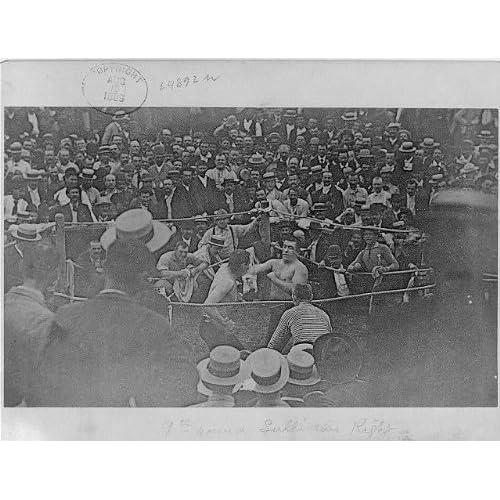 The last bare knuckle match for the lineal heavyweight world title, 1889
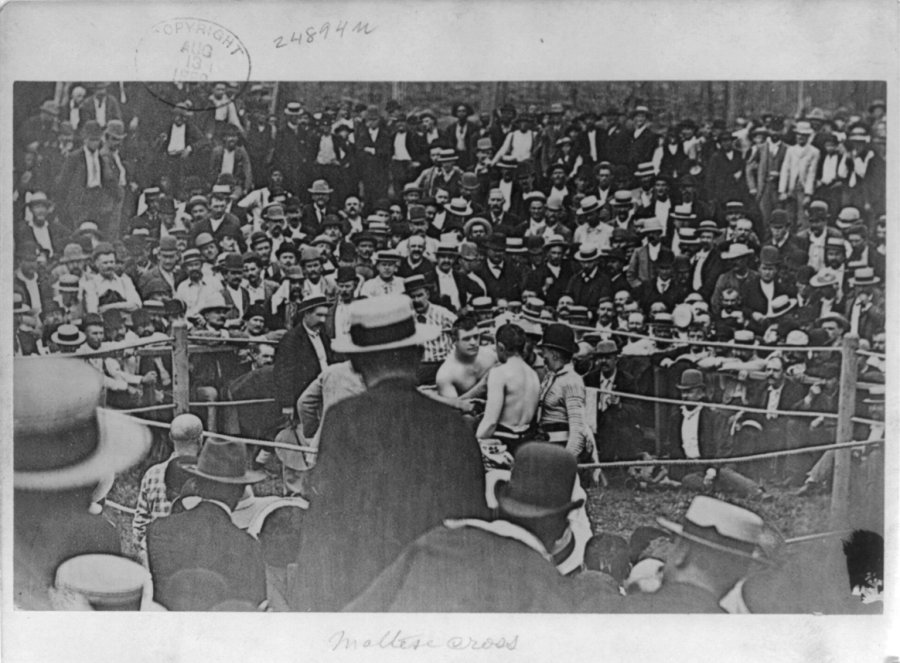 Another excellent shot of the last great bareknuckle lineal title match
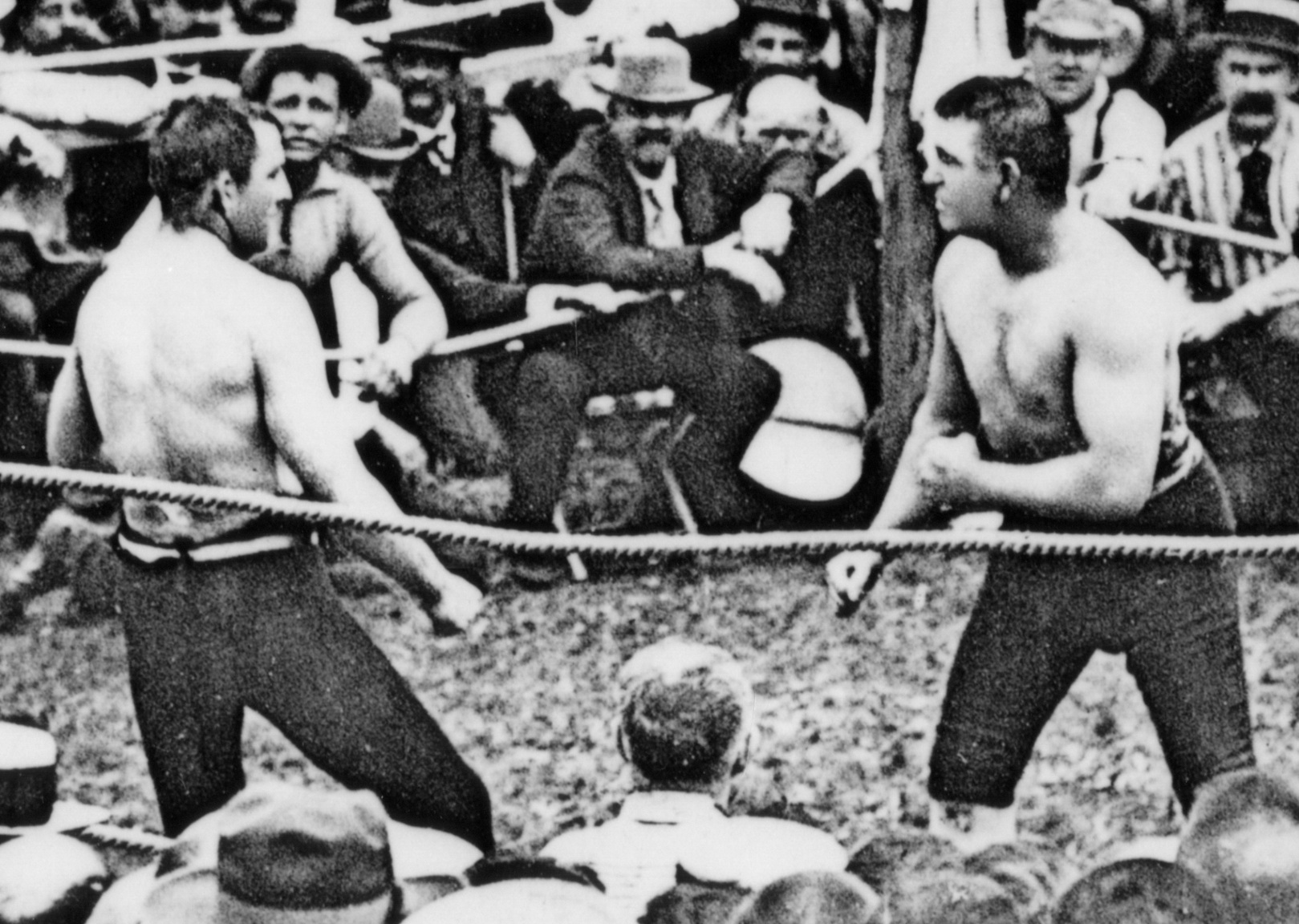 The most iconic shot of the contest; it must be noted that both men wore 'plasters' around their waist lines, and in some other photos you can see these plaster of paris moldings around their waists. These were worn to prevent low blows. It must also be doubly noted that Sullivan in all of his bare knuckle prize fights always shaved his hair down and did not wear a mustache because it gave opponents leverage in London Prize Ring rules, much like when Royce Gracie used hair pulling methods to gain leverage in the first few UFC events.
 Rare picture of four former champions: Burns, Corbett, Jeffries and Sullivan at Jeffries training camp for his unsuccessful title match comeback against Jack Johnson
 Another picture of Sullivan and Corbett around the time of the Jeffries fight
 John L. Sullivan with (presumably) the Chicago Cubs; baseball was Sullivan's first love having been a professional baseball player prior to becoming a prizefighter. While as champion he did play some exhibition baseball games and did rather well. It must be noted that future champion Rocky Marciano, who was alot like Sullivan, was also originally a baseball player.
 John L. Sullivan wasn't called the 'Boston Strongboy' for nothing; at the age of 17 he was capable of ligting kegs of nails, flour and beer overhead. As he grew older his prodigous strength was put to use in 'barrell lifting' and 'barrell throwing' contests. His physical strength was also noted in newspapers where he, on occasion, would stand a flipped over carriage back onto its wheels, or in this case (as depicted in an illustration in a Boston newspaper, lift a derailed trolley engine onto its tracks.
 John L. Sullivan when he fancied himself the 'Squire on Donlee-Ross'
 Sullivan, date of picture uncertain, but possibly following 1892; it is not hard to imagine by this picture alone, that Sullivan would lose to Corbett, but in retrospect what is all the more amazing is that he went 21 rounds with Corbett in such condition.
 Sullivan at Reno, Nevada the day of the Johnson/Jeffries fight hitting the speed bag; it must be noted that Sullivan perferred hitting the speed bag as opposted to punching bags when he was a fighter.
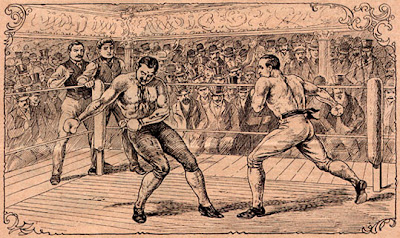 This modern day illustration of the Corbett/Sullivan fight is wrong on one account, there simply was no elevated ring in use that day, as both men fought on turf. Michael T. Isenberg, author of JOHN L. SULLIVAN AND HIS AMERICA states that turf was used. All illustrations showing an elevated ring must be dismissed. As are all illustrations depicting Sullivan fighting with his mustache.
Re: JOHN L. SULLIVAN, THE EARLY YEARS
Posted: 24 Mar 2013, 16:18
by HomicideHenry
SaadOffTheDeck wrote:I wouldn't rate him any higher, but I'm always up for learning new information about olden fighters,
Where would you rate him exactly?
Re: JOHN L. SULLIVAN, THE EARLY YEARS
Posted: 24 Mar 2013, 17:08
by SaadOffTheDeck
HomicideHenry wrote:SaadOffTheDeck wrote:I wouldn't rate him any higher, but I'm always up for learning new information about olden fighters,
Where would you rate him exactly?
I don't have exact ratings that deep. I imagine he'd be in my top 50 Heavyweights.
Re: JOHN L. SULLIVAN, THE EARLY YEARS
Posted: 24 Mar 2013, 17:37
by HomicideHenry
SaadOffTheDeck wrote:HomicideHenry wrote:SaadOffTheDeck wrote:I wouldn't rate him any higher, but I'm always up for learning new information about olden fighters,
Where would you rate him exactly?
I don't have exact ratings that deep. I imagine he'd be in my top 50 Heavyweights.
My thoughts are, the more I read and study on the man, the more amazed I am of his career and abilities. I became a boxing fan at the age of 15-16 years old and Sullivan was one of the first men I read about. Naively as I was then, I figured him to be the best heavyweight of all time. Then I researched other champions, and my list of the greats would change. For a time I had Jack Johnson as my number one, then Marciano, then Ali, etc. Now here I am almost thirty years old, and I am appreciating the early 20th century men again.
I don't know if I can rate Sullivan in the top ten, but I do believe I can in the top twenty or twenty five, and it is my feeling these days anyone in the top 20-30 in any weight division, could beat anyone on any given night in the top 20-30. Greatness is truly determined by a hair's breadth or less. As dominate as Louis was, he doesn't match Sullivan. As popular as Dempsey, Louis and Ali were, they too don't match Sullivan in that regard.
It then comes down to ability. Sullivan when he began was a wild swinging brawler who bulled his opponents. Because of this early start and depiction of him, alot of people hold him down in rankings. However, Rocky Marciano started the exact same way and was clumsy. He improved over time, as did Sullivan. Marciano is often in top ten lists, yet Sullivan is not. People say Sullivan fought in an era devoid of serious threats or old men. Marciano gets the same criticism, and still falls in the top ten. Both opinions that they two men fought in eras that were weak, are wrong.
By the time Sullivan was at the peak of his powers, he was an excellent feinter and counter puncher, and he had good speed in both his legs and hands. His power, unquestionably, couldn't be matched even when he fluctuated horribly in weight, and despite his conditioning the man seemed to have boundless amounts of energy and stamina. His chin, as proved in his match with Corbett when he was at his worst, and against the likes of Mitchell and Kilrain at his best, is very well the equal of any other heavyweight champion in history.
Whether he had a 'complete arsenal' as a fighter may be a question that may never be answered. I hope to one day re-read his great fights on a round by round basis, of what punches were thrown and landed to get an idea of what he was fully capable of. However, from what I have read and recollect he was a combination puncher, he didn't throw just one punch or just throw hooks. He worked the body, the head, etc. uppercuts, jabs, and hooks were apart of his arsenal. I know this because of certain fights (i.e, Slade) where he knocked the 200 plus pound New Zealander up and over the top rope from an uppercut.
It's a shame that Edison didn't develope the Kinetescope in time to have filmed Sullivan in action, though we would have just seen him in his later years and at the end, rather than from midway or the beginning to end. Corbett had that luxury. Sullivan didn't. I do think sometimes how he would have faired today, or in another era. I come to the same conclusions, almost every time, the more 'cushier' the generation the less likely Sullivan would have been great. Why? Because Sullivan was a product of the poor, the downtrodden, and life was nothing but hard. In an era like Dempsey's he would have excelled, in an era like Marciano's he would have excelled. Later than that, I don't think he could have. Then again, he showed natural instincts and talents from the get go, had he of been picked up by say a Charlie Goldman or Cus D'Amato, who knows what could have been.
Re: JOHN L. SULLIVAN, THE EARLY YEARS
Posted: 24 Mar 2013, 17:49
by SaadOffTheDeck
I rate on accomplishments, otherwise I'm just going by who I think would win and I'm wrong there on a weekly basis. He definitely isn't in my top 35 or so, I'd guess late 40's and I don't think he would fair well at all h2h with the top guys. I think Roy Jones would have toyed with him.
He still is an interesting read.
Re: JOHN L. SULLIVAN, THE EARLY YEARS
Posted: 24 Mar 2013, 18:06
by HomicideHenry
SaadOffTheDeck wrote:I rate on accomplishments, otherwise I'm just going by who I think would win and I'm wrong there on a weekly basis. He definitely isn't in my top 35 or so, I'd guess late 40's and I don't think he would fair well at all h2h with the top guys. I think Roy Jones would have toyed with him.
He still is an interesting read.
Accomplishments alone, Sullivan is up there with anyone else in the top ten though. That's the trouble with ranking him properly. He was the man who set not only the ground work, but he was the man who elevated this business from a undesirable 'profession' that was run by hoodlums and organised crime into the biggest sports venue in the world. Single handedly he did this. Besides George Washington, this man was America's first icon. That is probably the only thing that hurts Sullivan, because this man was every bit as big an American tall tale as Paul Bunyan, John Henry and Johnny Appleseed and it's hard to seperate the man from the myth because he did did most of it.
As for Jones, he faced the weakest link in the chain when he went to heavyweight. The Lewis-Post Lewis era was arguably the weakest in decades. I figure the washed up Tyson could have did Jones in had they of fought, or even the washed up Holyfield. Sullivan, may of been 'embarassed' for a while, but sooner or later Jones would have attempted to of traded, and it would have been his mistake. Ruiz was no power hitter, and he shot Jones across the ring with a body shot. Sullivan was more skilled and far more powerful than Ruiz and was far more ferocious. I don't see it ending well for Jones.
Re: JOHN L. SULLIVAN, THE EARLY YEARS
Posted: 24 Mar 2013, 18:26
by SaadOffTheDeck
Popularity isn't a criteria that I rate at all. By accomplishments I mean the actual fights.
Re: JOHN L. SULLIVAN, THE EARLY YEARS
Posted: 24 Mar 2013, 18:46
by Brutu
Are there any known sound recordings of "Jawnel"'s voice?
Re: JOHN L. SULLIVAN, THE EARLY YEARS
Posted: 24 Mar 2013, 18:49
by Brutu
From what I remember reading around 1894 Thomas Edison had originally asked John L. Sullivan even tho he was passed it of course ,to come to the studios at Orange N.J and be the subject of one of the earliest boxing film footage on the Kintescope,Corbett vs John L. Sullivan,but Sullivan wanted 25 thousand dollars for the appearence,so Edison studios got Courtney instead for the Corbett fight film..
Re: JOHN L. SULLIVAN, THE EARLY YEARS
Posted: 24 Mar 2013, 20:26
by HomicideHenry
Brutu wrote:Are there any known sound recordings of "Jawnel"'s voice?
I dont know. I do know for several years recreations of the Kilrain/Sullivan fight were held on the same location as the fight. There were several men throughout the years who portrayed John L. Sullivan and imitated his thick, Irish brogue.
Brutu wrote:From what I remember reading around 1894 Thomas Edison had originally asked John L. Sullivan even tho he was passed it of course ,to come to the studios at Orange N.J and be the subject of one of the earliest boxing film footage on the Kintescope,Corbett vs John L. Sullivan,but Sullivan wanted 25 thousand dollars for the appearence,so Edison studios got Courtney instead for the Corbett fight film..
This be true. I failed to mention it cus Sullivan did turn it down. If I am not mistaken, though it could be a stretch, that when Sullivan was offered to fight Corbett in a rematch in 1894, the Edison Film Company wanted involved, to be shot exclusively inside of Edison's studio.
Re: JOHN L. SULLIVAN, THE EARLY YEARS
Posted: 24 Mar 2013, 20:28
by HomicideHenry
SaadOffTheDeck wrote:Popularity isn't a criteria that I rate at all. By accomplishments I mean the actual fights.
Well, when I get started on ranking/evaluating the men he fought in his time, it will give a better idea of how to rank John L. Sullivan, but as it stands (off the top of my head) he defeated a few champions during his reign, and numerous former title challengers, as well as top contenders of his day. That is comparable to any of the all-time great champions.
Re: JOHN L. SULLIVAN, THE EARLY YEARS
Posted: 24 Mar 2013, 21:42
by HomicideHenry
EVALUATION OF THE OPPONENTS OF JOHN L. SULLIVAN'S CAREER
This mini-biography and evaulation of the late 19th century and early 20th century opponents of Sullivan will only further advance the board's knowledge of his career, and how to properly rank him both as a fighter and as a champion. Mind you, this break down is from 1877 - 1905, from Scannell to McCormick. Twelve years as champion, under both the London Prize Ring rules and Marquis of Queensbury rules. In fairness, alot of Sullivan's exhibitions and challenges were not listed or mentioned on this thread, but it is estimated that he kayoed 400-500 men during his career.
JEFF SCANNELL
This was Sullivan's "debut" to the sport of boxing, where he kayoed the once great title contender in less than two minutes. Considering Sullivan was a local strongman and baseball player, the fact he defeated a seasoned veteran like Scannell is something to be marveled at.
MIKE DONOVAN
Sullivan by this time had a local following, having beaten reputable talents John 'Cocky' Woods and John 'Patsy' Hogan. His first real test was against "Professor" Mike Donovan, a man who rose to the top of the boxing world as the American Middleweight Champion. He was considered one of the most scientific and fast boxers of the age. Sullivan would defeat Donovan twice in matches. Donovan was so great as a professional he often fought heavyweights and on two occasions held Jem Mace to a draw.
JOHN FLOOD
John Flood is the man who made Sullivan famous throughout the nation. While he wasn't considered the best heavyweight in all of Gotham, Flood was considered the roughest man in the Five Points and was a well known figure in the underworld for being an enforcer for Harry Hill, the preeminent sportsman of America. Flood was considered the favorite over Sullivan, but in less than eight minutes he was kayoed.
JOE GOSS
Less than two months after first facing Donovan, Sullivan easily defeated former world's champion Joe Goss. Goss was one of the most dominate champions under the LPR rules, having defeated the likes of Tom Allen, Jack Rooke, Posh Price, Bill Ryall, and Harry Crutchley. He was the middleweight champion of England, American Heavyweight champion, who would hold onto the title from 1876-1880.
JOHN DONALDSON
Donaldson was consider a master tactician and fast moving boxer in his time. However, after his losses to Sullivan (back to back) he became a well respected sparring partner for such men as James J. Corbett.
STEVE TAYLOR
Taylor was a very strong, big, tough brawler who didn't rely on ring science. He was, however, considered one of the top men on the east coast, that is until Sullivan ruined his reputation as a prospect. Taylor would go on to be Sullivan's chief sparring partner and they would tour together throughout the first two Grand Tour's of America as well as Europe and Australia.
JAMES DALTON
Considered in his time as the most dangerous man with fists in America, he had oustanding ring generalship and fast feet and hands, and quite a powerful punch. After losing to Sullivan, he did happen to defeat Paddy Ryan, and among others John Donaldson.
JOE COEBURN
Coeburn was another former champion, who fought Mike McCoole for the American Heavyweight title and won, and as a younger man fought to a draw for the American Middleweight title; he was also a fast mover who had a hard punch. He fought two draws with Jem Mace. This would be yet another easy win for Sullivan.
CHARLIE MITCHELL
As a middleweight he is still ranked among historians as one of the greatest to ever fought. As a heavyweight he was still an exceptional fighter. In his youth he picked up the Lightweight and Welterweight championships of England, and won the Middleweight title in 1882. As a heavyweight he defeated Tug Wilson, Alf Greenfield, and Mike Cleary before facing Sullivan where he would be kayoed in three rounds. Following the first loss to Sullivan, he would kayo Herbert Slade, draw Denver Ed Martin, draw Jake Kilrain, drop a decision to Dominick McCafferey, draws Sullivan in Chantilly, and defeat Jem Mace for the championship of England. He would also lose to Jim Corbett.
HERBERT SLADE
He was a natural all around athlete, having been a champion swimmer, vaulter, and wrestler. At 6'2" and 230 pounds, he was incredibly strong, and former champion Jem Mace did an excellent job making him a contender for the world title. However, his punches were of average power, and he was slow and somewhat clumsy. Sullivan easily dispatched him in three rounds, and later used him as a sparring partner for his Grand Tour's of America.
PADDY RYAN
Ryan was a man with incredible strength and carried a hard punch; he was a better wrestler than boxer, but he managed to win the American Heavyweight Championship over Joe Goss. Prior to this little is known of Ryan's career, other than he was a proclaimed champion of the 'Erie Canal' and he would lose his title in mere minutes to Sullivan. He would get two rematches with Sullivan, each with the same results; the final two being with gloves under MQ rules.
DOMINICK MCCAFFEREY
Considered a first class boxer who moved very quickly and was a master tactician. He defeated Charlie Mitchell, and as an old man dropped decisions to Peter Maher and Nonpariel Jack Dempsey. His loss to Sullivan marked the beginning of Sullivan's reign (officially) as gloved heavyweight champion, though Sullivan had previously been considered world champion of both rules for five years prior to this.
PATSY CARDIFF
Considered the biggest spoiler of his era, Cardiff was robbed in a draw against Mitchell, and had picked up the Pacific Northwest version of the Heavyweight crown, and had defeated Donaldson and Dalton; however in his later years he would lose by TKO 10 Peter Jackson and KO 16 George Godfrey. Sullivan drew Cardiff over six rounds, despite having a broken right arm.
JAKE KILRAIN
He was a man with boundless amounts of stamina, bouncy and carried a solid punch. In his career he would defeat George Godfrey, Joe Lannon, Jack Ashton, and several others. Richard Kyle Fox of the National Police Gazette made him 'Champion of The World' during Sullivan's absence due to illness, and would be stopped in 75 rounds by John L. Sullivan in what would be the last bare knuckle match for a lineal championship.
Re: JOHN L. SULLIVAN, THE EARLY YEARS
Posted: 24 Mar 2013, 22:10
by SaadOffTheDeck
HomicideHenry wrote:SaadOffTheDeck wrote:Popularity isn't a criteria that I rate at all. By accomplishments I mean the actual fights.
Well, when I get started on ranking/evaluating the men he fought in his time, it will give a better idea of how to rank John L. Sullivan, but as it stands (off the top of my head) he defeated a few champions during his reign, and numerous former title challengers, as well as top contenders of his day. That is comparable to any of the all-time great champions.

Re: JOHN L. SULLIVAN, THE EARLY YEARS
Posted: 25 Mar 2013, 07:25
by The Great John L
SaadOffTheDeck wrote:HomicideHenry wrote:SaadOffTheDeck wrote:Popularity isn't a criteria that I rate at all. By accomplishments I mean the actual fights.
Well, when I get started on ranking/evaluating the men he fought in his time, it will give a better idea of how to rank John L. Sullivan, but as it stands (off the top of my head) he defeated a few champions during his reign, and numerous former title challengers, as well as top contenders of his day. That is comparable to any of the all-time great champions.
Another well thought out Saad post, based on his extensive knowledge of the topic.
If you don't agree with Henry's brief analysis of Sullivans opponents, perhaps you would like to post your own detailed analysis based on your extensive knowledge of the era.