Basilio's Two Welterweight Title Fights with Tony DeMarco

Locked
granberry
Heavyweight
Heavyweight
Posts: 3742
Joined: 13 Jul 2006, 11:30

Basilio's Two Welterweight Title Fights with Tony DeMarco

Post by granberry »

The two 1955 welterweight title fights between Carmen Baslio and Tony DeMarco

were wars famous for the almost identical time of the two stoppages in Basilio's favor.


Image
Tony Demarco, the great left hooker, and Carmen Basilio

Image
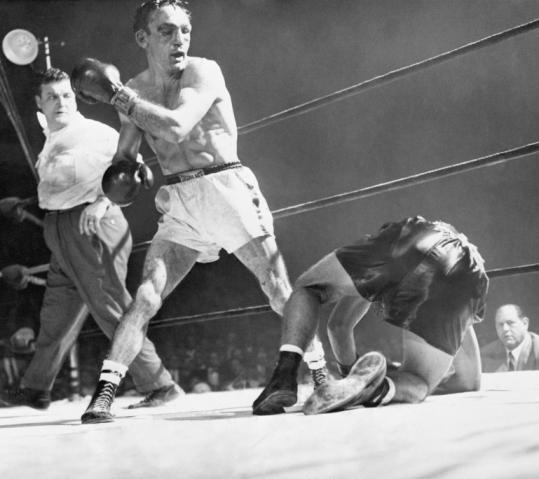
Tony Demarco vs. Carmen Basilio---December, 1955

Image
Tony DeMarco goes to the canvas during a fight with Carmen Basilio at the Boston Garden in December 1955. (Bettmann/Corbis)

Their first bout, where Basilio won DeMarco's title, ended at one minute, 52 seconds of the 12th round.

The second went exactly two seconds longer, ending at one minute, 54 seconds of the 12th round.


At the time of the stoppage in Basilio's favor in their second fight, the three scorers had Basilio well behind on points.

The referee had the fight 107-104 for DeMarco at that point, while the two judges had the fight 104-97 and 106-103 for DeMarco.


Image
Tony DeMarco in later years.
granberry
Heavyweight
Heavyweight
Posts: 3742
Joined: 13 Jul 2006, 11:30

Re: Basilio's Two Welterweight Title Fights with Tony DeMarco

Post by granberry »

Boxing, Boston and Tony DeMarco

By Robert Ecksel
http://www.thesweetscience.com/boxing-a ... y-demarco/

I was at the Mohegan Sun covering the fights not long ago and it was as festive as only live boxing can be, yet the occasion got a special charge when a special award was given to a special fighter named Tony DeMarco. The former champ was wearing a tux, looked like a million bucks, and appeared sturdy, sane and dynamic.

Tony DeMarco was born January 14, 1932 in Boston and grew up in the North End. DeMarco told me “the North End is the Little Italy of Boston, at that time particularly.” Tony’s father Vincent and mother Jiacomina (Jacqueline) came from Sicily. I wondered if DeMarco had any brothers and sisters.

“I do. Rather I should say I did. I had two brothers, one before I was born, just before I was born, and I took his name. He passed on when my mother was pregnant with me. In viewing the body at the home in those days, my dad in a quirky way believed in reincarnation, hoping it would be another boy to take over the name of the boy at the wake. He was also named Leonardo,” Tony DeMarco said. “That’s my name. But they called him Nardo. And sure enough I became the Nardo they hoped to have.”

Tony’s real first name is Nardo. DeMarco’s real last name was Liotta. I asked the former Leonardo Liotta, aka Tony DeMarco, how he and boxing first met.

“I kind of owe my career to the Boys Clubs,” he said, “the Parks Department. That’s how I got started. You go to the Boys Club and you pick up a pair of gloves and you’re not serious about it but you slap each other around and you’re only eleven and then all of the sudden you start getting serious about it - and that’s how it happened with me.”

Was it because he liked boxing or because he was skilled at the sport?

“Both,” DeMarco said. “I took a liking to it - and in the beginning it was such fun - and I started to pick up the techniques out of it and I stayed with it. I was winning championship after championship as a young boy in different tournaments. And of course you always want to become the champion. I was a champion a million times - in my dreams - and finally it came to be.”

Like most of the greats, Nardo Liotta started when he was young.

“Maybe ten, maybe eleven. When I was 95 pounds, 95 pounds,” DeMarco repeated. “I entered the tournaments at the borough’s Newsboy Foundation, which was a Boys Club downtown near the courthouse. We got started over there. I was 95 pounds and I won the Greater Boston Tournament, of all the Boys Clubs in Boston. It was a three-day tournament where we boxed each day - a process of elimination - and I knocked out three kids in three days, which, as you know, is quite difficult to do where you’re 95 pounds.”

I wanted to return to the subject of the champ’s name and how he became Tony DeMarco.

“When I was young, I wasn’t able to receive a boxing license unless I was eighteen. Consequently, I had to borrow someone’s name, and I borrowed Tony DeMarco’s name,” Tony DeMarco said. “He was 18 years old. That’s how I became Tony DeMarco . . . and I stuck with it!”

DeMarco had his first professional fight when he was sixteen years old. It was October 21, 1948. He kayoed Mestor Jones in one round.

“I don’t think it was the right thing to do,” DeMarco said about turning pro so young. “Not at the time, but now. I realize it wasn’t the right thing to do because I still could have used the experience. I would recommend youngsters stay in the amateurs and get a lot of experience. I had many fights in the Parks Department and many fights in the Boys Club as a youngster, but then I turned amateur and only had maybe 12 fights, which is very little experience. But the people I was with were not exactly the most sensible individuals and they thought, really, sincerely, that I would do good in the professional ranks. And I did. But I think I would have been better off to have waited a couple more years. But, as it stood, we fought 4-rounders, 6-rounders, and eventually the 8-rounders, and Tony DeMarco was the focus. I had lots of ups and downs - I had a lot of downs - going nowhere fast - because I think I had bad judgment in my management. They weren’t bad people, but I think they left a lot to be desired when it comes to management.”

Bad management in boxing is one of the things that plague the sport today. But good fortune was about to smile on DeMarco.

“Then a change came with my management and I ended up with someone who knew more about it. I start to have more meaningful fights and I became a main eventer in no time and I continued on and I became boxing champ of the world. I’ve had 71 fights and knocked out 33 guys of my 58 victories. And that’s where I am.”

DeMarco won the welterweight title on April 1, 1955 with a fourteenth round TKO over Johnny Saxton.

“Johnny Saxton was a good fighter, a colorful fighter,” remembered DeMarco. “He beat Kid Gavilan and he beat Carmen Basilio - who beat me by the way - and he fought other champions. He fought Gil Turner. Joey Giardello he fought too, the middleweight champion. He beat Virgil Akins, who also beat me. So Saxton was no stumblebum.”

Because Tony DeMarco is from Boston, a city as charming as it is tough, the former champ, once the toast of New England, fought in the old Boston Garden.

DeMarco smiled and said “I had 31 fights there. In fact, 21 of them were main events. I fought in Mechanics Hall. And then there was the Boston Arena. I fought there. I fought twice in Fenway Park. I also fought in Braves Field on the card of Rocky Marciano. I was still just getting started.”

I asked DeMarco to describe his skills for those who missed him in action.

“I’m a puncher, number one,” he said. “I’m a puncher. There are times when I fight on instinct. Sometimes I’m able to counterpunch, and sometimes I’m able to box, but mainly I would consider myself a slugger. But I did have the skills enough to box some boxers occasionally - like Vince Martinez, like Kid Gavilan - but the overall picture of me as a fighter, I would say I was a puncher.”

The former welterweight champ continued: “I had kind of a walk-in style. Jake LaMotta was one of my favorite fighters growing up, and I related to him. I looked up to him as a fighter. He’s quite a guy.”

DeMarco grew tight with some other legendary fighters.

“I was very friendly with Marciano. He’s from Brockton and I’m from Boston. We hit the same places several times. In fact, he trained at the Catskill Mountains and once or twice we ran into each other. He was training at Grossinger’s Country Club and I was four miles away from him at Kutsher’s Country Club, and we would visit each other, with our fathers no less, and they had a lot in common. They were both shoemakers. They were both like five feet two,” DeMarco recalls, “and they were very compatible.”

The fathers were compatible. So were the mothers.

“My mother went into a beauty shop and the next thing you know there’s a woman next to her and the conversation came where they were speaking about their sons. My mother says, in Italian, ‘Il mio figlio e campione del mondo.’ Which is, ‘My son is champion of the world.’ And the woman next to my mother says ‘Mio figlio e campione del mondo.’ And my mother says ‘What’s your name? Como se chiama tu?’ ‘Io sono Marchegiano.’ And Marchegiano is Marciano, the original name. ‘Io sono DeMarco. My son is Tony DeMarco.’ And of course they had a great celebration in Lee’s Beauty Shop in Hanover Street.
My mother and his mother got to be friendly, and his father and my father got to be friendly, so we all knew each other.”

Was there anyone else he remembered from those days?

“I met Carbo,” DeMarco said. “Those guys were wiseguys and they loved to own a fighter. It was like owning a racehorse.”

All in all, it sounds like Tony DeMarco feels good about the game.

“Boxing’s been good to me. I’ve become well known. I’m still reaping my benefits from boxing because of my reputation. I’m a very fortunate individual. I didn’t make a lot of money, unfortunately, unlike today where you fight today and you make a million. In my day we fought, we were lucky to make a couple thousand. So it was a different status then. But boxing has been good to me. I’ve been faithful to it, and I was determined to be and did and I became,” DeMarco said. “But I also had lucky streaks too.”
granberry
Heavyweight
Heavyweight
Posts: 3742
Joined: 13 Jul 2006, 11:30

Re: Basilio's Two Welterweight Title Fights with Tony DeMarco

Post by granberry »

Briefly a champion, forever a legend

By Bud Collins | December 11, 2005

http://www.boston.com/sports/other_spor ... _a_legend/

It was a shipwrecker of a punch.

None of us stuffed like galley slaves inside the since-vanished cavern called Boston Garden 50 years ago would ever forget it. The left fist of Tony DeMarco, within a 6-ounce leather glove, seemed to gain irresistible momentum, traveling several blocks from Fleet Street -- as Tony had -- toward the craggy chin of Carmen Basilio.

While paid attendance for that world welterweight championship fight was announced as 9,170, people who knew the leaky building well swore that at least 20,000 were in on it. It felt and sounded as though the populace of DeMarco's motherland, the North End, had relocated to the Garden.

Everybody saw that punch coming, a brother of the left hooks that had shattered Johnny Saxton eight months earlier and transferred the championship from his shoulders to Tony's. Everybody -- except Basilio.

When that punch detonated against Basilio's jaw in the seventh round, the multitude rose screaming, releasing a noise that could have outdone Niagara Falls up close. For an instant the place quaked, seemed to rearrange its foundation and wobble. Truly, Basilio, the 28-year-old ex-Marine, quaked and wobbled, too. His legs were jelly, and an old jazz tune, ''It Must Be Jelly 'Cause Jam Don't Shake Like That," skittered through my mind.

''Tony staggered me," Basilio, 78, is saying over the phone from his Rochester, N.Y., home. ''It was a big punch -- very big. Everybody wanted me out. That's OK. He was the hometown boy, and I'd taken the title from him a few months before in June. They were yelling for my blood."

They and DeMarco got some, too, from a gash above Basilio's right eye. Not enough. Within a few seconds that might have been playing out in slow motion, everything turned around.

DeMarco and his faithful thought he was the champion again. But the Basilio ship wouldn't wreck, refused to sink. As his legs buckled, Carmen clung to whatever part of Tony he could. He had to fall, didn't he?

No. Raised on a Canastota, N.Y., farm picking onions, Carmen was somehow rubbing them in the crowd's face, making the loyalists weep. As hope appeared to cloud in his eyes, he opened one of them to wink at a cornerman, Angelo Dundee.

Dundee, later renowned as Muhammad Ali's trainer, knew then his man would survive the barrage and win. Few saw that ocular defiance, though the wink was clear to some of us in press row. Pulling inwardly for DeMarco, I thought -- amazed, disappointed -- that his chance was slipping away.

DeMarco, 23, was at a pinnacle in that seventh round. Though he kept banging resolutely -- ''we both threw a lot of punches that could have been knockouts," he says -- Basilio began to out-strong-arm him. Toppled twice in the 10th, Tony suffered a TKO in the 12th, as he had in Syracuse.

Sam Silverman, promoter of the fight, called it ''a war. Tony gave it everything he had, but . . . but Basilio is a double-tough life-taker."

''It was one of my toughest fights," says Basilio.

At 5 feet 6 inches, 147 pounds (dimensions similar to DeMarco's), he came at foes as a malevolent troll, ever boring in whatever the punishment and damage. He would go on to lose the welterweight crown to Saxton, repossess it from Saxton, then add poundage to win the middleweight title at 153 pounds over Sugar Ray Robinson in 1957. ''Boston was great for me," he says, ''but it was the end, too. My last fight." Worn out by then, 1961, he lost a 15-round bid for another middleweight title, beaten in the same Garden ring by the champ, Paul Pender, the ex-Brookline fireman.

Few, if any, Boston athletes have been more an original of The Bean than DeMarco. Born in the Garden's neighborhood at 13 Fleet Street, Jan. 14, 1932, he won his world championship within short walking distance. Today, a genial host, he lives comfortably, very much intact, with Dorothy McGarry and two cats in an apartment one block from where the Garden stood. Although shabby and weary, that brick funhouse was the repository -- mausoleum? -- of the town's proudest indoor sporting deeds. Celtics and Bruins championships. Fights by men such as Lou Brouillard, DeMarco (31 of them) and Pender, Tommy Collins, and Marvin Hagler. The come-lately Garden is yet barren.

''I'm not really Tony DeMarco," laughs the man whose golden anniversary year of a brilliant triumph and gallant defeats this is. ''Yeah, I was 16, not old enough to get a boxing license. You had to be 18. I was born Leonardo Liotta -- my oldest friends still call me 'Nardo.' One of those friends was Tony DeMarco, who was 18. So I borrow his birth certificate. That worked. My first fight was at the Garden, a 4-rounder" -- a meteoric first-round knockout of somebody named Meteor Jones.

''But then the genuine Tony DeMarco decided to be a boxer. He couldn't be DeMarco because I was . . . so he borrows the birth certificate of another neighborhood guy, Marco Tremini. I'm DeMarco. DeMarco is Tremini, and, luckily, Tremini doesn't want to fight."

''And it sounds like 'Who's on first?' " interjects McGarry. Whether DeMarco or Liotta, she knows she's with the right guy, the Fistic Flower of Fleet Street.

Vincenzo Liotta, an immigrant from Sicily to Boston, used his hands as a shoemaker in his shop on Copley Square. He thought it would be a good trade for his son, disapproving of young Nardo's decision to use his fists as haymakers.

Those concussive fists, principally the rocketing left hook, made Tony probably the most appealing, even adored, of Boston-bred fighters. He was a big puncher -- 33 knockouts in 71 starts -- and heavy hitters sell tickets. Moreover, he bore a short-dark-and-harmful resemblance to the rugged movie star John Garfield in the terrific boxing movie, ''Body and Soul."

''I'd say, for local popularity, it was between Tony and Tommy Collins," says Freddy Valenti, whose father, Rip Valenti, managed both fighters. ''But Tommy never won a title."

Collins is best remembered for his gameness at the Garden in vainly trying to wrest the lightweight championship from Jimmy Carter in 1953. Carter flattened him a few times before the fight was stopped in the fourth round. Years afterward, Tommy had fun mocking himself. He would fall on a barroom floor, saying to onlookers, ''Now do you recognize me?"

DeMarco says, ''I wasn't really going anywhere my first five years, until Rip Valenti took over and brought in Sammy Fuller as my trainer. Rip got me a TV fight [1953] and I beat [former lightweight champ] Paddy DeMarco."

He was on his way. A streak of 15 victories (10 KOs) ran through 1953-54. A draw with the lightweight king, Carter, early in 1955 earned him the April 1 welterweight title shot at Philadelphian Saxton. Saxton, a 5-to-2 favorite, was knocked through the ropes in the 14th round. He rose, dazed, and Tony flooded him with punches -- ''they told me it was 24 straight I hit him" -- bringing about a TKO.

The title -- ''a dream" -- was his, and the town had its first welterweight champ since Brouillard in 1931. Partying in the North End lasted four days, characterized by the debonair John Ahern in the Globe as a Mardi Gras worthy of New Orleans.

His reign was brief: 69 days, before challenger Basilio knocked him out at Syracuse in the 12th round.

''If it had been only one day I would have been happy," Tony smiles. ''That was my dream -- to be a world champion. Looking back, I don't think I gave myself enough rest."

Three title bouts with dangerous adversaries, 38 rounds inside of eight months, was a huge order.

''But I almost got the title back." His brown eyes gleam. He thinks about the mammoth hook that Basilio absorbed at the Garden. ''He should have gone down," Tony says.

Nevertheless, he doesn't mind putting the 50-year-old tape on his TV screen so that once more I can see the case of staggers that he gave Basilio.

Basilio agrees that he probably should have tumbled, but, he chuckles, ''I knew I'd have to knock Tony out to win. You know how things were in Boston. But here's what I always say -- keep your hands up high and your ass off the floor." So he did until Gene Fullmer knocked out his fading self in 1959 and 1960.

Fading, too, was DeMarco, knocked out by Virgil Akins in 1957 and 1958, and by Denny Moyer in 1960 in the Garden ring where it all began for him 12 years before.

There are worse things than being knocked unconscious, and DeMarco knows that well. He lost his two children young, a son in a hit-and-run accident on his 10th birthday, a daughter to cancer. ''For a while I said, 'Why me?' But then, 'Why not me?' Everybody has bad things happen to them."

Thicker of torso and nose, soft-spoken, Tony looks good, as though he could go a couple of rounds, and is working on an autobiography. ''That year, '55, was my best, but I didn't make that much money. Maybe $170,000. But half goes to the manager, then half of what's left to the government. But they can never take away the title."

As brutal as his fights with Basilio were, the two forged a spiritual bond. Antagonists sometimes do that. They gladly collide at functions, and still poke each other -- verbally.

He was away from Boston for a while, operating a successful nightclub in Phoenix, but the North End is where he belongs. Gone is the building of his birth and youth on Fleet Street, but somebody should put up a plaque nearby to let folks know that a world champion sprang forth there: the Fistic Flower of Fleet Street.
granberry
Heavyweight
Heavyweight
Posts: 3742
Joined: 13 Jul 2006, 11:30

Re: Basilio's Two Welterweight Title Fights with Tony DeMarco

Post by granberry »

Image
Carmen Basilio, 1955
elmersalsa
Heavyweight
Heavyweight
Posts: 15688
Joined: 02 Feb 2003, 03:50

Re: Basilio's Two Welterweight Title Fights with Tony DeMarco

Post by elmersalsa »

I saw fight #2 but not fight #1...It must be a war that fight #1, granberry.
granberry
Heavyweight
Heavyweight
Posts: 3742
Joined: 13 Jul 2006, 11:30

Re: Basilio's Two Welterweight Title Fights with Tony DeMarco

Post by granberry »

THE MIKE WALLACE INTERVIEW
Guest: Carmen Basilio
10/26/57


http://www.hrc.utexas.edu/multimedia/vi ... men_t.html

WALLACE: Good evening. What you are about to witness is an unrehearsed, uncensored interview. My name is Mike Wallace, the cigarette is Philip Morris.

(OPENING CREDITS)

WALLACE: Tonight we go after the story of the middle-weight champion of the world, Carmen Basilio, who won his crown only last month in a savage fight with Sugar Ray Robinson. If you are curious to know whether Carmen Basilio really likes to fight, if you want to hear his answer to reports that he dislikes Ray Robinson as a man, and if you'd liked to get Carmen Basilio's reaction to the charge that boxing should be outlawed because of it's brutality, we'll go after those stories in just a moment.

My guest's opinions are not necessarily mine, the station's or my sponsor's, Philip Morris Incorporated; but whether you agree or disagree, we feel that none will deny the right of these views to be broadcast.

(COMMERCIAL)

WALLACE: And now to our story. Carmen Basilio was born thirty years ago, the son of a poor onion farmer in upstate New York. In 1948 he became a professional fighter, a career that was climaxed in Yankee Stadium on September 23rd, when he took the middle-weight crown away from the brilliant Sugar Ray Robinson.

Carmen, first of all let me ask you this: we interviewed Tony Galento, a few months -- seven or eight months back --. Tony Galento, ... Tony Galento told us he enjoyed fighting. He admitted that he got a kind of a satisfaction out of hitting and hurting a man. Now, what I'd like to find out from you, frankly, is do you like to fight, do you like to get into a ring and try to beat another man unconscious?

BASILIO: Well, I don't know if I enjoy beating a man into unconsciousness, but, ... I do enjoy winning. I like to fight. The boxing world has given me everything that I've got. I can't say that I dislike boxing.

WALLACE: Now, when you... when you get into a ring, er... you know that you're gonna have to hit a fellow and hurt him, possibly knock him unconscious. I got from Galento the feeling that he rather enjoyed the process; he enjoyed the fighting, not just the winning, but the fighting. What about it with you?

BASILIO: Well, I never did anything that I don't like to do. So, I come to the conclusion that I like to box, I like to fight. I don't know if, to say that, there's any person in the world that likes to get hurt. Maybe Galento meant that he likes to win; everybody likes to win by a knockout, which means they shorten the route that they have to go.

WALLACE: Sure. Your wife, Kay, has been quoted... she was quoted in the Saturday Evening Post, December 10th, two years ago, saying, "Every time he's booked to fight he's overjoyed. He tells people he's only in boxing for the money, but" she says, "I know it's really in his heart."

BASILIO: Well, I... I'm always happy when I sign for a fight. I know that I'm going to go into training, and I like to train. It means that I am going to get away from all of the banquet circuit, and I get a little bit of peace when I am in training.

WALLACE: You get a little bit of peace?

BASILIO: Yes. I am away from everybody, the phone doesn't ring, and ... I can relax. Actually I have to go into training to get some rest.

WALLACE: Uh-hum... Have you ever been afraid before going into a fight or in the ring?

BASILIO: I can't say that I've been really afraid; I will say that I have always held respect for my opponent, and I've gone into the ring a little bit leery. I always thought that if I went into the ring overconfident that I would get licked because I wasn't having respect for my opponent's ability.

WALLACE: Uh-huh... but the fear of getting hit, for instance, sport writers wrote the second time that Max Schmeling fought Joe Louis, and the time that Baer, Max Baer went into the ring against Louis, that there was real fear, that you could feel that fear in both those men. That you've never felt?

BASILIO: No, I've never felt that fear. I take it for granted that when I do go in the ring with any opponent that I am going to get hit, and some of those punches are going to hurt.

WALLACE: Uh-huh.

BASILIO: Right...

WALLACE: Tell me this: have you ever felt at all, Carmen, that it's the least bit degrading to earn a living by trying to beat another man unconscious or by getting beaten up yourself?

BASILIO: No, I don't think so. I know there's a lot of people that look upon the boxing game with dislike. But, I have met a lot of honorable men in the boxing game, and ... I don't feel as though that I am dishonorable.

WALLACE: Let's see, if we can more specifically get into the mind of a prize fighter, the way it works during the fight itself. I quote to you from Rocky Graziano's autobiography “Somebody Up There Likes Me”; here's how Rocky describes his feeling during a fight: he says, "I felt my blood get hot and my breath come faster, and this funny feeling rise up in my throat that I always got when a guy stood helpless there, and I begun to kill him off."

And then in another place he writes, "The bell rings and my blood boils and there's fire in my guts that got to bust out through my fists. He hits me in the ribs, on the head. I don't feel a thing. I feel like roaring like a bull and ramming my fist down his throat" Now, I saw films a couple of days ago of your fight against Robinson, and there was as much action, I guess, in that fight as in any fight I've ever seen. Is that the way you feel, is that the way you felt against Robinson?

BASILIO: Well, ... I... I didn't feel that way; but I felt that I was in a battle, that I had to win, and I wanted to win, and that, if he was hitting me, I had to get back and hit him twice to make up for the one time that he hit me.

WALLACE: Uh-hum... The New York Times, the day after the fight, said, "The eleventh round was the single most thrilling session of the night, Basilio shook Robinson with the left to the head, then they closed and whaled at each other in a savage exchange." You've been asked this before; I don't know that you can recollect the way that you felt. Can you tell us how you felt? Do you remember the eleventh round, do you remember what went on, or is it all kind of a blur of just getting in there and...?

BASILIO: Everything happened so fast that you just don't remember a lot of things. I know that I threw a lot of punches and he threw a lot of punches, and we... I could hear the crowd roaring, but, by that we know that it was a great round; to go back and try to pin¬-point things, that's kind of tough.

WALLACE: And, in the fourteenth round, when he buckled your knees with a right to the body, do you remember that blow? Do you, do you...?

BASILIO: Yes, I do.

WALLACE: You do!

BASILIO: He hit me, and he buckled me, but ... more than buckling me, I... it looked like I was being buckled more than I actually was because I went down and doubled up and started bobbing and weaving to avoid any more of his punches.

WALLACE: Before that fight with Sugar Ray, boxing writer Jessie Abramson, of the New York Herald Tribune, reported that you, quote, "...respect Robinson as a fighter but dislike him as a person" end quote. Why do you dislike Ray Robinson as a person?

BASILIO: Well, I think that was misinterpreted by a number of sportswriters. I don't dislike Ray Robinson as a person; I don't know whether I dislike anybody. But I'll say that I dislike a lot of his tactics, and the... business of the signing of the contracts for the fight.

WALLACE: Well, in a sense, didn't he have a perfect right to... After all, we talked to Ray about it and he said, "A fellow has very few pay-days during his lifetime," and he said "Face it, I was... I was the fellow who was really making the gate, er... don't I have a right, in as much as I'm giving away, not giving away... but signing away my services to get all that they are worth, to me."

BASILIO: He had the attitude that he was going in the Yankee Stadium alone, that he was drawing the crowd; it takes two to make a fight, especially a battle like the one that was seen in Yankee Stadium.

WALLACE: As he found out.

BASILIO: And, I felt that I was justified in getting as much possible as I could. Of course, it's his business to get as much as he can.

WALLACE: Up until now, Sugar Ray is... has not agreed to a rematch. Do you think he's ducking you?

BASILIO: No, I doubt that. We have a ninety-day return match contract with the IBC, and we haven't even discussed it yet.

WALLACE: Uh-huh... You are perfectly willing to fight him again?

BASILIO: Oh yes!

WALLACE: And you hope...?

BASILIO: I hope that er... he is willing to meet me in a return match.

WALLACE: Or if for no better reason than it, probably would be one of the biggest gates in history.

BASILIO: Probably one of the biggest gates in history, and probably my biggest pay-day in my fight career.

WALLACE: ... Of Course I gather that Robinson doesn't need the money. I understand Ray Robinson hasn't yet picked up his check of almost half a million dollars at the IBC for the fight that he had with you back in September. Do you know why?

BASILIO: Well, I gather that he's having a little trouble with the Internal Revenue.

WALLACE: And, so for that reason he doesn't want to pick it up because they'll pick it up from him right away, and he hopes he can work things out. Is that what you think?

BASILIO: Well, I don't know anything about that. I haven't been informed and ... of any of that.

WALLACE: Recently, when we interviewed Ray Robinson for our newspaper column... for our newspaper column, he told us that in the past he had been, quote, "...offered quite a few large sums of money," end quote, to take a dive, through a fight. Has that ever happened to you?

BASILIO: No, it hasn't. And if it did, I would have the man arrested that ever approached me on anything like that.

WALLACE: To your knowledge, does it happen frequently to fighters?

BASILIO: I have only read about it, such as this case with Ray Robinson, and I saw the movie, or, er... read about the trouble Rocky Grazziano had a few years ago. But that's the only thing that I know about.

WALLACE: That's a fact.

BASILIO: Yes.

WALLACE: You don't, ... in your talks with other fighters and managers and so forth...?

BASILIO: Never heard of it.

WALLACE: How does Ray rate with other men you've fought, Carmen?

BASILIO: He's a great fighter. Probably the hardest puncher that I ever fought, and undoubtedly gave me the toughest fight that I ever had.

WALLACE: ... Do you feel, in a sense, now that you've got his number, that you're... you're perfectly confident that next time around it's going to be as easy or...?

BASILIO: No. ... It wasn't easy...

WALLACE: (CHUCKLES)

BASILIO: ...and it won't be easy a second time. So, I'll always have to have respect for Ray Robinson as a fighter.

WALLACE: Of course we were talking about taxes a little while ago, fighters, and all athletes for that matter, pay taxes under the same percentage system as any other wage earner, but the athlete frequently has only about ten years of top-earning power and the champion may have considerably less than that. Do you think that it's unfair that the government doesn't give people like yourself a special tax break?

BASILIO: Well, it took me five years to get in to make pretty good money, and then your years are cut short, and, in the athletic field, I think that maybe someday the government will work out a deal where the... have the athletes big earnings spread over a period of years.

WALLACE: ... I quote from an article about you in the Saturday Evening Post. A couple of years ago, a sportswriter asked you, "When you have an opponent bleeding and reeling, don't you ever feel sorry for him?" And your answer was, "Sorry, are you kidding? Fighters aren't sorry, you have to cut the other guy down before he cuts you down. That's all."

Now, Carmen, suppose you cut a man down so hard that you killed him. That's happened before in boxing. Don't you ever worry about that?

BASILIO: Well, it's happened and I always pray before a fight that the fight is a good fight, and that both fighters come out uninjured.

WALLACE: Is that what you... I've seen on television that you frequently go down on your knees either before or after a fight, is that what you are praying about? Or is that just part of what you are praying about?

BASILIO: Well, I pray that, ... I am protected and the other fighter is protected from permanent injury, that it's a good fight, and I always ask for that extra power to win.

WALLACE: And you see nothing the least bit incongruous about asking God to help you beat up another man. A man who is probably just as good, just as religious a person, as you are. Do you think that you can enlist God's help in that way?

BASILIO: It's my belief that if you ask God for help, He'll give it to you. That's the way I believe in God.

WALLACE: Carmen, what do you think of proposals that boxing should be banned because of brutality. For instance, back in 1951, in Pageant Magazine, Jimmy Cannon, the sportswriter, wrote, "It should be declared unlawful; it is the garbage pile of sports; it damages more young men than it helps." Dan Parker the boxing writer of the New York Daily Mirror calls boxing, 'legalized murder.' Now, these are fellows who are sportswriters and have spent a good deal of time watching and thinking about boxing, and that's their opinion.

BASILIO: That's their opinion. Did they ever take an census to see how many young high school boys are killed in high school football every year? And how about these hockey players, that's a rough sport. I'd rather get hit by a post than get belted with a hockey stick.

WALLACE: Well, of course, in football, let's say, or in hockey the object of the game is to get the puck or the ball over the other... into the other opponent's goal, over the goal line. Whereas in boxing, the object of the game is to disable, if possible really, actually not to disable, but to beat up... to beat down your opponent. In a sense, it is 'legalized murder' because a good many men have been killed that way, not a good many men, but er...

BASILIO: If that's the case, then football is 'legalized murder' too, or any other sport that is rough like that... that they get killed, has got to be 'legalized murder.' Er... naturally they're trying for a touchdown but on the way through they are hitting their men as hard... their opponents as hard as they can.

How many men get knocked out two or three times during one single game. That doesn't happen in a fight, if he gets knocked out once, the fight's over with, and he is suspended for er... sixty days.

WALLACE: Until they are sure that he's not...?

BASILIO: That he's recuperated from any possible injuries.

WALLACE: Of course studies have been made on this issue, Carmen. According to Nat Fleischer's Ring Record Book, 142 amateur and professional fighters have been killed since 1945. A hundred forty-two Statistics show that boxing is fifty-nine times more deadly than college football. Now isn't this damning enough to have boxing banned?

BASILIO: I doubt it. I don't think so. I don't think we have that many deaths now; since that time, they've had a lot of new rules for protection of fighters, to prevent injuries. Er... a brain examination every so many months, especially if they're knocked out, they have to have this brain examination to pass this and then they are able to fight.

WALLACE: Carmen, somehow you don't seem to follow the pattern of the poor boy, who gets rich from fighting. You don't have the hangers-on, the entourage of jesters and so-called assistants that champions like... well like Ray Robinson have had. You live in a six-room house rather than a luxurious mansion; why the difference in pattern between you and some other champions?

BASILIO: Well, every personality is different. I was brought up in a small town, with small things, and I stick to small things, that's what I like.

WALLACE: We hear some about gangsters, Carmen, the underworld investing the fight game, controlling bouts. What do you know about that kind of thing?

BASILIO: I've never met any of them. All I've done is, I've read about them, never met them, I just think that, er... these people are ghosts because all I ever do is read about them.

WALLACE: You've never met any underworld figures, never sat down and broken bread with any underworld figures at all?

BASILIO: None of them. All I do is read about them, and I doubt that the people writing about them know them, that's just what they hear.

WALLACE: You fight frequently under the auspices of the International Boxing Club headed by Jim Norris, who has been widely criticized in the press, I think you'll agree, for associating with underworld figures?

BASILIO: Well, I don't know anything about that, but I do know, that Mr. Norris, in my opinion, what business I've had to do with him, is a gentleman and a man of his word. And if it wasn't for Mr. Norris, I wouldn't be middleweight champion of the world today; he's given me the opportunity to put me where I am today.

WALLACE: So, as far as...?

BASILIO: As far as I'm concerned, anything said about the associates of Mr. Norris aren't true. As far as that I know.

WALLACE: ... Carmen, you're obviously and justly proud of your ability as a fighter, therefore I'd like to get your reaction to the kind of charge that old-timers constantly make about the current... the new champions.

For instance, in sportswriter Jimmy Powers' column, September 16th, the former feather-weight champion of the world, Abe Attell, said this, he said"Frankly, I would not class Basilio with the all-time welters, fellows like Kid McCoy, Jack Broughton, Mickey Walker, Henry Armstrong; he's a little rough around the edges for that" end of the quote. And in a moment, I'd like to get your answer to that. We'll get the answer to that question in just sixty seconds.

(COMMERCIAL)

WALLACE: Now then, Carmen, Abe Atell, former feather-weight champion of the world, said "Frankly, I would not class Basilio with the all-time welters, fellows like Kid McCoy, Jack Britton, Mickey Walker, Henry Armstrong; he is a little rough around the edges for that." How do you feel about that?

BASILIO: I feel that Mr. Attell is living back in the ages when he was fighting, and the old-time fighters always stick to their era. I don't agree with him. I would wish that Mr. Attell, not to throw any disrespect on him, because from what I read he was a great fighter in his day, I wish that he was around today and be my weight, so I could fight him and see how rough around the edges I am.

WALLACE: What makes a fighter? What makes a fighter, Carmen? What do you have to have in your heart in order to be a fighter?

BASILIO: Well, you've got to have determination, a will to win.

WALLACE: Well, of course, but doesn't it take more than just...?

BASILIO: It takes more than that. The determination isn't only in the ring, the determination is in training, how hard a man trains to get himself in the best condition possible; and when a man really works hard in training, he's... seems to be really determined to win.

WALLACE: Of course, Abe Atell isn't the only one who doesn't think that you rate like the old-timers. Barney Ross once wrote, this was in Parade Magazine, November 4th, 1956, he said Jimmy McLarnin, the welterweight champ of twenty years ago, could knock you out in four rounds.

BASILIO: Well, this isn't twenty years ago. This is today, and if Jimmy McLarnin was around I'd willingly let him take a chance at it. Not to throw disrespect on Jimmy because I always thought he was a great fighter, but they have their opinions and I have mine, and I think that anybody I walk in the ring with, I could lick, and that goes for McLarnin, Barney Ross or any of them.

WALLACE: Uh-huh... This talk about a fellow having to be hungry in order to be a fighter. You think that that's probably true?

BASILIO: Possibly yes, because a fighter starts off with nothing, and he knows that by winning more fights he's going to get up to the top, and he'll have more, he'll fight harder, and naturally he's hungry so he's going to fight harder, so I think that er... that's what makes a hungry fighter and that's what makes him get to the top.

WALLACE: Do you consider yourself a top hard fellow outside of the ring?

BASILIO: In... what respect?

WALLACE: Well, are you hard in your personal relationships? Do you ever get into a fight outside of the ring?

BASILIO: No, I don't look for them. I try to be as gentle as possible with everybody I meet.

WALLACE: Uh-huh... And what about in your...? You're not just a fighter now, you're a business, a lot of people... you employ a lot of people, a lot of people depend upon you for their livelihood. The thing that impressed me about Sugar Ray Robinson when I talked to him was that he wanted to know where every penny was coming from and was going to. Are you a hard man with a buck, too?

BASILIO: Well, I... I had a business, I had a gas station here a couple of years ago, a year ago, right up until the early part of this year, and I gave a lot of credit out to my friends, and it eventually put me out of business. So, since then, I've learned to be a little bit tough on my creditors.

WALLACE: Boxing has taken a toll on your face, Carmen. Are you at all sensitive about your appearance, about looking like a prize fighter?

BASILIO: Well, the only thing that I can see is my eyebrows; naturally, when I went into the fight game I expected to get banged up a little bit, and, er... I don't think that for all the fights that I've been through, that I'm so badly banged up.

WALLACE: No, matter of fact. Er... This is the first time I've seen you up close; with the exception of your eyebrows, er... you're pretty well unmarked. What interests you when you are not fighting? What I mean by that is, you make your living with your body, and in your spare time I'm told you're a hunter, a fisher man. Do you ever feel that you might be neglecting something more important? The... the thinking part of your personality.

BASILIO: Well, you mean looking forward into the future?

WALLACE: Well, not only that, er... do you read much?

BASILIO: Well, I read.

WALLACE: What interests you besides sports?

BASILIO: Well, I ... as far as any business or anything into the future I haven't really decided on what I want to do. I do work for an insurance company; I have an agent's license. I don't have a lot of time to work at it, but I do that; and, I think that maybe when I do quit fighting I may go into insurance business.

WALLACE: Why don't you quit now? You've been fighting for ten years, you've taken a good deal of punishment, your wife, Kay, has developed an ulcer, I understand, from watching you...

BASILIO: That's right.

WALLACE: Why don't you quit?

BASILIO: Well, I've just got to the point where I can make enough money, so maybe I'll have something to retire with.

WALLACE: In other words, give you half a dozen good pay-days and maybe you will.

BASILIO: I might step out of the picture. That's right.

WALLACE: Carmen, I thank you very much for coming and taking this time with us tonight.

BASILIO: Thank you.

WALLACE: Continued good luck to you, Champion of the world, Carmen Basilio.

BASILIO: Thank you.

WALLACE: Old-timers who complain that easy living is ruining the fight game, studiously avoid mentioning Carmen Basilio -- rough, tough, and apparently indestructible, he comes as close as anybody in the ring today, to the great hungry fighters of the past. We'll bring you a rundown on next week's interview with one of Hollywood's biggest stars in just a moment.

(COMMERCIAL)

WALLACE: Next week we go after the story of one of the leading film stars in America, a dynamic, outspoken actor, at the height of his career. You see him behind me, he's Kirk Douglas, whose latest film 'The Vikings' has just been completed in Europe.

If you are curious to hear Kirk Douglas answer to the charge that Hollywood is riddled with false values and the fear of failure, if you want to know why he feels that success in films can become, as he puts it, a monster, and if you'd like to get his candid opinions on such controversial issues as Zionism, Communism, post-war Germany, and the US State Department, we'll go after those stories next week. Till then, for Philip Morris, Mike Wallace. Good night.

ANNCR: The Mike Wallace Interview is brought to you by Philip Morris Incorporated, the quality house.
BoxBuzz
Heavyweight
Heavyweight
Posts: 29847
Joined: 07 Jun 2005, 16:37

Re: Basilio's Two Welterweight Title Fights with Tony DeMarco

Post by BoxBuzz »

Thank You granberry.


(I've ever combined those words in a single sentence before...it felt eerie and a bit surreal)

Anyway who knows maybe it will create some converts in the Hearns/Basilio thread.
granberry
Heavyweight
Heavyweight
Posts: 3742
Joined: 13 Jul 2006, 11:30

Re: Basilio's Two Welterweight Title Fights with Tony DeMarco

Post by granberry »

The two fights you had with Tony DeMarco were both “fights of the year,” and both also ended in a 12-round stoppage in your favor. Can you tell us about those fights?

Carmen Basilio:

"I won my first welterweight title against Tony DeMarco. I fought him in Syracuse; tough fight. I stopped him in the 12th. I fought him again in Boston, his home town, and I stopped him in the 12th again. He staggered me in that fight. He hit me with a good shot. Tony was a tough, dangerous puncher."


http://www.fightbeat.com/article_detail.php?AT=179
granberry
Heavyweight
Heavyweight
Posts: 3742
Joined: 13 Jul 2006, 11:30

Re: Basilio's Two Welterweight Title Fights with Tony DeMarco

Post by granberry »

No Room For The Groom
Everyone but Carmen Basilio gets a crack at the welterweight title


Budd Schulberg March 21, 1955

http://vault.sportsillustrated.cnn.com/ ... /index.htm

Two of my heroes are Joe Louis and Joe E. Lewis , a couple of champions who know how to set you up and move in and murder you, the former with quicker-than-the-eye combination punches, the latter with smart, jabbing lines, satirical songs and a mischievous elegance that earns him my vote on the first ballot in the comedians' Hall of Fame.

This may seem a roundabout way of getting to the main item on our agenda, the forthcoming Saxton-DeMarco welterweight title fight. But bear with us, for both Joes cast their shadows over the Palermo-Sam Silverman thing that is coming up in Boston , April 1. April 1 is, of course, April Fool's Day, which just goes to show that Philadelphia 's Blinky and Boston 's Sam have a sense of humor. In this case the joke is on Carmen Basilio , the perennial No. 1 welterweight challenger who lost an eyelash title fight decision to Kid Gavilan a year and a half ago and has been doing a lot of road work ever since, chasing first Gavilan and then his successor, the crowned unchampion, Johnny Saxton . Saxton , you may remember, won the title from Gavilan in Blinky's home town last fall in the smelliest fight since a couple of grapplers wrestled in the ring in You Asked For It.

Joe Louis , unlike Blinky and his eight-armed—forgive the word—champion, never walked away from a challenger. Unlike Johnny and practically every heavyweight champion including John L. Sullivan , the Bomber took on the best heavyweights alive between 1934 and 1951. Call him a champion and you have to find another word for Saxton . This is some indication of what hoods like Palermo are doing to our cruel and noble sport. A Palermo champion leads you out of the world of sport and into the hairsplitting netherworld of semantics.

As for Joe E. Lewis ' right to a paragraph or two in a boxing column, I submit that he described the Gavilan-to-Saxton-to-DeMarco runaround of Basilio with all the humor of a Red Smith and all the eloquence of a Jimmy Cannon in a certain ballad with which he used to regale the last show customers at the Copacabana. It concerns the unhappy lot of a prospective husband whose efforts to wed the lady of his choice are hopelessly thwarted by the crowding in of all sorts of visitors from the butcher to the baker to his uncle who plays the horses at Jamaica .

The butcher, in this case, would be Gavilan, on the basis of what he does to the King's English rather than the King's men. Saxton will do nicely for the baker, a fellow who kneads the dough so desperately that Referee Abe Simon can't pry him loose from the stuff. The uncle who plays the horses at Jamaica could be Blinky, although booking the numbers might put him a little more in character.

A DONNYTRICKLE WITH PERFUME

Boxing fans from San Ysidro, Calif. to Fort Kent, Maine will fill in the name of the groom, Carmen Basilio , who to my mind hasn't lost a fight since the one to Billy Graham nearly three years ago. In 1953 he was uncouth enough to knock Kid Gavilan off his feet and nearly off his throne. The commissioners, whose word is as good as their word, decreed that Gavilan should meet the upstate (N.Y.) left-hooker within six months—another six months—and another. Dissolve through, as we say in the movies, and who's in the ring with the fading mambo dancer? The fifth-ranking Saxton , clearly entitled to the honor by virtue of a draw with Johnny Lombardo, who himself had qualified for Saxton by losing six of his last nine. Before Lombardo, Saxton had gone into the record books as a winner over Johnny Brat-ton, in another Donnytrickle that gave off a heady perfume of dead fish.

But don't go away, fight fans, your interests were being protected. The commissioners were going to see to it that Saxton defended against Basilio within six months or forfeit his title.

So what could be more logical (for this business) than that Johnny Saxton , inspired by his nontitle defeat at the hands of Ronnie Delaney, meet fourth-ranking Tony DeMarco in Chowder Town this April Fool's Day?

Basilio celebrates his 28th birthday the following day and is beginning to look a little old for a groom after being left waiting at the church since September 18, 1953. As usual he has been promised a title bout with the Saxton-DeMarco winner on his home ground, Syracuse , on April 29. Norman Rothschild, the youthful, personable and trusting promoter up there, says, "We have contracts on file with the New York State Athletic Commission calling for Basilio to meet whoever is the welterweight champion on that date."

Meanwhile the Massachusetts Boxing Commission has its own contracts on the record, calling for a return Saxton-DeMarco match within 90 days.

Harry (short for harried) Markson, the pipe-smoking, book-reading Union College graduate who is the managing director of the IBC really had his heart set on a Saxton-Basilio match. It used to be protocol to stab you in the back in the boxing business. There seems to be a new trend toward the frontal assault. Quoth Markson, "As Joseph Welch, the Boston attorney has said, 'I can stand one stab in the heart a day.' Lamar [Mass. Boxing Commissioner] has stabbed me in the heart this day. From a Harvard man yet."

As Joe E. Lewis ' parable would put it, the church is just too crowded. The brother-in-law from Toledo got in, a guy with a misfit tuxedo got in—but the groom...

Tony DeMarco is a pretty fair fighter, but Basilio has been all dressed up and no place to go for a long time. April Fool's night in Bean Town, Tony and his soft-shoe partner will be a couple of guys in misfit tuxedos.

P.S. APPPFF (Association for the Protection of the Poor Put-upon Fight Fan) arise! You have nothing to lose but your patience.
BoxBuzz
Heavyweight
Heavyweight
Posts: 29847
Joined: 07 Jun 2005, 16:37

Re: Basilio's Two Welterweight Title Fights with Tony DeMarco

Post by BoxBuzz »

Terry D wrote:
BoxBuzz wrote:Thank You granberry.


(I've ever combined those words in a single sentence before...it felt eerie and a bit surreal)

Anyway who knows maybe it will create some converts in the Hearns/Basilio thread.
Tut, tut Buzz, some of us young guys have, annoyingly, seen the fights in question and will not be swayed by a bunch of someone else's press clippings or E-sources all can find quite easily. The De Marco fight has no bearing on the Hearns situation, aside from showing how Basillo would NOT fight that night :TU:

This is a vanity thread. The author should be answering his own 'switch' debacle thread, although I've provided a concise enough answer there. Or perhaps finally respond to the post I made on Abe Attell a while ago, after being accused of not knowing who he is. Anyone who puts out the call strongly only to fail on the response should be pulled up in my opinion, otherwise why have a forum at all?

....and good people can disagree on this subject and remain credible. I base my thoughts on some of the more intangibles like my perception of heart and endurance and willingness to take the incoming while still delivering the goods to his opponent. To me this could certainly go either way and I've expressed the way I think it would go.

One thing that works in Tommy's favor...is that no amount of "hype" will psyche him. Not that Carmen ever engaged in that but a reputation did not seem to even enter into Tommy's thinking. You either beat him in the ring or forget about. Your reputation or your history or your attitude did not compute into any advantage for you when it came to Tommy.

Would you agree?
granberry
Heavyweight
Heavyweight
Posts: 3742
Joined: 13 Jul 2006, 11:30

Re: Basilio's Two Welterweight Title Fights with Tony DeMarco

Post by granberry »

Two Departures: A jeer for Saxton and a tear for Graham

Budd Schulberg April 11, 1955

http://vault.sportsillustrated.cnn.com/ ... /index.htm

Despite the hubbub surrounding him after his On the Waterfront won the Academy Award, SI's boxing writer took time to consider a new and an old situation in the welterweight division:

The captains and the kings depart, an old sportswriter called Kipling once put it. Last Friday night a welterweight king who didn't deserve the crown and an old beauty of a welterweight who once deserved it and got dished out of it both departed on the short end. We mean Johnny Saxton , who got run over by a small truck named Tony DeMarco in Boston ; and Billy Graham , the old-school gentleman boxer who mastered every trick of his trade except the final one which seems most difficult of all—knowing when to quit.

TABLEAU OF A TREND

The juxtaposition of the DeMarco-Saxton and the Graham-Vejar bouts last Friday night, the former an untelevised financial wash-out for the world's welterweight title, the latter a regular IBC-TV offering from Syracuse , struck me as a tableau of the welterweight trend. Put the series of Gavilan-Graham fights alongside the DeMarco-Saxton and you have a measuring stick for the slump in first-class talent that elevates strong club fighters into contenders and champions in the present bear market.

It is more than nostalgia for the late 40s that convinces me that a real smart, shifting, feinting, jabbing, punch-and-get-away boxer like Graham or the spirited, flurrying Gavilan would have lapped the strong, plodding, two-fisted but ungifted Boston Italian who relieved Johnny Saxton of his tainted laurels the other evening.

Just the same, we should be grateful to Tony DeMarco for clearing the air. Johnny Saxton had about as much right to be the welterweight champion of the world as mentor Blinky Palermo has to be mayor of Philadelphia . (An underworld assistant mayor is about the end of the line for Blink.) Carmen Basilio , The Canastota Express, was sidetracked a couple of times in order that Blinky and his toothless tiger could enjoy a shot at the aging Gavilan's crown and then pick up $40,000 for defending the tarnished diadem against the third-ranking DeMarco . Rumors were rife as cod in Boston that plans for a Saxton-DeMarco rematch would leave Basilio where he is usually to be found—on the outside looking in. But apparently Blinky Palermo was so touched by the gesture of Boxing Commissioner Henry Lamar ( Harvard ?) in granting him a license—a privilege denied him by New York 's middle-brow City College commissioners—that he immediately began to make like a Harvard man. In his new role of gentleman, scholar and sportsman, he waived Saxton 's rights to a return match so that DeMarco would be free to meet the legitimate contender, Basilio .

The APPPFF herewith welcomes to its ranks the philanthropist and humanitarian, Mr. Palermo . In fact, we may have to change our name to the Association for the Protection of the Poor Put-upon Fight Fan and Palermo . A promising Palermo heavyweight called Clarence Henry got a detached retina and a haul-down to headquarters for monkeying around with the Giardello-Honest Bobby Jones fight. Another of Blinky's rated heavyweights got himself caught in a revolving door named Hurricane Jackson . And now Saxton . Before we start getting up a collection though, it's comforting to remember that Blinky still has a few little unmentionable things going for him in Philadelphia . Even if he is persona grata at Harvard .

The new welterweight champion who goes by the square handle of Leonard Liotta is a squat, swarthy popular young man who likes to fight and—eschewing finesse, as they say in Cambridge—comes at you with both hands. That sounds something like Basilio , and if they really meet in Syracuse in June it could be quite a go.

QUIT WITH HONOR

So long live the king, at least until he tangles with Carmen. And as for Billy Graham , who beat Basilio easily in August of 1952, Billy, it's time to quit with honor. You'll be 33 this September. You've got your looks, your brains and a nice family, and you've given a fresh polish to that old saw about being a "credit to the game." There was a night four years ago when you were the classiest welterweight in the world but you were sound where Gavilan was flashy, and the judges went for flash. A Billy Graham who can't lick a Chris Christensen, a Ramon Fuentes or even a Chico Vejar is a hapless impersonator of the real Billy Graham who knew the secret of the old-time skills.
Robinson
Heavyweight
Heavyweight
Posts: 4415
Joined: 24 Apr 2007, 22:34

Re: Basilio's Two Welterweight Title Fights with Tony DeMarco

Post by Robinson »

Thanks Gran for the articles and photos.

I must confess I know very little about the welters
I know of the great names, but not who these men were
I feel bad about that.

Im going to print these out later and add them to my big
folder.

Thanks again Gran
granberry
Heavyweight
Heavyweight
Posts: 3742
Joined: 13 Jul 2006, 11:30

Re: Basilio's Two Welterweight Title Fights with Tony DeMarco

Post by granberry »

Terror: 342 Seconds With Basilio

The last act of Carmen in the Basilio-Saxton opera was a reign of frightfulness and when the curtain came down there was no longer doubt as to who was the welterweight hero


Martin Kane March 04, 1957

http://vault.sportsillustrated.cnn.com/ ... /index.htm

There came to mind the picture of Jack Dempsey at Toledo , with steel-hard fury in his fists, battering down the helpless hulk, Jess Willard . Johnny Saxton was no dull Willard , of course. He was a good welterweight ex-champion of high defensive skills. But Champion Carmen Basilio on this night in Cleveland was a 147-pound Dempsey , trained to perhaps the keenest fighting edge of his career, a vicious little man who came out of his corner like a sprinter off the starting blocks. With no thought of defending himself he devoted every second thereafter to an obsession, the destruction of Johnny Saxton . He ignored Saxton's jabs. He drove his gloved fists into Saxton's liver and heart, he rocked Saxton's head with lefts and rights and he never paused to consider what to do next. He just did it.

"Pace yourself," his mind warned him. "You can't keep this up all night." He believes he did pace himself, that he slowed down a trifle toward the end of the first round, but witnesses detected no special slackening in the speed of his attack. Regardless of what his brain advised, Carmen Basilio could no more ease up than a pit bull terrier could give quarter.

So the third of the Basilio-Saxton fights was the thriller of them all, not because there was much opposition from Saxton—there was practically none—but because Basilio had come to prove that subtlety and deviousness are no match for his kind of fighting.

Saxton had made it plain before the bout that never again would he stand and slug it out with Basilio , as he had bravely and foolishly tried when he was all but knocked out in the ninth round of their second fight. He would, he said, revert to type and try to win points with his normal jab-and-retreat style, a tactic that had won him a most dubious decision in Chicago .

The fans knew Saxton's plan, and many of the 8,500 booed him when he climbed the steps of the Arena ring. But almost from the opening bell they were cheering in frenzy as Basilio disclosed his own plan to counter what his challenger referred to as "science and skill." It was, very simply, to force his way past Saxton's jab and to punch as hard and fast and unrelentingly as superb condition would let him.

Basilio 's bruised right hand, which had caused one postponement of the fight, was not altogether healed. At the weigh-in he tucked it protectingly into a jacket pocket and shook hands with his left. But in the ring there was no sign that he favored the right. He threw it hard and often.

"The hand was all right," he said afterward, peeling an orange in the dressing room. "When I'm fighting I don't notice pain."

So, in the very first round, the third punch that Basilio threw was a right to Saxton's hard head. And in the very first minute Saxton was staggered by another right to the jaw, a cross that was followed instantly by a left hook. The combination slowed Saxton so that he was unable thereafter to run backward fast enough to get out of the way. He was caught on the ropes three times and was groggy at the-bell. At least five smashing rights had landed on Saxton's head during those first three minutes. One of them set Saxton's-mouth to bleeding but in Basilio 's opinion they were not so important as his body blows. These must have been among the most punishing any fighter of his weight ever delivered. Basilio is properly proud of his infighting.

"The head shots were all right," he said, "but those punches to the body, that's what takes it out of them."

They took so much out of Saxton that he was scarcely able to defend himself in the second round. Basilio battered him from rope to rope. At one point he hooked a left cleanly into Saxton's solar plexus and almost ended the fight. Saxton's big, staring eyes turned glassy and one of his legs jerked in a convulsive movement.

"I knew I had him," Basilio said. "I could see it in his eyes."

Saxton fought on with wonderful courage. He took more body blows, more head blows, and in the end Basilio was hitting him at will, a little wildly in his eagerness. Then a sweeping left hook found the button on Saxton's jaw. He went down, flat on his back, totally unconscious. Somehow he struggled to his feet at what may or may not have been the count of 10—the crowd was roaring so that it was impossible to hear—and as he did so Referee Tony LaBranche crisscrossed his arms to signal a knockout. He had to guide Saxton to his corner. Two minutes and 42 seconds of the second round had gone by, but to Saxton this brief period must have been an eternity of punishment.

"What I'd like now," Carmen Basilio said an hour or two later, opening a bottle of beer at the International Boxing Club's press headquarters, "is a shot at the middleweight title. I'll take Ray Robinson or Gene Fullmer , whoever wins. I like to fight."

"Thank God I wasn't hurt," said Johnny Saxton , suffering from a psycho-semantic condition.
BoxBuzz
Heavyweight
Heavyweight
Posts: 29847
Joined: 07 Jun 2005, 16:37

Re: Basilio's Two Welterweight Title Fights with Tony DeMarco

Post by BoxBuzz »

quote]

Hearns as he had a good boxing brain. Perhaps he could be moved by the occasion though. In the first Leonard fight he seemed pumped-up in the first round, hitting Ray after the bell with a right hand, perhaps burning nervous energy in the process.

Against Hagler he forgot the game plan, or took a strategically damaging leg massage early, and when he did discover the plan again his legs were jelly. Leading me to think he possibly could be affected by pre-fight ballyhoo, at the most rarified level. Ironically the first Leonard fight settled down into a fight that showed Hearns could adapt to a switch in style, one of the things that makes a fighter great.

In a dream fight between these two men I, again, would go with Hearns because before you consider the intangibles you consider the tangibles and Basillo would be facially affected by the type of punching Hearns can bring. Basillo cannot fight the De Marco type fight because any fool can see that he would be a sucker for straight shots from Hearns using this style. Forcing Basillo to go draw from the well of pain and move forward to wear Hearns down.

Consequently Hearns by TKO.[/quote]

Still it's hard to go against a fighter as good as Basillio who would happily fight even if his face was torn off by the incoming as long as the ref allowed it. But you make your point, even if my money still feels safer to me with Carmen.
Locked