CNorkusJr wrote:Wow,great pictures Frank. Gorilla Jones was one of Charlie Powell's trainers at the time my father fought Powell.
I met Gorilla Jones while fighting for his manager Suey welch, who also managed Charlie Powell.
Just curious Rick, did Suey Welch ever talk about the Norkus/Powell fights,or refer to them while you were working with him. Not that he may have reason too, just curious.
All told, I got the impression that Suey Welch did not do the right thing moneywise with Charlie for some of his fights, do you know if Charlie & Suey had a strained relationship at the end of Charlie's career.? Did Charlie give Suey any credit or mention for his career at his Induction in CBHOF acceptance speech.?
Former world title challenger Andy Ganigan is still in a bad way after he was assaulted in his native Hawaii a year ago. The huge-punching southpaw of the 1970s and 1980s was attacked after leaving a bar at midnight last March. Nobody has been charged, although a giant 21-year-old by the name of Matthew Kupa was initially arrested. "It's really hard," said Kia Ganigan, Andy's eldest son, who believes the assailant wanted to make a name for himself by beating up a 57-year-old ex-fighter. This sort of despicable action has happened many, many times with other fighters but, according to police, Kupa punched Ganigan after the two had squared up, and Ganigan fell and struck his head, suffering brain damage.
Ganigan lived and died by the sword as a ferocious fighter. He made The Ring magazine's 100 greatest punchers of all time by flattening Sean O'Grady in two rounds in 1981 in the States, when O'Grady was 76-2. Ganigan dropped O'Grady three times to secure a shot at the late, great Alexis Arguello for the WBC lightweight title in Las Vegas and felled the iron-jawed Nicaraguan in the first round before a murderous body shot took all the fight out of him in round five, although Ganigan was dangerous right up to the finish.
He had one more fight before retiring with 30 knockouts in 34 wins. Andy once strung together 15 'clean' kayoes. The Ring placed him above Ingemar Johansson in their all-time rankings.
Last edited by bennie on 17 Feb 2011, 05:16, edited 1 time in total.
CNorkusJr wrote:Wow,great pictures Frank. Gorilla Jones was one of Charlie Powell's trainers at the time my father fought Powell.
I met Gorilla Jones while fighting for his manager Suey welch, who also managed Charlie Powell.
Just curious Rick, did Suey Welch ever talk about the Norkus/Powell fights,or refer to them while you were working with him. Not that he may have reason too, just curious.
All told, I got the impression that Suey Welch did not do the right thing moneywise with Charlie for some of his fights, do you know if Charlie & Suey had a strained relationship at the end of Charlie's career.? Did Charlie give Suey any credit or mention for his career at his Induction in CBHOF acceptance speech.?
Suey . . .
Charlie, I never heard Suey speak of Powell or your father. I didn't know that Suey managed Charlie Powell until years later, long after Suey's death. I met Gorilla Jones several times as he was a regular at local Cauliflower Alley events, and lunches at George Parnassus' office. He and Suey had remained close. I know that Jones at one time owned a home in L.A. with a giant statue of a gorilla in the front yard. He was always laughing, had his hair straightened and slicked back. Welch and I never had any money dealings as I was basically a prelim kid with little to steal money wise, however, I have heard he had robbed several boxers, taking huge cuts, etc. Suey was known as a bar and restaurant owner in town, and was very heavily connected. It was not a good idea to cross Suey Welch, I've heard, but he was always kind to me. When I was with Suey he also handled Gil King and later, Art Hafey. By the way, I did read a quote from Charlie Powell referring to how there was little left of his purses after Suey had divided up the profits. Charlie said it in a joking manner, but I could tell he was not joking.
Last edited by Rick Farris on 16 Feb 2011, 08:08, edited 1 time in total.
Rick Farris wrote:
I met Gorilla Jones while fighting for his manager Suey welch, who also managed Charlie Powell.
Just curious Rick, did Suey Welch ever talk about the Norkus/Powell fights,or refer to them while you were working with him. Not that he may have reason too, just curious.
All told, I got the impression that Suey Welch did not do the right thing moneywise with Charlie for some of his fights, do you know if Charlie & Suey had a strained relationship at the end of Charlie's career.? Did Charlie give Suey any credit or mention for his career at his Induction in CBHOF acceptance speech.?
Suey . . .
Charlie, I never heard Suey speak of Powell or your father. I didn't know that Suey managed Charlie Powell until years later, long after Suey's death. I met Gorilla Jones several times as he was a regular at local Cauliflower Alley events, and lunches at George Parnassus' office. He and Suey had remained close. I know that Jones at one time owned a home in L.A. with a giant statue of a gorilla in the front yard. He was always laughing, had his hair straightened and slicked back. Welch and I never had any money dealings as I was basically a prelim kid with little to steal money wise, however, I have heard he had robbed several boxers, taking huge cuts, etc. Suey was known as a bar and restaurant owner in town, and was very heavily connected. It was not a good idea to cross Suey Welch, I've heard, but he was always kind to me. When I was with Suey he also handled Gil King and later, Art Hafey. By the way, I did read a quote from Charlie Powell referring to how there was little left of his purses after Suey had divided up the profits. Charlie said it in a joking manner, but I could tell he was not joking.
Thank You for the information Rick. It seems alot of mgrs or handlers in the day had a bar or tavern. My fathers first mgr was Abe Bressler out of Bayonne ,NJ. He owned a tavern and thanks to Brutu I found out it was the Bayview Tavern in that same city. There was know doubt that he was connected either and hence a working relationship with Al Weill. Mostly kept under wraps at the time. Abe finally left the area and ended up being a floor manager at the original Sands Hotel in Las Vegas. That kinda puts things in perspective too.My father never told me that he had purses taken out from underneath him- and maybe there wasnt, but because he had TV bouts and Main Events, the money was well spent on whatever Bressler or Ghee Leico got for him.
I have a newspaper article here on my fathers fight with Powell, the second fight they had, held in San Diego 1958. Welch guaranteed my father $3,000 & 2 plane tickets for the appearance. It was well known that Charlie Powell wanted to even the score with my father from 1954.The gate was less than expected and at the end of the night,when all things was added up, my father and his handlers got $2,700 and Charlie Powell got nothing.He did however get the avenged win. I dont know if the $300 difference was ever made up but it was not a good way to handle business by Welch on behalf of Mr Powell.
By the way, the Norkus-Powell fight was not the Main Event that evening. Tommy Harrison was the featured event. Monroe Ratliff KO'd Harrison 4th Rd.
Andy Russell (singer)
From Wikipedia, the free encyclopedia
Jump to: navigation, search
Andy Russell (September 16, 1919-April 16, 1992) was an American popular vocalist, specializing in traditional pop and Latin music.
He was born Andrés Rabago Pérez in the Boyle Heights area of East Los Angeles. He was one of ten children (eight boys, two girls) born to parents who were Mexican immigrants of Spanish descent. Already as a teenager he had begun to perform as a vocalist and drummer with a local band headed by Don Ramon Cruz. In the early forties he Anglicized his name (Andy was obvious, but "Russell" was after the singer Russ Columbo). He became vocalist and drummer with the bands of Johnny Richards, Gus Arnheim, Sonny Dunham, and Alvino Rey. By 1944, he had become well enough regarded a pop vocalist to be featured on radio, and in the next year had his Old Gold Show. He also signed on with Capitol Records.[1]
His first charted hit was "Bésame Mucho" (Capitol #149, 1944). The same year he had his biggest hit, which became his signature tune, "Amor" (Capitol #156, with the flip side "The Day After Forever") from the film "Broadway Rhythm". He had two more hits that year: "What a Difference a Day Made" (Capitol #167, paired with "Don't You Notice Anything New?") and "I Dream of You"/"Magic Is Moonlight" (Capitol #175). He had another big hit in 1946 with "I Can't Begin to Tell You" (Capitol #221) from the film "The Dolly Sisters." This became the fourth top ten seller in the country for Russell in less than two years and the big time was calling. The next big hit came later in 1946: a two-sided hit with "Laughing on the Outside" and "They Say It's Wonderful" (from the Broadway show Annie Get Your Gun) (Capitol #252). His next hit was "Pretending" (Capitol #271, backed with "Who Do You Love") was another top-ten seller. He was also invited to Hollywood and screen tested for motion pictures. In 1946 he appeared in The Stork Club and Breakfast In Hollywood. He was on the soundtrack of Walt Disney's Make Mine Music, and appeared in the picture Copacabana the next year.[2]
In 1946, the people running the pop music radio program Your Hit Parade asked him to take the place of Frank Sinatra (Sinatra returned in 1947). This led to increased popularity for the singer.
Russell appeared in the new medium, television, in the early 1950s on Your Show of Shows with Sid Caesar on NBC, but continued to record, though less frequently. By 1952, Russell's hits had stopped coming, so Capitol Records lost interest in him as a hit making pop star. Especially, as the rock 'n roll age was beginning to dawn, Capitol (like the other major labels) began to look on with negative feeling. Russell realized at this point in time that was still quite popular in Mexico, so he began to spend time there performing for his fans. He occasionally recorded for RCA Victor Records in the mid-1950s.
In the late-1950s Russell moved to Mexico City, and later to Argentina. In the latter country, he had a successful television variety show that ran for seven years. El Show de IKA was sponsored by the nation's largest automaker, Industrias Kaiser Argentina (IKA).[3] A Jeep was driven on the stage during every performance with dancers as well as a 50-piece orchestra and choir accompaning Russell.[3] It was the most expensive TV show produced in that country and the first to use cameras mounted high above the stage.[3]
In the mid-1960s, he moved back to the United States for a time and went back to Capitol, making a few LP albums. He also made some LPs for the Argentine market that were well received. Though he continued to appear and perform, by the mid-eighties he was generally forgotten. Exceptions to this rule were his 1967 Capitol singles "It's Such a Pretty World Today" and "I'm Still Not Through Missing You", which achieved top ten status on Billboard's Easy Listening chart.
He died in Sun City, Arizona. He was buried in the Loma Vista Memorial Park in Fullerton, California.[4]
Jimmy McLarnin (left) & Young Corbett III (right center): June 1978 (Fresno CA)
Jimmy McLarnin . . .
I had the good fortune of meeting Jimmy McLarnin in 1971, about the same time I met Gorilla Jones and a few other boxing legends in the office of George Parnassus. This was a big deal to me, because McLarnin was one of my grandfather's favorites from back in the day. I grew up listening to stories about McLarnin's battles and meeting him was an honor. I knew of his history with his manager, Pop Foster, and the special relationship the two shared. McLarnin looked more like a business exec than a boxing champ, and in fact he was very successful in business. At the time he had a Tool & Die company in Glendale, California, and a beautiful home in the hills of Glendale. His money was well invested. Foster himself was a very wealthy man, and left his fortune to McLarnin when he passed away. When Jimmy passed away a few years ago, he and Max Schmeling were the two oldest former boxing champions alive. Jimmy was a little younger than Schmeling, and passed shortly before the former heavyweight champ from Germany. I know McLarnin was active in Cauliflower Alley functions, and was as sharp as a young man back when I met him.
April 15, 1950 (Jeffries Residence, Burbank CA): Tom Sharkey, Everett L. Sanders, Jim Thorpe, and James J. Jeffries.
The typed caption is wrong. That photo was not taken on Jeff's birthday in 1950. Neither Sharkey nor Thorpe were at his birthday celebration in 1950. It must have been taken earlier - probably early to mid-1940s.
GREATEST BRITISH FIGHTERS OF ALL TIME
by John Bardelli
British fighters adorn the ranks of the pantheon of the greatest fighters of all time, irrespective of birth place or nationality, challenging for spots within the top twenty-five greatest in each division. From the ranks of those indomitable Brits, come representatives from each division --- heavyweight to paperweight, heralding from each decade from the 1800's through the decade of the 2010's into the beginning of still another decade commencing in 2011.
Consider, for example, that within the IBRO divisional top twenty rankings, one finds within the heavyweight rankings, Lennox Lewis ranked number 12 by IBRO, --- a ranking which I would never personally adhere to, considering that to secure that ranking Lennox Lewis had to be ranked higher than Mike Tyson, Evander Holyfied, Sam Langford, and notable other greats, whose names I will not go into at this time, including that of Joe Jeannette, for goodness sakes.
No English light-heavyweights were ranked within the IBRO rankings although an examination of the ring records of Len Harvey, Jock McAvoy, and Ruby Bob Fitzsimmons establishes just how great the company of light heavyweights were to exclude one such as a Len Harvey 111-(51)-13(2)-9 and a Jock McAvoy 132(88)-14(2)-1, stellar records, indeed, and records that are greater than those accomplished by fighters of the same ilk as Hamad, Hatton and Lennox Lewis
Bob Fitzsimmons --- and his place in boxing history defies description. Hailing from New Zealand and the United States, one needs to write a book to describe his contributions to boxing history and it is something I do not intend to embark upon within this brief essay. Suffice it to say, that it is sacrilege to mention Lewis, Hamad, or Hatton in the same breath as Bob Fitzsimmons whether discussing English greats or all-time great fighters. Fitzsimmons is rated and/or considered by many boxing historians as the pound for pound greatest fighter who ever lived. Enough said about Ruby Robert.
As super middleweights --- where do Joe Calzaghe, Nigel Benn, Michael Watson and Chris Eubank rate in terms of over-all greatness of moderns in comparison to Lewis, Hamad, and Hatton? Although each is a relatively modern fighter, for my money, all four rate superior to Hamad and Hatton. That leaves a comparison with Lennox Lewis. You can do your own evaluating and comparing of the respective careers of Calzaghe, Benn and Eubank with that of Lewis ... and draw your own conclusions. Hopefully, what is written hereafter will be helpful to the reader in his/her considerations.
Within the Middleweights, consider the careers of Randy Turpin, Frank Moody, Tommy Milligan, and Arthur Sadd as fighters who compiled impressionable records considering the caliber of opposition and the longevity of their respective careers. And for sure, we cannot forget Australian Les Darcy, taken by death at an early age, and the accomplishments and promise he exacted. For sure, each was greater and made more impact on English boxing history than that of either Hamad or Hatton. Again, Lewis having garnered the heavyweight crown makes it difficult to compare because of the prestige that comes with his having won the Heavyweight Championship of the World. However, as you will later see, the caliber of opposition Lewis had to go through to win the title was thin, wearing, and on the wane. Yet, one must give him credit for win the title he did despite other factors inclusive of quality of opposition.
Were each of these middleweights greater than heavyweight Lennox Lewis? Arguments can be made pro and con. Lewis is in the relative limelight as his career has only recently ended. We have a generation of sports writers and boxing fans who have no recall that Mike Weaver was once the Heavyweight Champion of the World. Although Art endures, Fame is both fickle and fleeting. Time will present formidable arguments to the all-around greatness of Lennox Lewis, I am sure.
Consider in the world of baseball, as another example. We have a generation of fans who know nothing of Ty Cobb and his diamond exploits. Nor do they have any comprehension of the greatness of Mickey Mantle or Willie Mays. They recall Mark McGuire's titanic homerun shots and consider that McGuire must have been the greatest power hitter in baseball when he shattered Roger Maris' 61 homeruns in a single season. Yet little do they know that Mickey Mantle's eight longest homeruns traveled greater distances than did Mark McGuire's longest homerun. In that same respect, the modern fan will point to the homerun exploits of Barry Bonds "far eclipsing" Babe Ruth's record of 714 homeruns. Yet, they have no idea of the live ball, the shortening of homerun fences, and lowering of baseball mounds, as all being contributory to favoring Bonds and the modern ball player in its emphasis on the "long ball." Yet they believe Bonds to be physically stronger than Ruth without being able to answer why Ruth hit, during his major league career, over 50 homeruns which traveled over 500 feet while Barry Bonds was never able to hit a 500 foot homerun.
It is the crush of history and the death of their own generation of opposition, and fans, and writers, coupled with the deterioration and loss of historical descriptions of their fights which has relegated Turpin, Moody, Milligan, and Sadd --- all to the scrap heap of history --- long forgotten warriors who, at one time held veritable positions equivalent to those of a Hamad, Hatton, or a Lewis, all whose recognition has been enhanced through the scope of television and video/film preservation.
Lewis, Hamad and Hatton have had the benefit of being exposed by the preservation of their fights on film and video. It is a rare treat or, indeed, often impossible, to be able to see Randy Turpin, Frank Moody, or Arthur Sadd, and as a consequence, one cannot fathom what these fighters brought into the ring in establishing the inimitable records that they were able to accomplish during their own days in the sun.
With all due respect, fans who were caught up in the emotion and hoopla of the breeze left by a Ricky Hatton, a Naseem Hamed or a Lennox Lewis, --- believing as they are entitled to so believe --- that these fighters, impressionable to eyes which have not touched greatness, were the elite heralding from that nation, are incapable of understanding the meaning of the creme de la creme of the fighters emanating from England and the United Kingdom and the lasting records which, when examined, simply leave one in awe in appreciation.
Consider that Hatton, Hamed and Lennox Lewis, fought a total of 128 combined fights during their respect careers, recording 105 combined knockouts in the process. Ted "Kid" Lewis' career as a welterweight saw Lewis go to post 234 times recording 80 knockouts in the process.
Ted "Kid" Lewis was thought to be great enough to enter the ring against non-other than Jack Dempsey had Lewis emerged victorious over Georges Carpentier in a 1922 encounter. We are left with the celluloid embers of Lewis, fighting as a middleweight, being stiffened laying on the canvas at the feet of the Orchard Man who, after experiencing some moments where it looked like Lewis might register a knockout, himself over Carpentier in their brilliant but brief encounter. Carpentier seized the moment when Lewis, like Jack Sharkey some 5 years later in July of 1927, took his eyes off a still lethal Jack Dempsey and paid the customary price ... that of being deposited on the canvas lying in a heap, in a couple of historical tidal reversals which may have changed the course of boxing history.
Ted "Kid" Lewis' accomplishments in the ring are virtually on par with any fighter who every entered the ring, British and non-British. Lewis won the British featherweight title while he was only 18 years old and later in that same year he added the European crown. He won world the welterweight title from Jack Britton in 1915. Before his career ended, he would fight Britton 20 times.
He added to his laurels Britain's middleweight, light heavyweight and heavyweight crowns, before challenging Dempsey and world light heavyweight (and European heavyweight) champion Georges Carpentier in 1922.
There is only one way to describe the indomitable Ted "Kid" Lewis --- he was a marvel of the ring, this Gershon Mendeloff, fearless in every aspect of the word as is evidenced by an examination of his record and the veritable list of opponents he fought, a significant number who are members of an elite Boxing Hall of Fame. In 1912, Lewis fought 39 fights, alone, nearly eclipsing the total number of fights engaged in by Hatton (47), Hamad (37), and Lennox Lewis (44) in their own respective careers.
To be sure, when one speaks about the number of fights engaged in by a fighter, one has to take into consideration the quality of opposition to lend meaning to sheer statistics standing on their own merit. I am not here to represent that Ted "Kid" Lewis was a greater fighter because of the sheer volume of activity in which he engaged during the course of a 20 year ring career (1909 - 1929). However, when one knows something about the opponents fought by Ted "Kid" Lewis including, as examples, Johnny Basham, Mike O'Dowd, Jack Britton, Augie Ratner, left-hook artist Charley White, Willie Ritchie, Soldier Bartfield, Mike Gibbons, Albert Badoud, Italian Joe Gans, Benny Leonard, Georges Carpentier, Maxey Roosenbloom, Roland Todd, and Tommy Milligan --- and compares the opposition to those fought by Hatton, Hamad and Lennox Lewis, the opposition faced by Ted "Kid" Lewis stands eons above the quality of the chief opposition faced
by Hatton ---- Freddy Pendleton, Kostya Tszyu, Floyd Mayweather, Jr., Jose Luis Costillo and Manny Pacquiao;
and by Hamad --- Manuel Medina, Kevin Kelley, and Marco Barrera.
The best of the opposition faced by Lennox Lewis, when considered, reveals a washed up Donovan Ruddock, a washed up Frank Bruno, a viable but psychological distressed Oliver McCall, Tommy Morrison, Ray Mercer, Andrew Golota, Shannon Briggs, Hasim Rahman, Evander Holyfield, David Tua, a washed up Mike Tyson, and Vitali Klitshcko. Who in that mix presents Hall of Fame caliber opposition ---- Tyson and Holyfield. Some will argue for Klitshko's inclusion. I admire Lewis for going through these fighters in climbing to the top and defending his title once he got there. On any given night, the roof can cave in --- as it did in the McCall and Rahman fights. He redeemed himself valiantly and forcefully as a great fighter will do when the chips are on the line. To come back and prevail against a fighter who has inflicted a knockout is deserving of recognition as a major accomplishment. And Lewis is deserving of such recognition and nothing should be taken from him for what he did accomplish in that regard, those losses non-withstanding.
Inclusion of Ted "Kid" Lewis as the greatest welterweight heralding from England, leaves us with Jack "Kid"Berg, and Johnny Basham, vying for recognition for their storied careers as well.
Berg, "The Whitechapel Whirlwind," held in the highest esteem by his trainer, Ray Arcel, as one of the greatest fighters to have every entered the ring, by that endorsement alone certainly merits honors beyond those achieved by Hamad, Hatton and Lewis as the greatest to come out of England. True, Arcel did not see Hamad, Hatton, nor Lewis ply their trade within the ring. But one questions what it was that they did, on a comparison basis, that would lead Arcel to rank any of them beyond what he saw during his years as a trainer to Jack "Kid" Berg, years where Berg fought 192 fights, recording 61 KOs while losing but 26 fights.
Dropping down to the lightweight division, consider the ring career of Freddy Welsh and Lenny Wickwar, names not familiar to a generation of newborn boxing historians and fans alike. If there is no film footage or video perpetuation --- the younger fans in our midst cannot envision or relate to the greatness possessed by a fighter of an earlier era because their center of relativity surrounds only that which they have seen within the circle of their own lifetime --- anything else constitutes an invasion of the sanctity of their mind and opinion. This, in philosophical terms, is known as solipsism --- the essence being that knowledge of anything outside one's own specific mind is unjustified and cannot be known and might not exist.
It is unimaginable to the modern mind that Lenny Wickwar fought 465 fights! But he did ... and he did it in the course of a 19 year fight career meaning that he had to average 24 fights per year or two fights a month to accomplish the feat. But fight he did and, in compiling such a record --- just in terms of sheer volume of fights --- the feat merits inclusion into the category of greatness akin to the record of any fighter who ever stepped into the ring.
Moving into the echelons of the great featherweights ... let me direct you to a boxing historian hailing from England --- one of the greatest boxing writers on the planet, none other than Mike Casey, and let Mr. Casey expound upon the meaning of the word "great" when it comes down to defining two fighters hailing from England or the United Kingdom --- Young Griffo and Jem Driscoll. Young Griffo and Jem Driscoll. These two essays should be read and reread to garner a semblance of what it means to be a great fighter and any writing of Mr. Casey brings with it a measuring stick inclusive of the temper of the times.
Casey is a prodigious writer and is capable of bringing light to forgotten eras, perhaps like no writer I have ever read. Please do read them and when you come away from the treat that lies within ... ask yourself if you think that Hamad, Hatton, or Lewis measure up to either of these greats and their ring accomplishments.
From the class of featherweights, one cannot forget Owen Moran or John Phinneas among those who are long forgotten but whose records and accomplishments speak volumes and about whom very little is written requiring a sojourn back to the prime sources to garner the impact each had upon the minds of boxing enthusiasts during their respective boxing lifetimes.
Getting right to the heart of the matter, the argument presented, namely, that Hatton, Hamad and Lewis constitute the formidable trio of English fighters, the best ever produced, --- that argument is put immediately to rest in the examination of a single career --- the career of Jimmy Wilde, alone, emerging as a flyweight and generally considered the greatest flyweight who ever stepped into the ring. Indeed, many call him the greatest fighter ever to have stepped into the ring including Gene Tunney.
Known variably as The Ghost With a Hammer or The Mighty Atom, it is inescapable that the record established by Jimmy Wilde has stood the test of time and constitutes a record against which all fighters, from the heavyweight division to the paperweight division, will be measured when evaluating greatness. Here, take it again from Mike Casey, and build upon the assembling fortress of knowledge being compiled to come to grips with the modernity argument of bigger, faster, stronger. It isn't so ... and here's proof ... in the personage of one who commands attention as one of the greatest ten fighters ever to have entered the ring to ply his trade of leather swapping ... here is the Welshman in all his glory. Jimmy Wilde
Hatton, Hamad, Lennox Lewis ... the greatest ever to come out of England? Not by a longshot my friend ... and the proof is in the pudding. To think that they do represent the greatest from England is wishful thinking at its best and, additionally, proof that solipsism is a veritable philosophical underpinning sustaining someone's ego in formulating such a belief.
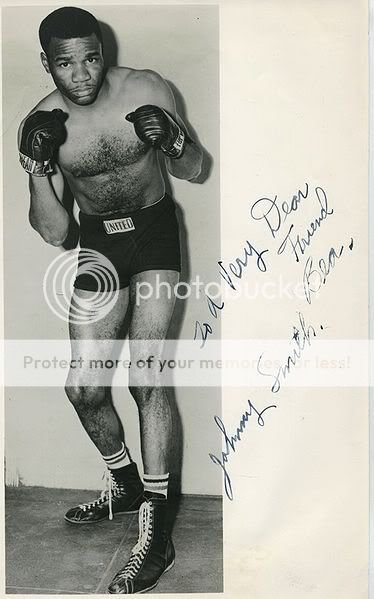
Managed by Johnny Flores. Flores told us that "Joltin" Johnny Smith was too good for his own good, and had a hard time getting bouts anywhere, especially in L.A. where everybody was aware of his devistating punching power. I saw him knockout a good local middleweight named Lonnie Harris one day at the Main Street Gym.
Thanks for taking the time to post this article, filled with noteworthy comparisons.
He says a mouthful. One thing that cannot be denied, as time goes on, many sportsmen of legend seem to be forgotten and rarely mentioned. I am not even too sure that young men aged 25 or younger can properly place Babe Ruth and his exploits, much less boxing greats of yore. To be very honest with you, in the last 6 months alone, I have learned to respect a bevy of California boxers who I never knew of or just knew of a bare mention without story.
Certainly, not everyone can remember all things and all things boxing and its history, but I am afraid that the way things are going in the sport, names like Zale, Graziano, Ramos, McLarnin are discussed only by those who are aged enough to remember who they were (are).The article above gives good ink and mention of English Champs and contenders.
The LaMotta name might live on a few more years as each time Raging Bull is on TV.
It is truly ashame that boxing announcers today very rarely compare the fighters of today with mention of those of the great past in their respective weight classes. They rather compare each to comtemporaries who are in the ring with them. No fault in that, but if you were to lay out a bigger picture it just might get someone up off their butt to look up the records of the legends of the past. Put a light on the past. If pacman & Mayweather ever do get together, would it hurt to show a Gavilan highlight film,a Carlos Ortiz film, or Saddler or Pep fight to show these kids who they should be compared to.Instead, you have to set your DVRs to record at 4am the ring classics on ESPN, usually the same old- same old too.If boxing is becoming a forgotten sport, its the media that only has itself to blame.
Now pardon me as I throw a handful of darts at a Chris Arreola picture hanging up over my dart board.
April 15, 1950 (Jeffries Residence, Burbank CA): Tom Sharkey, Everett L. Sanders, Jim Thorpe, and James J. Jeffries.
The typed caption is wrong. That photo was not taken on Jeff's birthday in 1950. Neither Sharkey nor Thorpe were at his birthday celebration in 1950. It must have been taken earlier - probably early to mid-1940s.
I always knew Jeffries was a big man. You can see it in his highlight films of his fights too.
These pictures do him justice- what I really feel is intriguing is the size of Thorpe.
Looks like as tall as the great Jeffries if not a hair bigger, but he was a hell of a runner in all he did. And at their age, probably an inch or two shorter than in their prime.
Height and speed like that is phenominal.