Frank, is Salas in the CBHOF? Seems like he should be. I think he's still alive. It would be an nice honor if he's not already in.kikibalt wrote:Tom, In 1952 Lauro Salas got his first title fight v Jimmy Carter after giving Art Aragon a terrific fight. Both at a Hollywood nite club and at the Olympic Auditorium, I have heard lots of different versions of the nite club fight, and all lean to Salas getting the best of Aragon, but who knows. The nite club fight was played big in the local media and the powers that be at the Olympic knew they had a sell-out fight on their hands, the only problem was that Salas was really too small for Aragon, But Salas being Salas said he would fight Art at any weight, not sure, but I thing Art came in at 137 and Salas under 135. It was a great-close action fight and the unanimous decision went to Art, it was a good decision. Soon after that the Olympic was looking for a suitable opponent for Jimmy Carter to defend his title against, well they didn’t have to look no further then Lauro Salas, the fight was made and in front if a near sell-out crowd Salas again out-Salas himself. In both the Aragon and first Carter fight Salas fought way beyond his usual self. After a great fight and every close fight, the decision went to Carter, but a rematch had to be made. This time after a great and close fight the decision went to Salas, again a good decision. I am happy to say I seen live all three of the above fights.raylawpc wrote:What were your impressions of the Salas-Carter fights?kikibalt wrote: Yeah, Tom, I seen both of the Cater/Salas LA fights. Also seen Salas/Aragon fight, the one at the Olympic, wasn't lucky enough to have seen the one in the bar...You never read much about Salas these days. What did you think of him and his fights with Carter?
Classic American West Coast Boxing
Re: Classic American West Coast Boxing
Re: Classic American West Coast Boxing
With all the excitement lately on the thread, I guess I missed this too. So I join Charlie in offering belated congrats to you and your family!!CNorkusJr wrote:Sorry I'm late- Congrats Randy.kikibalt wrote:Congrats!!Randyman wrote:Big day today. my daughter's boyfriend, Josh, asked Jeri and I for our youngest daughter's (Savannah) hand in marriage. Of course we gave him our blessings. He proposed to her earlier tonight. She accepted. We could not have asked for a better young man for her.
I gotta tell you guys though. this is my baby. So you know how I feel!
If Josh makes Savannah Happy, and thats makes you and Jeri Happy- Then thats the way it should be. It was nice to hear you say that Josh asked you and Jeri for your Blessing first.
Sounds like a good start from a respectful young man.
May their eventual union bring many beautiful grandchildren.
Re: Classic American West Coast Boxing
No, he is not in the CBHOF. I agree with you that he should be in. I'll talk to Don after his surgery, see what he says...Btw, Salas died some years back, I believe it was somewhere in South America where he passed..raylawpc wrote:Frank, is Salas in the CBHOF? Seems like he should be. I think he's still alive. It would be an nice honor if he's not already in.kikibalt wrote:Tom, In 1952 Lauro Salas got his first title fight v Jimmy Carter after giving Art Aragon a terrific fight. Both at a Hollywood nite club and at the Olympic Auditorium, I have heard lots of different versions of the nite club fight, and all lean to Salas getting the best of Aragon, but who knows. The nite club fight was played big in the local media and the powers that be at the Olympic knew they had a sell-out fight on their hands, the only problem was that Salas was really too small for Aragon, But Salas being Salas said he would fight Art at any weight, not sure, but I thing Art came in at 137 and Salas under 135. It was a great-close action fight and the unanimous decision went to Art, it was a good decision. Soon after that the Olympic was looking for a suitable opponent for Jimmy Carter to defend his title against, well they didn’t have to look no further then Lauro Salas, the fight was made and in front if a near sell-out crowd Salas again out-Salas himself. In both the Aragon and first Carter fight Salas fought way beyond his usual self. After a great fight and every close fight, the decision went to Carter, but a rematch had to be made. This time after a great and close fight the decision went to Salas, again a good decision. I am happy to say I seen live all three of the above fights.raylawpc wrote: What were your impressions of the Salas-Carter fights?
Re: Classic American West Coast Boxing
Yes, I see he died in 1987. The cyber boxing zone didn't show a date of death; I should have stayed with boxrec.com!kikibalt wrote:No, he is not in the CBHOF. I agree with you that he should be in. I'll talk to Don after his surgery, see what he says...Btw, Salas died some years back, I believe it was somewhere in South America where he passed..raylawpc wrote:Frank, is Salas in the CBHOF? Seems like he should be. I think he's still alive. It would be an nice honor if he's not already in.kikibalt wrote: Tom, In 1952 Lauro Salas got his first title fight v Jimmy Carter after giving Art Aragon a terrific fight. Both at a Hollywood nite club and at the Olympic Auditorium, I have heard lots of different versions of the nite club fight, and all lean to Salas getting the best of Aragon, but who knows. The nite club fight was played big in the local media and the powers that be at the Olympic knew they had a sell-out fight on their hands, the only problem was that Salas was really too small for Aragon, But Salas being Salas said he would fight Art at any weight, not sure, but I thing Art came in at 137 and Salas under 135. It was a great-close action fight and the unanimous decision went to Art, it was a good decision. Soon after that the Olympic was looking for a suitable opponent for Jimmy Carter to defend his title against, well they didn’t have to look no further then Lauro Salas, the fight was made and in front if a near sell-out crowd Salas again out-Salas himself. In both the Aragon and first Carter fight Salas fought way beyond his usual self. After a great fight and every close fight, the decision went to Carter, but a rematch had to be made. This time after a great and close fight the decision went to Salas, again a good decision. I am happy to say I seen live all three of the above fights.

Re: Classic American West Coast Boxing
Art "Golden Boy" Aragon/Lauro Salas..
Of all the incidents in which Aragon has participated during his eight years of tempestuous ring life, none has given him such publicity as the 20-minute brawl he and Lauro Salas staged one particular winter dawn in 1951. The affair took place in a small Mexican restaurant where Sunset Boulevard begins it's winding march towards the Pacific Ocean. At that time both were in the public eye as championship caliber. Aragon, who always carries with him an air of superior pugilistic breeding, leaves no room for brother boxers to move around when bunched together socially. That was the kind of atmosphere Lauro Salas ran into when he pushed open the doors of the Mexican bistro on Sunset Boulevard that early dawn of december 1951. Art, as one version puts it, was sitting at one booth enjoying a huge portion of stinging hot tamales. No sooner had he knocked of the last delicacy when Salas-so the story goes-came over, grabbed Art by the shoulder and gave his spanish version of Aragon, the man, Aragon, the fighter, and Aragon, the son. From then on there were no more words to be said. Both men threw boxing etiquette out of the window and put on one of the wildest punching fiesta ever seen anywhere on Sunset Boulevard. They locked horns so hard that patrons got knocked off there feet trying to stop the slugging show. Some quick-thinking night owler thought that buckets of cold water would be the thing to do and sure enough Art and Lauro stopped the fracas when they got there early morning bath. When officers of the law showed up all was quiet and perfect. Both men had licked their wounds sufficiently well to leave no evidence of assault. Out of this imprompty brannigan both were signed for a 10-round rematch, this time with a pay envelope and thousands were turned away. Aragon got the decision in a savage contest..
Of all the incidents in which Aragon has participated during his eight years of tempestuous ring life, none has given him such publicity as the 20-minute brawl he and Lauro Salas staged one particular winter dawn in 1951. The affair took place in a small Mexican restaurant where Sunset Boulevard begins it's winding march towards the Pacific Ocean. At that time both were in the public eye as championship caliber. Aragon, who always carries with him an air of superior pugilistic breeding, leaves no room for brother boxers to move around when bunched together socially. That was the kind of atmosphere Lauro Salas ran into when he pushed open the doors of the Mexican bistro on Sunset Boulevard that early dawn of december 1951. Art, as one version puts it, was sitting at one booth enjoying a huge portion of stinging hot tamales. No sooner had he knocked of the last delicacy when Salas-so the story goes-came over, grabbed Art by the shoulder and gave his spanish version of Aragon, the man, Aragon, the fighter, and Aragon, the son. From then on there were no more words to be said. Both men threw boxing etiquette out of the window and put on one of the wildest punching fiesta ever seen anywhere on Sunset Boulevard. They locked horns so hard that patrons got knocked off there feet trying to stop the slugging show. Some quick-thinking night owler thought that buckets of cold water would be the thing to do and sure enough Art and Lauro stopped the fracas when they got there early morning bath. When officers of the law showed up all was quiet and perfect. Both men had licked their wounds sufficiently well to leave no evidence of assault. Out of this imprompty brannigan both were signed for a 10-round rematch, this time with a pay envelope and thousands were turned away. Aragon got the decision in a savage contest..
Re: Classic American West Coast Boxing
Nice piece of PR work Paul. My understanding from my talks years ago with people that were there is that it was a two or three punch with some shoving/pushing type of fight that lasted couple of minutes. I was told that the fight started because Aragon called Salas a fu*king Mexican....Cholo wrote:Art "Golden Boy" Aragon/Lauro Salas..
Of all the incidents in which Aragon has participated during his eight years of tempestuous ring life, none has given him such publicity as the 20-minute brawl he and Lauro Salas staged one particular winter dawn in 1951. The affair took place in a small Mexican restaurant where Sunset Boulevard begins it's winding march towards the Pacific Ocean. At that time both were in the public eye as championship caliber. Aragon, who always carries with him an air of superior pugilistic breeding, leaves no room for brother boxers to move around when bunched together socially. That was the kind of atmosphere Lauro Salas ran into when he pushed open the doors of the Mexican bistro on Sunset Boulevard that early dawn of december 1951. Art, as one version puts it, was sitting at one booth enjoying a huge portion of stinging hot tamales. No sooner had he knocked of the last delicacy when Salas-so the story goes-came over, grabbed Art by the shoulder and gave his spanish version of Aragon, the man, Aragon, the fighter, and Aragon, the son. From then on there were no more words to be said. Both men threw boxing etiquette out of the window and put on one of the wildest punching fiesta ever seen anywhere on Sunset Boulevard. They locked horns so hard that patrons got knocked off there feet trying to stop the slugging show. Some quick-thinking night owler thought that buckets of cold water would be the thing to do and sure enough Art and Lauro stopped the fracas when they got there early morning bath. When officers of the law showed up all was quiet and perfect. Both men had licked their wounds sufficiently well to leave no evidence of assault. Out of this imprompty brannigan both were signed for a 10-round rematch, this time with a pay envelope and thousands were turned away. Aragon got the decision in a savage contest..
This story reminds me of the fish story, every time the fish story is told the fish gets bigger... 
Re: Classic American West Coast Boxing
Frankkikibalt wrote:Nice piece of PR work Paul. My understanding from my talks years ago with people that were there is that it was a two or three punch with some shoving/pushing type of fight that lasted couple of minutes. I was told that the fight started because Aragon called Salas a fu*king Mexican....Cholo wrote:Art "Golden Boy" Aragon/Lauro Salas..
Of all the incidents in which Aragon has participated during his eight years of tempestuous ring life, none has given him such publicity as the 20-minute brawl he and Lauro Salas staged one particular winter dawn in 1951. The affair took place in a small Mexican restaurant where Sunset Boulevard begins it's winding march towards the Pacific Ocean. At that time both were in the public eye as championship caliber. Aragon, who always carries with him an air of superior pugilistic breeding, leaves no room for brother boxers to move around when bunched together socially. That was the kind of atmosphere Lauro Salas ran into when he pushed open the doors of the Mexican bistro on Sunset Boulevard that early dawn of december 1951. Art, as one version puts it, was sitting at one booth enjoying a huge portion of stinging hot tamales. No sooner had he knocked of the last delicacy when Salas-so the story goes-came over, grabbed Art by the shoulder and gave his spanish version of Aragon, the man, Aragon, the fighter, and Aragon, the son. From then on there were no more words to be said. Both men threw boxing etiquette out of the window and put on one of the wildest punching fiesta ever seen anywhere on Sunset Boulevard. They locked horns so hard that patrons got knocked off there feet trying to stop the slugging show. Some quick-thinking night owler thought that buckets of cold water would be the thing to do and sure enough Art and Lauro stopped the fracas when they got there early morning bath. When officers of the law showed up all was quiet and perfect. Both men had licked their wounds sufficiently well to leave no evidence of assault. Out of this imprompty brannigan both were signed for a 10-round rematch, this time with a pay envelope and thousands were turned away. Aragon got the decision in a savage contest..
Re: Classic American West Coast Boxing
Frank, The fight between Aragon/Salas at the Olympic was a good one, you were there Frank?..
Re: Classic American West Coast Boxing
Yes Paul, I was there and it was a great fight with Salas going after Aragon and Aragon not backing away from him. Art was just too big and strong for Salas. Great fight though...Cholo wrote:Frank, The fight between Aragon/Salas at the Olympic was a good one, you were there Frank?..
Re: Classic American West Coast Boxing
Frank, The Golden era of L.A. boxing..kikibalt wrote:Yes Paul, I was there and it was a great fight with Salas going after Aragon and Aragon not backing away from him. Art was just too big and strong for Salas. Great fight though...Cholo wrote:Frank, The fight between Aragon/Salas at the Olympic was a good one, you were there Frank?..
Re: Classic American West Coast Boxing
YES!!!!Cholo wrote:Frank, The Golden era of L.A. boxing..kikibalt wrote:Yes Paul, I was there and it was a great fight with Salas going after Aragon and Aragon not backing away from him. Art was just too big and strong for Salas. Great fight though...Cholo wrote:Frank, The fight between Aragon/Salas at the Olympic was a good one, you were there Frank?..
Re: Classic American West Coast Boxing
Randy, back in the '50's there was a hamburger stand in the parking lot behind of some department stores on the corner of Kern Ave and Whittier Blvd. E.L.A. It was on the northeast side off of Whittier Blvd. The stand was actually on Kern Ave, half a block off the Blvd.
Connie and I used to go there all the time and eat hamburgers. Pops, the man that owned the stand would put green chile salsa on the burgers for us..
. Pops passed around 1960 and his son-in-law kept the place going for about a year, then he sold it, it was never the same... 
Re: Classic American West Coast Boxing
Touching gloves with…Sammy Goss
by Dan Hanley

In the summer of ‘73 during a series of telecasts on ABC from New York’s Felt Forum, I was introduced to the east coast’s version of Mexican featherweight warfare. And I was absolutely smitten with the rampaging style of Sammy Goss as I watched this ’sure thing’ in action on those Saturday afternoons. Catching up with Sammy takes me back to the days of network TV and the efforts displayed which drew rabid crowds into unforgiving arenas of attrition. Good times.
DH: Sammy, you’re originally from Trenton, New Jersey, is that right?
SG: Born and bred and still here to this day.
DH: You’ve got quite the family background in boxing. Tell me about it.
SG: Well, my Dad was Jesse Goss. He was a fighter and eventually a trainer. As a matter of fact he trained Ike Williams back in the day. I started boxing around the age of 6 or 7 and all my brothers boxed. But boxing was not just in the family but also in the entire neighborhood. Everything was about boxing.
DH: How old were you when you formally started?
SG: I was 15. My father brought me down to the Trenton PAL to Percy Richardson for instruction.
DH: You had a remarkable amateur career. What are your stats?
SG: Well, I came along very fast. I was 5 time N.J. Golden Glove champ, 5 time state AAU champ, 1965 National AAU flyweight champ, 1968 National AAU bantamweight champ and 1968 National Golden Glove runnerup, losing in the finals to Earl Large of New Mexico.
DH: Now didn’t the AAU title grant you a berth at the ‘68 Olympic Trials?
SG: Yes it did. And in the finals of the trials I beat Earl Large. However, since I had lost to him recently in the Nationals it was decided we had to have a boxoff. So I beat him again for the bantamweight spot on the 1968 Olympic team.
DH: Tell me about Mexico City 1968.
SG: I would have had to win 5 fights to medal in the tournament, I received a bye in the 1st round and the second round I was fighting an eastern European. Now remember, Percy Richardson was not in my corner. I got to that point with Percy Richardson, who knew my style. In the Olympics we all had the National Coach, who was Pappy Gault. In the first round of my bout I had my opponent hurt bad but when I got back to my corner Gault jumped all over me. He wanted me to go to the body and nothing but. Well, he’s the coach and I had to do as I was told but I had to try and get under and in there and ate nothing but jabs trying to get in. He just kept popping me as I bore in and I lost the decision. That was all for me and I went pro after that.
DH: Who did you turn pro with?
SG: Well, Percy Richardson of course along with Frank Cariello were my trainers and I was managed by Pinny Schaeffer and Pat Duffy. We were together from beginning to end and we had the best time. (laughing) Those crazy guys could joke, let me tell you.
DH: You were up and down the eastern seaboard after turning pro. Maine, Pennsylvania, New York, New Jersey, Massachusetts. Was it an issue getting fights for you?
SG: Well, I was taking the fights as they were coming to me, but then we hooked up with Promoter Russell Peltz in Philadelphia. And now, although I still lived in Trenton, I would take the train into Philly on weekends for some real serious sparring.
DH: I take it you were introduced to the Philadelphia gym wars?
SG: Oh man, you had to be on your toes. Sparring in Philly, to me, meant working on defense because every sparring partner was looking to beat on me in order to make a reputation for himself.
DH: You were a very busy fighter. In a year and half after turning pro you were 18-1 and went into a fight which smacked of old school rivalry. You and Augie Pantellas had been making a lot of noise out of Philly. In fact, Marty Feldman, Pantellas’ trainer, said that this had been brewing for two years. Tell me about the fight.
SG: Well, you’re right, this really was a rivalry. We packed them into the Philadelphia Spectrum that night, which was one of my best paydays. I don’t recall the figures but I remember I made enough to put a down payment on a house. As for Augie Pantellas, he was a puncher and this was going to be a very tough fight if I fought him the same way. But during training I watched the tape of the Sugar Ray Robinson - Jake LaMotta title fight every single night. I copied the same moves. I boxed, I spun him and countered him and took an easy decision.
DH: Were you aware that Promoter Lou Lucchese offered to bring lightweight champ Ken Buchanan to Philly to fight the winner in a non-title?
SG: I was not. And obviously I never heard anymore about it. See, Lucchese was more Pantellas’ promoter, whereas I was affiliated with Russell Peltz. But Buchanan would have been too big for me anyway. I was comfortable between 126-130.
DH: Your next fight set you back a bit. That was one bad dude you fought in Ricardo Arredondo. Does the fact that he would become world champ less than a year later suggest that you may have been overmatched at this stage of your career?
SG: Yes, he was far more polished than I was.

DH: Were you ‘in’ the fight at all?
SG: No, to tell you the truth, he was picking me off coming in. He had reach on me and could hit. But it was a learning experience.
DH: Several fights later you had a similar result against Jose Luis Lopez, getting stopped in 6. Was it simply a case of having a problem solving the Mexican style?
SG: Yeah, it was the same thing. He was a tall guy and he caught me with an uppercut. But we rematched about a year later and I had it down. I made him chase me, boxed and took the fight easily. See, the first fight I was going after him and walking into the shots.
DH: It does seem like you had it figured out with a two round blowout of Raul Cruz in your next fight. But thinking of some of these Mexican fighters made me wonder why you never relocated to the west coast for more work.
SG: I suppose I should have but Russell Peltz was bringing in the talent for me, so I didn’t have any complaints.
DH: In March of ‘73 you fought for the first and only time in Madison Square Garden. A 12 rounder against Walter Seeley. It was a brilliant win, but whatever happened to Garden matchmaker Teddy Brenner’s promise of an October title fight for the winner at the Garden against featherweight champ Ernesto Marcel?
SG: Don’t know. Nothing ever came of it. Of course, like Lucchese and Pantellas in Philly, the Garden was Seeley’s promoter.
DH: Jose Fernandez of the Dominican Republic was coming off of a tremendous result over in Europe when you beat him at the Felt Forum. Then you rematched on National TV for the newly created American Jr. Lightweight title. Tell me about the fight.
SG: Everything was right that night. He came right at me, I boxed, I punched. I couldn’t miss.
DH: The following month you were back on the air against undefeated Edwin Viruet. But you came in as a late substitute for Chango Carmona. Were you ready for this fight?
SG: I was staying in shape, so yes, I was ready and won a close decision.
DH: There was some controversey over your 8th round knockdown, wasn’t there?
SG: (laughing) Yeah, I caught him good with a leaping left hook, but he couldn’t pull away because I came down on his foot. He was a good fighter but I beat him with body punches.
DH: At this time you were Ring Magazine’s #1 contender for the 130 lb. title. What kind of efforts were there to get you a title shot?
SG: I know Russell Peltz was working on it but the only one we heard from was Ricardo Arredondo offering us a non-title fight. I was the #1 contender, I wasn’t going to go for that.
DH: For the first time in your career you took time off. It was seven months before you fought again and looked very ring rusty against a club fighter. Why the inactivity?
SG: I think it was a combination of me needing a rest and them working on a title fight.
DH: In August of ‘74 you signed to defend your American title in an all-Philly affair with undefeated rival Tyrone Everett. I understand the fight reeked of bad blood. Tell me about it.
SG: Tyrone was saying a lot of nasty things in the press, which really angered me and I was responding to it, which really heated things up. As for the fight, he dropped me around the 3rd round. I then began doing well with body punches but then he began running and boxing on the retreat. Percy was telling me between rounds to chase him and I was saying, “I’ll chase him but I don’t know if I can catch him.” And he won the fight. Afterwards Tyrone shook hands with me and apologized for the things he was saying and that it was just to hype the fight and pump up the gate.
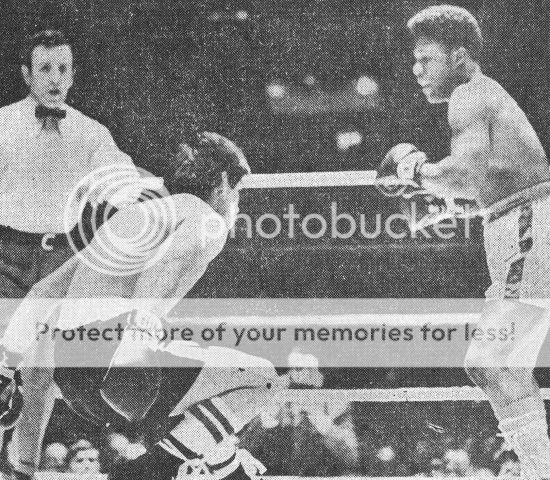
Goss (right) seen here dropping Raul Cruz.
DH: After that fight you began fighting on the road more. You fought Flipper Uehara over in Japan and held him to a draw. He was one of Japan’s hotshots at the time. How do you perceive the draw?
SG: That was no draw. I gave him one severe body beating. He came up to me after the fight and said, “I never fought anybody that hit to the body like you.”
DH: Something happened around this time that really bummed me out. You started losing to guys you had once dominated such as Jose Fernandez and Augie Pantellas. Were you spent after such a long amateur and pro career?
SG: I really think I was. I was just tired by that point.
DH: While on the road you fought twice in South Africa when apartheid was at its height. How were you treated over there?
SG: Oh, I was treated alright, like one of their own. I had no issues. As for my two fights over there, the first fight was against ‘Happy Boy’ Mgxaji and I thought I beat him. From bell to bell I pounded his body but they gave it to him. My fight with Brian Baronet was also my last. In the 7th round I was hit with a right and something happened to me. I went down and just sat there and let them count me out. Percy asked me afterwards what happened and I told him that my head felt like a bottle of coca-cola after you shook it up. I felt something rushing to the top of my head. It was enough. And I never fought again.
DH: What have you been doing with yourself over the years?
SG: I have been running the Goss & Goss Gym in Trenton along with my brothers Barry and Tommy. We’re giving kids the same chance we had.
DH: Sammy, if there was one fight you wanted that you never got an opportunity at, what would it be?
SG: A third fight with Augie Pantellas.
DH: Whooa! I thought for sure you were going to say a title fight with Ben Villaflor or Kuniaki Shibata.
SG: (laughing) Nope! I felt I beat him again in our rematch. I wanted a third fight with Augie Pantellas to set things straight.
DH: Sammy, last question, while we’ve been talking I’ve been noticing that fighters you beat such as Jose Marin, Jose Fernandez and Edwin Viruet along with fighters you felt you beat such as Flipper Uehara and Happy Boy Mgxaji all received title shots sometime after fighting you. Where was the justice?
SG: Really? All of them? Well, I don’t know how those guys made out in life, but I’m healthy, have all my senses, have my family and my own home from my ring earnings. So…maybe I did OK.
Alas, in the fight game, fate can be a cruel bitch. She provides amateur silverware to adorn the shelves, grants Olympian status to enhance the transition to pro and even bestows the ranking of #1 contender for world laurels. Yet, obstinately withholds the elusive shot at that very same world title. Cruel indeed. However, cruel fate has left no malice in the heart of Sammy Goss as he teaches the very same sport which left him marooned from the brass ring. For that alone I say, way to go champ.
See ya next round
Dan Hanley
[email protected]
by Dan Hanley
In the summer of ‘73 during a series of telecasts on ABC from New York’s Felt Forum, I was introduced to the east coast’s version of Mexican featherweight warfare. And I was absolutely smitten with the rampaging style of Sammy Goss as I watched this ’sure thing’ in action on those Saturday afternoons. Catching up with Sammy takes me back to the days of network TV and the efforts displayed which drew rabid crowds into unforgiving arenas of attrition. Good times.
DH: Sammy, you’re originally from Trenton, New Jersey, is that right?
SG: Born and bred and still here to this day.
DH: You’ve got quite the family background in boxing. Tell me about it.
SG: Well, my Dad was Jesse Goss. He was a fighter and eventually a trainer. As a matter of fact he trained Ike Williams back in the day. I started boxing around the age of 6 or 7 and all my brothers boxed. But boxing was not just in the family but also in the entire neighborhood. Everything was about boxing.
DH: How old were you when you formally started?
SG: I was 15. My father brought me down to the Trenton PAL to Percy Richardson for instruction.
DH: You had a remarkable amateur career. What are your stats?
SG: Well, I came along very fast. I was 5 time N.J. Golden Glove champ, 5 time state AAU champ, 1965 National AAU flyweight champ, 1968 National AAU bantamweight champ and 1968 National Golden Glove runnerup, losing in the finals to Earl Large of New Mexico.
DH: Now didn’t the AAU title grant you a berth at the ‘68 Olympic Trials?
SG: Yes it did. And in the finals of the trials I beat Earl Large. However, since I had lost to him recently in the Nationals it was decided we had to have a boxoff. So I beat him again for the bantamweight spot on the 1968 Olympic team.
DH: Tell me about Mexico City 1968.
SG: I would have had to win 5 fights to medal in the tournament, I received a bye in the 1st round and the second round I was fighting an eastern European. Now remember, Percy Richardson was not in my corner. I got to that point with Percy Richardson, who knew my style. In the Olympics we all had the National Coach, who was Pappy Gault. In the first round of my bout I had my opponent hurt bad but when I got back to my corner Gault jumped all over me. He wanted me to go to the body and nothing but. Well, he’s the coach and I had to do as I was told but I had to try and get under and in there and ate nothing but jabs trying to get in. He just kept popping me as I bore in and I lost the decision. That was all for me and I went pro after that.
DH: Who did you turn pro with?
SG: Well, Percy Richardson of course along with Frank Cariello were my trainers and I was managed by Pinny Schaeffer and Pat Duffy. We were together from beginning to end and we had the best time. (laughing) Those crazy guys could joke, let me tell you.
DH: You were up and down the eastern seaboard after turning pro. Maine, Pennsylvania, New York, New Jersey, Massachusetts. Was it an issue getting fights for you?
SG: Well, I was taking the fights as they were coming to me, but then we hooked up with Promoter Russell Peltz in Philadelphia. And now, although I still lived in Trenton, I would take the train into Philly on weekends for some real serious sparring.
DH: I take it you were introduced to the Philadelphia gym wars?
SG: Oh man, you had to be on your toes. Sparring in Philly, to me, meant working on defense because every sparring partner was looking to beat on me in order to make a reputation for himself.
DH: You were a very busy fighter. In a year and half after turning pro you were 18-1 and went into a fight which smacked of old school rivalry. You and Augie Pantellas had been making a lot of noise out of Philly. In fact, Marty Feldman, Pantellas’ trainer, said that this had been brewing for two years. Tell me about the fight.
SG: Well, you’re right, this really was a rivalry. We packed them into the Philadelphia Spectrum that night, which was one of my best paydays. I don’t recall the figures but I remember I made enough to put a down payment on a house. As for Augie Pantellas, he was a puncher and this was going to be a very tough fight if I fought him the same way. But during training I watched the tape of the Sugar Ray Robinson - Jake LaMotta title fight every single night. I copied the same moves. I boxed, I spun him and countered him and took an easy decision.
DH: Were you aware that Promoter Lou Lucchese offered to bring lightweight champ Ken Buchanan to Philly to fight the winner in a non-title?
SG: I was not. And obviously I never heard anymore about it. See, Lucchese was more Pantellas’ promoter, whereas I was affiliated with Russell Peltz. But Buchanan would have been too big for me anyway. I was comfortable between 126-130.
DH: Your next fight set you back a bit. That was one bad dude you fought in Ricardo Arredondo. Does the fact that he would become world champ less than a year later suggest that you may have been overmatched at this stage of your career?
SG: Yes, he was far more polished than I was.
DH: Were you ‘in’ the fight at all?
SG: No, to tell you the truth, he was picking me off coming in. He had reach on me and could hit. But it was a learning experience.
DH: Several fights later you had a similar result against Jose Luis Lopez, getting stopped in 6. Was it simply a case of having a problem solving the Mexican style?
SG: Yeah, it was the same thing. He was a tall guy and he caught me with an uppercut. But we rematched about a year later and I had it down. I made him chase me, boxed and took the fight easily. See, the first fight I was going after him and walking into the shots.
DH: It does seem like you had it figured out with a two round blowout of Raul Cruz in your next fight. But thinking of some of these Mexican fighters made me wonder why you never relocated to the west coast for more work.
SG: I suppose I should have but Russell Peltz was bringing in the talent for me, so I didn’t have any complaints.
DH: In March of ‘73 you fought for the first and only time in Madison Square Garden. A 12 rounder against Walter Seeley. It was a brilliant win, but whatever happened to Garden matchmaker Teddy Brenner’s promise of an October title fight for the winner at the Garden against featherweight champ Ernesto Marcel?
SG: Don’t know. Nothing ever came of it. Of course, like Lucchese and Pantellas in Philly, the Garden was Seeley’s promoter.
DH: Jose Fernandez of the Dominican Republic was coming off of a tremendous result over in Europe when you beat him at the Felt Forum. Then you rematched on National TV for the newly created American Jr. Lightweight title. Tell me about the fight.
SG: Everything was right that night. He came right at me, I boxed, I punched. I couldn’t miss.
DH: The following month you were back on the air against undefeated Edwin Viruet. But you came in as a late substitute for Chango Carmona. Were you ready for this fight?
SG: I was staying in shape, so yes, I was ready and won a close decision.
DH: There was some controversey over your 8th round knockdown, wasn’t there?
SG: (laughing) Yeah, I caught him good with a leaping left hook, but he couldn’t pull away because I came down on his foot. He was a good fighter but I beat him with body punches.
DH: At this time you were Ring Magazine’s #1 contender for the 130 lb. title. What kind of efforts were there to get you a title shot?
SG: I know Russell Peltz was working on it but the only one we heard from was Ricardo Arredondo offering us a non-title fight. I was the #1 contender, I wasn’t going to go for that.
DH: For the first time in your career you took time off. It was seven months before you fought again and looked very ring rusty against a club fighter. Why the inactivity?
SG: I think it was a combination of me needing a rest and them working on a title fight.
DH: In August of ‘74 you signed to defend your American title in an all-Philly affair with undefeated rival Tyrone Everett. I understand the fight reeked of bad blood. Tell me about it.
SG: Tyrone was saying a lot of nasty things in the press, which really angered me and I was responding to it, which really heated things up. As for the fight, he dropped me around the 3rd round. I then began doing well with body punches but then he began running and boxing on the retreat. Percy was telling me between rounds to chase him and I was saying, “I’ll chase him but I don’t know if I can catch him.” And he won the fight. Afterwards Tyrone shook hands with me and apologized for the things he was saying and that it was just to hype the fight and pump up the gate.
Goss (right) seen here dropping Raul Cruz.
DH: After that fight you began fighting on the road more. You fought Flipper Uehara over in Japan and held him to a draw. He was one of Japan’s hotshots at the time. How do you perceive the draw?
SG: That was no draw. I gave him one severe body beating. He came up to me after the fight and said, “I never fought anybody that hit to the body like you.”
DH: Something happened around this time that really bummed me out. You started losing to guys you had once dominated such as Jose Fernandez and Augie Pantellas. Were you spent after such a long amateur and pro career?
SG: I really think I was. I was just tired by that point.
DH: While on the road you fought twice in South Africa when apartheid was at its height. How were you treated over there?
SG: Oh, I was treated alright, like one of their own. I had no issues. As for my two fights over there, the first fight was against ‘Happy Boy’ Mgxaji and I thought I beat him. From bell to bell I pounded his body but they gave it to him. My fight with Brian Baronet was also my last. In the 7th round I was hit with a right and something happened to me. I went down and just sat there and let them count me out. Percy asked me afterwards what happened and I told him that my head felt like a bottle of coca-cola after you shook it up. I felt something rushing to the top of my head. It was enough. And I never fought again.
DH: What have you been doing with yourself over the years?
SG: I have been running the Goss & Goss Gym in Trenton along with my brothers Barry and Tommy. We’re giving kids the same chance we had.
DH: Sammy, if there was one fight you wanted that you never got an opportunity at, what would it be?
SG: A third fight with Augie Pantellas.
DH: Whooa! I thought for sure you were going to say a title fight with Ben Villaflor or Kuniaki Shibata.
SG: (laughing) Nope! I felt I beat him again in our rematch. I wanted a third fight with Augie Pantellas to set things straight.
DH: Sammy, last question, while we’ve been talking I’ve been noticing that fighters you beat such as Jose Marin, Jose Fernandez and Edwin Viruet along with fighters you felt you beat such as Flipper Uehara and Happy Boy Mgxaji all received title shots sometime after fighting you. Where was the justice?
SG: Really? All of them? Well, I don’t know how those guys made out in life, but I’m healthy, have all my senses, have my family and my own home from my ring earnings. So…maybe I did OK.
Alas, in the fight game, fate can be a cruel bitch. She provides amateur silverware to adorn the shelves, grants Olympian status to enhance the transition to pro and even bestows the ranking of #1 contender for world laurels. Yet, obstinately withholds the elusive shot at that very same world title. Cruel indeed. However, cruel fate has left no malice in the heart of Sammy Goss as he teaches the very same sport which left him marooned from the brass ring. For that alone I say, way to go champ.
See ya next round
Dan Hanley
[email protected]
Re: Classic American West Coast Boxing
Frank I enjoyed that post on Sammy Goss. Brought back some good memories.
My father had started to talk to Arthur Mercante Sr at that time about getting his refereeing license in NYS. Arthur lived not to far from us here on long Island,and when he wasnt reffing-he was Town of Hempstead's Director of Athletics-a political position that had Arthur overseeing small sports gyms and pools and setting up exercise and self -defense lessons for the local township.(I believe in NYS at that time-the state venues wasnt allowed to give "Boxing Classes", they had to be called "Self Defence" classes.(Boxing Gyms were privately ran). Regardless, many people in the NYS Athletic Comm remembered my father and he was a shoe in to get his pro ref license. (They felt very confident in his skills though he never reffed a amateur bout-just a few unofficial smokers locally).I think timing was just right too. My father was 6 foot and had heft on him but could move around. Most of the refs at that time were smaller in size and getting pushed around by the bigger heavyweights coming into higher wt classes. My father was used primarily for the big Heavyweights like Renaldo Snipes,Ramon Ronquillo,Christy Elliot,Mike Rossman and a few others.My father knew how to break them and take a few last second jabs at the end of the rd.
(I know the Quarry's are big CA guys-I went to the Rossman vs Mike Quarry fight in Nassau Coliseum when Roberto Duran was Main Event vs Eddie Viruet.)
Before they let him get in the ring though-he had to go into the Garden during 1973 or so to watch some fights sitting in with some judges ringside and conversing with the refs afterwards on the fights to get the scoring skills down. I went with him and sat alone ringside while he sat with the various officials learning the ropes.
Some of those fights we went to were the Sammy Goss fights. Though I do remember watching Sammy fight- one of the nights had Vito Antuerfermo on the card and I went to see that fight mostly.Johnny Davis was another guy I liked to who fought on the undercards. Goss was good and quick-what you expect from a featherweight. But honestly I liked the Heavies alot more.My father un-officially had to score his fights with the likes of Tony Castellano,Artie Aidella,Al Reid and a few legendary NY judges.In 1974, my father was in the ring himself. Great days and memories.
My father had started to talk to Arthur Mercante Sr at that time about getting his refereeing license in NYS. Arthur lived not to far from us here on long Island,and when he wasnt reffing-he was Town of Hempstead's Director of Athletics-a political position that had Arthur overseeing small sports gyms and pools and setting up exercise and self -defense lessons for the local township.(I believe in NYS at that time-the state venues wasnt allowed to give "Boxing Classes", they had to be called "Self Defence" classes.(Boxing Gyms were privately ran). Regardless, many people in the NYS Athletic Comm remembered my father and he was a shoe in to get his pro ref license. (They felt very confident in his skills though he never reffed a amateur bout-just a few unofficial smokers locally).I think timing was just right too. My father was 6 foot and had heft on him but could move around. Most of the refs at that time were smaller in size and getting pushed around by the bigger heavyweights coming into higher wt classes. My father was used primarily for the big Heavyweights like Renaldo Snipes,Ramon Ronquillo,Christy Elliot,Mike Rossman and a few others.My father knew how to break them and take a few last second jabs at the end of the rd.
(I know the Quarry's are big CA guys-I went to the Rossman vs Mike Quarry fight in Nassau Coliseum when Roberto Duran was Main Event vs Eddie Viruet.)
Before they let him get in the ring though-he had to go into the Garden during 1973 or so to watch some fights sitting in with some judges ringside and conversing with the refs afterwards on the fights to get the scoring skills down. I went with him and sat alone ringside while he sat with the various officials learning the ropes.
Some of those fights we went to were the Sammy Goss fights. Though I do remember watching Sammy fight- one of the nights had Vito Antuerfermo on the card and I went to see that fight mostly.Johnny Davis was another guy I liked to who fought on the undercards. Goss was good and quick-what you expect from a featherweight. But honestly I liked the Heavies alot more.My father un-officially had to score his fights with the likes of Tony Castellano,Artie Aidella,Al Reid and a few legendary NY judges.In 1974, my father was in the ring himself. Great days and memories.
Re: Classic American West Coast Boxing
Charlie, You saw the great Roberto Duran, I have that fight on dvd, Viruet was a slick crafty boxer but Roberto was a bit special. I loved Roberto's fighting style even when he was pushing 50 he was still great to watch, "El Cholo"..CNorkusJr wrote:Frank I enjoyed that post on Sammy Goss. Brought back some good memories.
My father had started to talk to Arthur Mercante Sr at that time about getting his refereeing license in NYS. Arthur lived not to far from us here on long Island,and when he wasnt reffing-he was Town of Hempstead's Director of Athletics-a political position that had Arthur overseeing small sports gyms and pools and setting up exercise and self -defense lessons for the local township.(I believe in NYS at that time-the state venues wasnt allowed to give "Boxing Classes", they had to be called "Self Defence" classes.(Boxing Gyms were privately ran). Regardless, many people in the NYS Athletic Comm remembered my father and he was a shoe in to get his pro ref license. (They felt very confident in his skills though he never reffed a amateur bout-just a few unofficial smokers locally).I think timing was just right too. My father was 6 foot and had heft on him but could move around. Most of the refs at that time were smaller in size and getting pushed around by the bigger heavyweights coming into higher wt classes. My father was used primarily for the big Heavyweights like Renaldo Snipes,Ramon Ronquillo,Christy Elliot,Mike Rossman and a few others.My father knew how to break them and take a few last second jabs at the end of the rd.
(I know the Quarry's are big CA guys-I went to the Rossman vs Mike Quarry fight in Nassau Coliseum when Roberto Duran was Main Event vs Eddie Viruet.)
Before they let him get in the ring though-he had to go into the Garden during 1973 or so to watch some fights sitting in with some judges ringside and conversing with the refs afterwards on the fights to get the scoring skills down. I went with him and sat alone ringside while he sat with the various officials learning the ropes.
Some of those fights we went to were the Sammy Goss fights. Though I do remember watching Sammy fight- one of the nights had Vito Antuerfermo on the card and I went to see that fight mostly.Johnny Davis was another guy I liked to who fought on the undercards. Goss was good and quick-what you expect from a featherweight. But honestly I liked the Heavies alot more.My father un-officially had to score his fights with the likes of Tony Castellano,Artie Aidella,Al Reid and a few legendary NY judges.In 1974, my father was in the ring himself. Great days and memories.
Re: Classic American West Coast Boxing
Not only did I see him fight from ringside back then, but I watched him train in the Gleason's Gym in midtown by Madison Square Garden. Solely by coincidence, I grew up with Bobby Gleason's grandson,John Savarese, here in my hometown on Long Island.John was my Best Man for my 2nd wedding just 5 years ago. We see each other often. He has some nice Bobby Gleason memorabilia including his plaque from the Boxings Writers Assn. When Bobby sold his original Gym in the Bronx (the area was going downhill fast,boxers werent turning out as much as the arsonists were), he moved Gleasons Gym to midtown Manhattan. Bobby stilled had his famed connections and Roberto Duran trained there in the week or so leading to his fights in Madison Sq Garden. My father brought me in there to see him.Roberto really knew how to put on a show. He didnt talk much I remembered but he let his skilled workout do its talking. a real workhorse. Afterwards he addressed whatever media was there with an interperter and I remember whatever he said got quite a few laughs from the men he addressed and understood. Real talent period.
Eventually Bobby Gleason passed on and left his gym in the hands of his daughter. She and her husband tried to run it but other family committments prevented them from putting the time and effort needed for a proper gym management. Bruce Silverglade and a partner were the regular gym managers at that time and they eventually bought it-kept it in Manhattan and when rent went too high-moved to the present day location in Brooklyn Ny.
The gym in midtown,along with 14th St gym, 42 St Gym run by Jimmy Glenn and a few others hosted boxings biggest names that fought in Garden. It was a boxing paradise then,dwindling down to just a few poignant spots today. But Duran was loved in NY, even if Viruet fought here more often.
I relate to Felix Trinidad as being just as popular in NY as Duran was by his crowd. Trinidad brought out the Puerto rican support in droves in his fights here.
Eventually Bobby Gleason passed on and left his gym in the hands of his daughter. She and her husband tried to run it but other family committments prevented them from putting the time and effort needed for a proper gym management. Bruce Silverglade and a partner were the regular gym managers at that time and they eventually bought it-kept it in Manhattan and when rent went too high-moved to the present day location in Brooklyn Ny.
The gym in midtown,along with 14th St gym, 42 St Gym run by Jimmy Glenn and a few others hosted boxings biggest names that fought in Garden. It was a boxing paradise then,dwindling down to just a few poignant spots today. But Duran was loved in NY, even if Viruet fought here more often.
I relate to Felix Trinidad as being just as popular in NY as Duran was by his crowd. Trinidad brought out the Puerto rican support in droves in his fights here.
Re: Classic American West Coast Boxing
Charlie, is the Viruet you refer to Edwin? I remember him as a pretty good lightweight, who took Duran to the limit twice. He had two or three brothers who were also boxers, one named Adolfo (I think). Edwin was a rangy fellow with a somewhat unorthodox style, through which he was very effective. I always enjoyed watching him fight. Does Edwin participate in any of your veteran boxer groups in NY? Do you know what he's up to today?CNorkusJr wrote:Not only did I see him fight from ringside back then, but I watched him train in the Gleason's Gym in midtown by Madison Square Garden. Solely by coincidence, I grew up with Bobby Gleason's grandson,John Savarese, here in my hometown on Long Island.John was my Best Man for my 2nd wedding just 5 years ago. We see each other often. He has some nice Bobby Gleason memorabilia including his plaque from the Boxings Writers Assn. When Bobby sold his original Gym in the Bronx (the area was going downhill fast,boxers werent turning out as much as the arsonists were), he moved Gleasons Gym to midtown Manhattan. Bobby stilled had his famed connections and Roberto Duran trained there in the week or so leading to his fights in Madison Sq Garden. My father brought me in there to see him.Roberto really knew how to put on a show. He didnt talk much I remembered but he let his skilled workout do its talking. a real workhorse. Afterwards he addressed whatever media was there with an interperter and I remember whatever he said got quite a few laughs from the men he addressed and understood. Real talent period.
Eventually Bobby Gleason passed on and left his gym in the hands of his daughter. She and her husband tried to run it but other family committments prevented them from putting the time and effort needed for a proper gym management. Bruce Silverglade and a partner were the regular gym managers at that time and they eventually bought it-kept it in Manhattan and when rent went too high-moved to the present day location in Brooklyn Ny.
The gym in midtown,along with 14th St gym, 42 St Gym run by Jimmy Glenn and a few others hosted boxings biggest names that fought in Garden. It was a boxing paradise then,dwindling down to just a few poignant spots today. But Duran was loved in NY, even if Viruet fought here more often.
I relate to Felix Trinidad as being just as popular in NY as Duran was by his crowd. Trinidad brought out the Puerto rican support in droves in his fights here.
Re: Classic American West Coast Boxing
Great post charlie.CNorkusJr wrote:Frank I enjoyed that post on Sammy Goss. Brought back some good memories.
My father had started to talk to Arthur Mercante Sr at that time about getting his refereeing license in NYS. Arthur lived not to far from us here on long Island,and when he wasnt reffing-he was Town of Hempstead's Director of Athletics-a political position that had Arthur overseeing small sports gyms and pools and setting up exercise and self -defense lessons for the local township.(I believe in NYS at that time-the state venues wasnt allowed to give "Boxing Classes", they had to be called "Self Defence" classes.(Boxing Gyms were privately ran). Regardless, many people in the NYS Athletic Comm remembered my father and he was a shoe in to get his pro ref license. (They felt very confident in his skills though he never reffed a amateur bout-just a few unofficial smokers locally).I think timing was just right too. My father was 6 foot and had heft on him but could move around. Most of the refs at that time were smaller in size and getting pushed around by the bigger heavyweights coming into higher wt classes. My father was used primarily for the big Heavyweights like Renaldo Snipes,Ramon Ronquillo,Christy Elliot,Mike Rossman and a few others.My father knew how to break them and take a few last second jabs at the end of the rd.
(I know the Quarry's are big CA guys-I went to the Rossman vs Mike Quarry fight in Nassau Coliseum when Roberto Duran was Main Event vs Eddie Viruet.)
Before they let him get in the ring though-he had to go into the Garden during 1973 or so to watch some fights sitting in with some judges ringside and conversing with the refs afterwards on the fights to get the scoring skills down. I went with him and sat alone ringside while he sat with the various officials learning the ropes.
Some of those fights we went to were the Sammy Goss fights. Though I do remember watching Sammy fight- one of the nights had Vito Antuerfermo on the card and I went to see that fight mostly.Johnny Davis was another guy I liked to who fought on the undercards. Goss was good and quick-what you expect from a featherweight. But honestly I liked the Heavies alot more.My father un-officially had to score his fights with the likes of Tony Castellano,Artie Aidella,Al Reid and a few legendary NY judges.In 1974, my father was in the ring himself. Great days and memories.
In 1979, may it was 1980, there was talk of bringing Sammy Goss to L.A for a fight with my son Frankie. It would have been a great fight for Frankie as Goss was definitely on the down slight at that time. But it never came to be.
Re: Classic American West Coast Boxing
Frank- I think a fight between Frankie and Sammy Goss would have been tops. A slam bang affair I would think. Both held no punches back. I could see how the match-up would have been a crowd pleaser and certainly a TV show. Frankie had to be chomping on the bit to get a crack at him at that time. Sammy had powerful combinations even at the end of his fights. He seemed to get stronger as the fight went on, probably sensing that he could take his man out. Frankie I thought was strong early on and probably could have flatten Sammy right out early. It would have been a good match-up for sure.
Eddie Viruet is Edwin Viruet. The few times Edwin showed up at the Ring 8 meetings, he didnt seem to mind that he was addressed Eddie or Ed. The meetings are pretty much informal even though 200 + are in the room. My father always insisted I call a Champion fighter "Champ" or "Mr. last name" He used to say " He earned it- you call him Champ"
Today with so many titles being thrown around - if a guy earned his Champ Title-then I call him champ.If he was an alphabet city guy- then Mr.so and so would be fine.
My father knows exactly what I'm talking about too.
Adolpho Viruet I believe is his brother who I saw also. I haven't seen either Viruet's in some time now but they were around the fight game and arenas often..
Eddie Viruet is Edwin Viruet. The few times Edwin showed up at the Ring 8 meetings, he didnt seem to mind that he was addressed Eddie or Ed. The meetings are pretty much informal even though 200 + are in the room. My father always insisted I call a Champion fighter "Champ" or "Mr. last name" He used to say " He earned it- you call him Champ"
Today with so many titles being thrown around - if a guy earned his Champ Title-then I call him champ.If he was an alphabet city guy- then Mr.so and so would be fine.
My father knows exactly what I'm talking about too.
Adolpho Viruet I believe is his brother who I saw also. I haven't seen either Viruet's in some time now but they were around the fight game and arenas often..
Re: Classic American West Coast Boxing
Thanks Charlie. I remember Edwin fighting Duran in a 10-round non-title fight when everyone thought Duran would blow him out of there. But Viruet, with that unorthodox style of his, held his own with the champ and earned a title shot.CNorkusJr wrote:Frank- I think a fight between Frankie and Sammy Goss would have been tops. A slam bang affair I would think. Both held no punches back. I could see how the match-up would have been a crowd pleaser and certainly a TV show. Frankie had to be chomping on the bit to get a crack at him at that time. Sammy had powerful combinations even at the end of his fights. He seemed to get stronger as the fight went on, probably sensing that he could take his man out. Frankie I thought was strong early on and probably could have flatten Sammy right out early. It would have been a good match-up for sure.
Eddie Viruet is Edwin Viruet. The few times Edwin showed up at the Ring 8 meetings, he didnt seem to mind that he was addressed Eddie or Ed. The meetings are pretty much informal even though 200 + are in the room. My father always insisted I call a Champion fighter "Champ" or "Mr. last name" He used to say " He earned it- you call him Champ"
Today with so many titles being thrown around - if a guy earned his Champ Title-then I call him champ.If he was an alphabet city guy- then Mr.so and so would be fine.
My father knows exactly what I'm talking about too.
Adolpho Viruet I believe is his brother who I saw also. I haven't seen either Viruet's in some time now but they were around the fight game and arenas often..
-
Rick Farris
- Heavyweight

- Posts: 7200
- Joined: 15 Feb 2008, 16:04
Re: Classic American West Coast Boxing
I can see the experts are doing a good job with this thread, but amazed nobody remembers Duran's exciting ten round win over Adolph Viruet. C'Mon guys, it was on TV! Adolph was a total opposite of Edwin. Shorter, stocky, a guy who'd stand in the hole and bang with Duran. He lost a decision, butt gave an equally impressive battle as his brother. Also, the fact is Duran did not train hard for either brother. That's why most boxers lasted the full route with Duran. Now Tom, try harder next time you chime in from the cheap seats. Now carry on ...
Last edited by Rick Farris on 07 Oct 2011, 23:24, edited 1 time in total.
Re: Classic American West Coast Boxing
Charlie, Must have been great to watch the little master training at Gleason's Gym, I've read he seldom took any prisoners in sparring. Did you see the Palomino fight at the Garden in 1979?CNorkusJr wrote:Not only did I see him fight from ringside back then, but I watched him train in the Gleason's Gym in midtown by Madison Square Garden. Solely by coincidence, I grew up with Bobby Gleason's grandson,John Savarese, here in my hometown on Long Island.John was my Best Man for my 2nd wedding just 5 years ago. We see each other often. He has some nice Bobby Gleason memorabilia including his plaque from the Boxings Writers Assn. When Bobby sold his original Gym in the Bronx (the area was going downhill fast,boxers werent turning out as much as the arsonists were), he moved Gleasons Gym to midtown Manhattan. Bobby stilled had his famed connections and Roberto Duran trained there in the week or so leading to his fights in Madison Sq Garden. My father brought me in there to see him.Roberto really knew how to put on a show. He didnt talk much I remembered but he let his skilled workout do its talking. a real workhorse. Afterwards he addressed whatever media was there with an interperter and I remember whatever he said got quite a few laughs from the men he addressed and understood. Real talent period.
Eventually Bobby Gleason passed on and left his gym in the hands of his daughter. She and her husband tried to run it but other family committments prevented them from putting the time and effort needed for a proper gym management. Bruce Silverglade and a partner were the regular gym managers at that time and they eventually bought it-kept it in Manhattan and when rent went too high-moved to the present day location in Brooklyn Ny.
The gym in midtown,along with 14th St gym, 42 St Gym run by Jimmy Glenn and a few others hosted boxings biggest names that fought in Garden. It was a boxing paradise then,dwindling down to just a few poignant spots today. But Duran was loved in NY, even if Viruet fought here more often.
I relate to Felix Trinidad as being just as popular in NY as Duran was by his crowd. Trinidad brought out the Puerto rican support in droves in his fights here.
Re: Classic American West Coast Boxing
Rick, I'm with you on Duran training, Adolpho Viruet was a southpaw I think? Duran didn't like the Viruet brothers so i've read..Rick Farris wrote:I can see the experts are doing a good job with this thread, but amazed nobody remembers Duran's exciting ten round win over Adolph Viruet. C'Mon guys, it was on TV! Adolph was a total opposite of Edwin. Shorter, stocky, a guy who'd stand in the hole and bang with Duran. He lost a decision, butt gave an equally impressive battle as his brother. Also, the fact is Duran did not train hard for either brother. That's why most boxers lasted the full route with Duran. Now Tom, try harder next time you chime in from the cheap seats. Now carry on ...
Re: Classic American West Coast Boxing
My yahoo email account was hacked last night, sometime after 9:00 PM. If anybody received any email from my account around that time, it was send without my knowledge, so please disregard the email....I apologize for any inconvenience it might have caused you.