Here is the excerpt, that I typed by hand, from "The Fighters: A Pictorial History of SA Boxing from 1881" by Chris Greyvenstein, published in 1981.
During Arthur's reign as heavyweight champion Ewart Potgieter appeared on the scene to harvest more headlines than any other heavyweight in the quarter of a century which was to elapse between the end of the Ralph era and the emergence of Kallie Knoetze and Gerrie Coetzee.
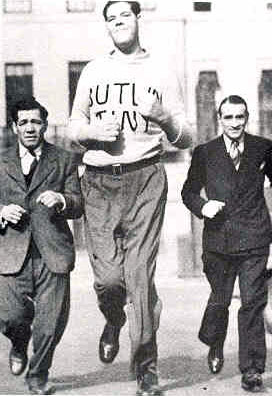
Ewart Frederick Potgieter, the son of a cattle farmer in the district of Vryheid, Natal, was an overnight sensation when he was unveiled to an incredulous boxing world in 1953. He stood 7 ft 2 in in bare feet and he carried more than 350lb (over 150kg) on his enormous frame. He was one of the tallest proffessional boxers in history, alongside Jim Cully and John Rankin, none of whom could match the South Africans weight.
Potgieter, or Pottie as he soon became known, was "discovered" by Norman Wiener, the town's hotel-keeper, and persuaded to become a boxer. Johnny Holt, the accomplished bantamweight or pre-war years, was engaged to coach him and despite his extraordinary size, Potgieter proved to have fine reflexes and normal co-ordination. His build was proportionate to his towering height and he was certainly not a circus freak to be trotted out to satisfy the base curiosity of other, presumably normal, humans.
An intelligent young man, then 22 years old, Potgieter had an amiable, attractive personality and he had long ago become accustomed to the fact that he was Gulliver in Lilliput. His parents, two sisters and a younger brother, were all well above average height and size but he was by far the biggest. Everything he wore had to be tailor-made; the only item of clothing he could ever buy across the counter was a handkerchief. Even a normal tie was of no use to him. He always had to duck when entering a room and two hotel beds had to be pushed together to accommodate him. He could not travel by train as the compartments and sleeping bunks were hopelessly inadequate, and seats had to be removed to make space for him on aircraft. He was quite unable to get into any of the smaller makes of cars, and knives and forks looked like toys in his huge hands. His hands, in fact, were so big that regulation sized gloves had to be discarded for custom-made ones when he became a fighter.
His appetite was average and one of his biggest problems was that fact that he was always given piles of food by well-meaning hostesses. A man of impeccable character, Potgieter did not drink or smoke but he liked dancing and there was apparently never any danger of him placing his size thirteen shoes (not particularly big for someone of his height) on the feet of a partner.
He was remarkably mobile in the ring but his style was mechanical. His boxing career was confined to 19 bouts over less than four years and although he usually beat his carefully selected opponents it soon became apparent that he had no real aspirations to become a really world class heavyweight. He had several fights in Britain and the United States but the over-active pituitary gland which was the cause of his great height in the first place brought his career to an abrupt end. After major operations in the United States he returned to his farm and his cattle and settled down to life as a husband and father.
Unfortunately Potgieters health has steadily deteriorated over the years and in recent years, his huge frame emaciated, he walks with painful difficulty and is virtually crippled. His brief venture into the relentless world of professional boxing brought him little profit or pleasure but he did earn a place in our boxing history, not merely because of his gigantic size but more so for his natural dignity and unaffected charm.
Ewart Potgieter was never a champion but he always behaved like one.
It's a wonderful, wonderful book by the way, and I'm extremely glad I've kept hold of it through all these years.