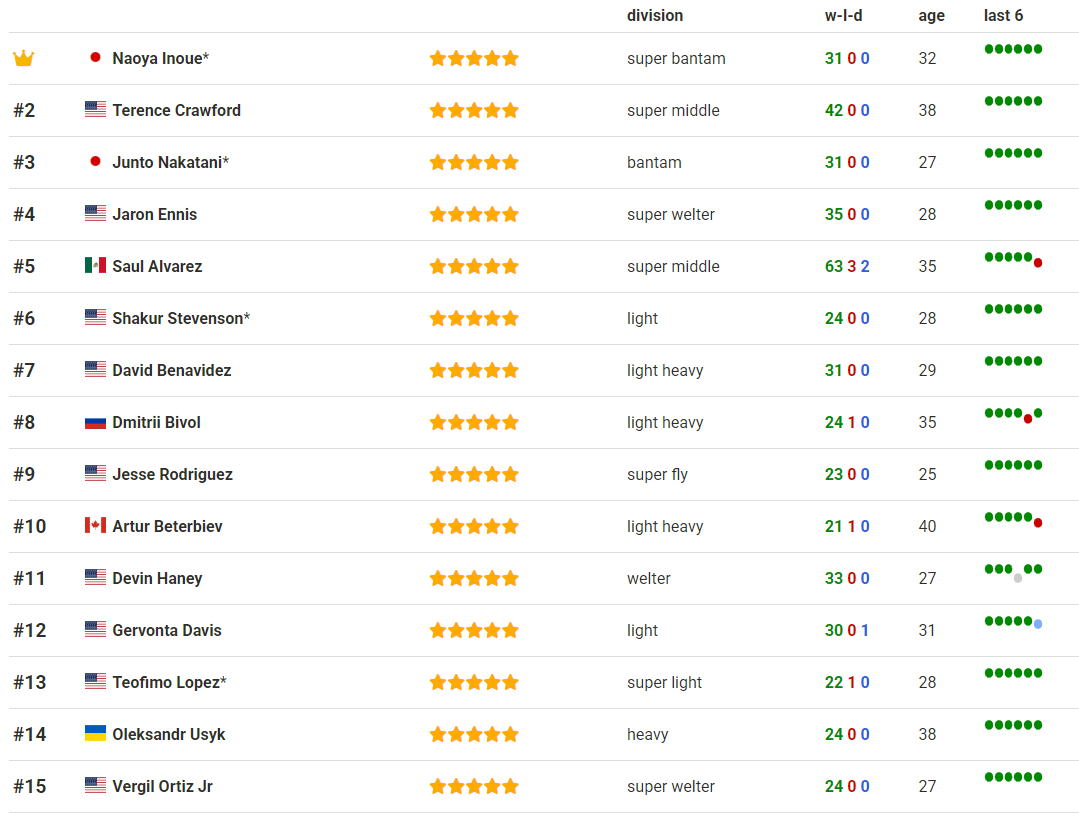
This piece will address the most controversial aspect of the BoxRec algorithmic rankings: why is it that while the rankings within individual weight classes look relatively reasonable, the moment we click the "lb to lb" tab, even the ultimate heavyweight elites are ranked shockingly low on the overall list? To thoroughly analyze this discrepancy, we need to look into how ranking points are calculated, and at the end of the article, we will propose a potential fix that could resolve this issue without breaking BoxRec's core formula.
The Key Feature of the Updated Formula
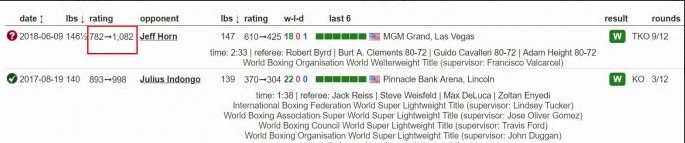
Long-time users will remember that years ago, points for bouts were awarded publicly. The layout featured two specific columns: "Rating Before" and "Rating After." These individual columns allowed users to predict and estimate how many points a fighter would gain or lose after a particular matchup, provided they had even a basic understanding of the BoxRec formula back then. However, the current formula operates completely differently: match results no longer affect just that single specific fight, but rather reverberate through the fighters' entire careers retrospectively.
What does this mean?
Originally, all boxers started with 0 points (or a nominal minimum value that served as a baseline for calculations).
Let’s say Jack had 10 points and defeated Bobby, who had 50 points. Since Jack pulled off an upset according to BoxRec’s criteria, the total points in the system after the fight wouldn't just be 60 (10 + 50), but, for example, 80. This happened because of the so-called "upset bonus." Following the fight, Jack would take, say, 25 points from Bobby. However, the final scores wouldn't simply adjust to 35 for Jack and 25 for Bobby; Jack would also be awarded an additional 20-point upset bonus. Consequently, Jack would end up with 55 points, and Bobby with 25. This mechanism allowed the total pool of points within the system to grow. And since boxers naturally retire and exit the sport, any excess points in the system were balanced out when fighters took their accumulated points with them into retirement. Without this "upset bonus," the overall point pool would have shrunk year after year.
The modern formula is configured entirely differently. When initially calculating points, the system injects two "invisible" fights into a fighter's record—one win and one loss. This is done so prospects don't have to start from absolute zero, giving the algorithm a baseline pool of data to draw from. Crucially, as a boxer's career progresses and the quality of their opposition rises, their rating adjustments are not just applied to recent fights but actually recalculate their past.

What is the mechanism behind this?
Previously, points were strictly added to the latest fight. Today, the system performs a historical recalculation of an entire career after every new result.
Why did BoxRec’s administration implement this change?
Not all debutants are created equal. If Oleksandr Usyk, for instance, proved through his subsequent career that he is an elite fighter, is it fair to treat him at the very dawn of his professional career as a mere "journeyman with 0 points"? Modern BoxRec is designed to recognize this hindsight: it realizes that a fighter like Usyk was an elite talent from day one. Therefore, his rating dynamically adjusts not only for his current bout but retroactively across his entire career timeline.
For example, if Usyk's past opponents go on to win fights and increase their own ratings, their success directly boosts the ratings of the fighters who beat them. This means that even if Usyk doesn't fight for a while, but Tyson Fury, Anthony Joshua, or Murat Gassiev secure highly-rated victories, it's not just them who move up—Usyk receives additional points too. By virtue of his prior victories over them, he proved he was the superior fighter. As his past opponents increase their standing over time, it confirms they weren't pushovers, but rather high-caliber opposition, which in turn elevates the value of Usyk's legacy wins.
All of these intricacies are explicitly codified in the new formula. To quote one of the official rules governing this aspect:
Current Ratings and the "Winner Above Loser" Rule
A boxer's current rating is derived from BoxRec ratings at the time of their recent fights.
The "Winner Above Loser" rule: for a period of 36 months, the winner of a bout is held above the loser in the rankings.
This restriction can be bypassed if the loser achieves future success against a higher-rated opponent.
In practice, this means that even if Daniel Dubois does not rematch Usyk but continues to defeat top-tier opponents, Usyk's rating will still grow for 36 months following their bout.
This rule highlights that a fighter's rating can increase if they beat an opponent who goes on to prove themselves as an elite fighter in the future, even if that opponent hadn't yet reached their peak at the time of their head-to-head match. At the same time, the 36-month cap allows a previously defeated fighter to eventually surpass their conqueror in the rankings down the road, even if a rematch never materializes. Opponents essentially "pull up" each other's ratings within this 36-month window.
What is wrong with the Heavyweights?
Now, let us address the core topic of this article: what is wrong with the heavyweights? Why are they ranked so unfairly low in the P4P rankings?
The issue stems precisely from the interconnectedness between fighters mentioned above. This is why I had to dedicate so much time to explaining it.
What is the essence of this connection?
The modern structure of weight divisions encourages frequent movement between weight classes. The difference between the 105 lb and 108 lb divisions is just 3 pounds. Between 154 lb and 160 lb, it's only 6 pounds. However, the gap between 175 lb (Light Heavyweight) and 200 lb (Cruiserweight) is a massive 25 pounds. Because the lighter divisions are closely packed, the fluid exchange and circulation of rating points happens intensely and continuously up until the Light Heavyweight division. While light heavyweights occasionally move up to cruiserweight, and cruiserweights sometimes transition to heavyweight, these jumps are far less frequent due to the sheer size contrast.
The Second Reason
The second issue involves how points are scaled when a fighter changes divisions. This adjustment is proportional to the weight class:
RATING REDUCTIONS AND INCREASES BASED ON DIVISION TRANSITIONS
Over 90.7 kg (200+ lbs) Heavyweight
-30.5% ↑ ********** +43.88% ↓
Up to 90.7 kg (200 lbs) Cruiserweight
-23.5% ↑ ********** +30.72% ↓
Up to 79.4 kg (175 lbs) Light Heavyweight
-7.8% ↑ ********** +8.46% ↓
Up to 76.2 kg (168 lbs) Super Middleweight
-9.4% ↑ ********** +10.38% ↓
Up to 72.6 kg (160 lbs) Middleweight
-7.3% ↑ ********** +7.89% ↓
Up to 69.9 kg (154 lbs) Super Welterweight
-8.9% ↑ ********** +9.77% ↓
Up to 66.7 kg (147 lbs) Welterweight
-9.2% ↑ ********** +10.13% ↓
Up to 63.5 kg (140 lbs) Super Lightweight
-7% ↑ ********** +7.53% ↓
Up to 61.2 kg (135 lbs) Lightweight
-7.4% ↑ ********** +7.99% ↓
Up to 59.0 kg (130 lbs) Super Featherweight
-6% ↑ ********** +6.38% ↓
Up to 57.2 kg (126 lbs) Featherweight
-6.4% ↑ ********** +6.84% ↓
Up to 55.2 kg (122 lbs) Super Bantamweight
-6.5% ↑ ********** +6.95% ↓
Up to 53.5 kg (118 lbs) Bantamweight
-5.2% ↑ ********** +5.49% ↓
Up to 52.2 kg (115 lbs) Super Flyweight
-5.3% ↑ ********** +5.60% ↓
Up to 50.8 kg (112 lbs) Flyweight
-5.4% ↑ ********** +5.71% ↓
Up to 49.0 kg (108 lbs) Light Flyweight
-5.5% ↑ ********** +5.82% ↓
Up to 47.6 kg (105 lbs) Minimumweight
Looking at this distribution, you can see that if a light heavyweight moves up to cruiserweight, their points drop by 23.5%. If they subsequently move all the way up to heavyweight, their points are slashed yet again, this time by 30.5%.
To put this into perspective, at the time of writing, light heavyweight David Benavidez holds a rating of 37.44 points. His next scheduled bout is against Gilberto Ramirez, who sits at 17.65 points. This matchup is set to take place at cruiserweight. When the fight actually happens, the system won't evaluate Benavidez using his 37.44-point baseline. Instead, he will be treated as a fighter with 28.64 points. Furthermore, if Benavidez were to bypass cruiserweight completely and jump straight into the heavyweight division, his rating would plummet all the way down to 19.90 points.

BoxRec's Solution
As you have probably realized, users on our local forums aren't the only ones frustrated by this imbalance. BoxRec itself acknowledged the issue and introduced a separate, standalone P4P ranking table designed to offer a fairer representation of the division landscape. However, this implementation acts as a purely cosmetic patch and has absolutely no actual mathematical influence on the primary global "lb to lb" rankings.
My Proposed Solution
I see a much more elegant solution to this problem. It wouldn't require rewriting the entire BoxRec 3.0 algorithm from scratch, but it would better balance the overall leaderboard. What needs to be done? It’s actually quite simple.
Within the mathematical formula, the baseline weight variable for Cruiserweight should be adjusted under the hood to behave as if it were 185 lbs instead of 200 lbs. Similarly, the Heavyweight baseline should be adjusted from 240 lbs (which is the current hidden algorithmic value used for heavyweights) down to a range of 195–205 lbs.
Cruiserweight would still show up as "Cruiserweight" on the front end, and Heavyweight would still be labeled "Heavyweight." However, altering these backend values within the transition formula would finally bring cruiserweights and heavyweights in line with the rest of the sport, creating a balanced and cohesive global ranking system.
---
Andrii Atanasov.