
The Life and Times of Luis Sarria
By Enrique Encinosa
Sports historians enthralled with the Ali legend have written little about Luis Sarria. There are reasons for such apathy. Sarria knew little English and his well-mannered, soft voice and quiet demeanor were overshadowed by the ranting of Bundini, the brilliant glibness of Pacheco and the blue-collar appeal of Angelo.
The sports historians missed out on a treasure find. Luis was one of the most interesting characters in the game, considered among Cubans to be the greatest fight trainer the nation ever produced. He had wit and a dignified manner that was the mirror of his good soul.
Luis Sarria was born on the 29th of October, 1911, in Cumanayagua, a farming town in central Cuba. His childhood was marked by poverty, hunger, illness and death. One of his sisters died before reaching adulthood. A brother - with whom Luis shared a bed - died in his sleep by the age of twelve,
Sarria was an orphan who wore hand me down clothes and had known gnawing hunger in his belly. Many years later, when a journalist made a casual remark about having skipped lunch and feeling very hungry, Sarria smiled and said softly: “You don’t know what going hungry is like. Son, when you are hungry you can eat melted lead.”
He was on his own by the age of thirteen, working at shining shoes in a street stall in the southern city of Cienfuegos. As he grew in size and strength he made good wages for very hard work during the season of the sugar harvest, wielding a sharp machete under the hot Cuban sun. He also worked in the tobacco fields of Las Villas Province, in central Cuba.
Luis Sarria started in boxing at the age of thirteen, fighting in amateur smokers where a hat would be passed for the fighters and winning bettors would tip their favorites. After a few fights - mostly victories - Sarria turned pro, beating an American fighter named Ernie Balin in a four-round fight.
“The money was not there,” he said about his prelim fights. “They paid a peso a round, so it was four pesos for a four- rounder. That was very little money but when I did not have any money at all, a peso could buy me a couple of cheap meals to get by another day.”
Sarria fought in Cienfuegos and Santa Clara, winning most of his bouts, then headed for Havana, a very active fight center, where he set up a shoe shine stand in the porch of a café named “El Polo.” He lived in a cheap boarding house and trained at a boxing gym after working a full shift to earn a few bucks.
Sarria shined shoes and sold newspapers, fighting prelim bouts for a few pesos. He scored a win over Pedro Canales and was a known fighter in undercards at Cuba’s famed Arena Cristal, a venue that had featured Kid Chocolate as one of its headline performers.
For his first - and only - main event, Sarria was paid fifty pesos in 1938. His opponent was Ramon Rodriguez, an established journeyman welterweight with a decent punch and a difficult southpaw style. “It was the toughest fight of my life,” Sarria recalled in a rare interview, many years later. “He hit very hard, dropping me early, but by then I knew how to survive and it took all my skill to last the ten rounds, losing on points.”
Sarria realized that his career as a boxer was going nowhere. He was a good boxer with a fighting heart, but he lacked power and his chin was ordinary. His last fight took place in 1939, when he faced Domingo Govin, a young welterweight with a hungry attitude. In the first round both men threw hard right hands and went down in a rare double knockdown. Both lifted themselves groggily from the canvas, but Sarria was the worst of the two as their seconds worked over them in their corners. “I lost by TKO in two,” Sarria said, “Referee Benitez stepped in and that was my last, my thirtieth pro fight. I won nineteen.”
Luis Sarria continued to shine shoes but began a new career as a boxing trainer. A pattern was soon established: Sarria’s fighters won most of their fights. The young trainer did not allow his students to climb through the ropes unfit, nor did he overmatch them to make a quick buck. Green kids became proficient inside the ropes, and his amateur team picked up medals at tournaments.
By 1943, Luis Sarria was the trainer and corner for the legendary Kid Tunero, an old Cuban pro who defeated four world titleholders, including Ezzard Charles; by 1948, Sarria was named trainer for the Cuban amateur team, winning three gold medals at the Guatemala Central American Games.
The fifties established Luis Sarria as one of Cuba’s best trainers. He was the teacher and corner for three future world champions: Luis Rodriguez, Sugar Ramos and Jose Legra. Sarria also worked with world contenders including his amateur star turned pro heavyweight Julio Mederos, Spanish welterweight champion Ben Buker, lightweight Douglas Vaillant and national flyweight titleholder Amado Mir.
Life was good. Luis was a respected trainer making a modest living, keeping his belly full while working at his favorite trade, but his world changed in 1959, when Fidel Castro took power in Cuba. As Cuba entered the Cold War, with guerrilla fighting and resistance movements opposing the Marxist revolution and thousands being executed by firing squads, Luis Sarria contemplated leaving his country to live in a foreign land. “Luis Rodriguez and I came to exile together,” Sarria said in an interview. “When Castro took over Cuba he abolished pro boxing but it took him a couple of years to get around to doing it and boxers were allowed to fight in other countries. Luis Rodriguez and I traveled to the United States several times. Once, after a fight, we were both alone in the dressing room and I told him, "You go back alone this time.” Luis looked at me and said “Sarria, are you staying?" And I said to him: “Yes, I cannot go back to that crap.” Luis Rodriguez looked at me and he nodded, and then said, “I am staying also. I feel the same way.”
In Miami, Sarria started life once again. He was flat broke, an exile in a strange land, but he had a good reputation as an honest trainer and he had a friend in Angelo Dundee. The Dundee brothers had spent over a decade importing and exporting Cuban fighters for their Miami Beach cards. Angelo spoke chopped up Spanish and his gym was filling up with new exiles: Luis Rodriguez, Florentino Fernandez, Jose Napoles, Angel Robinson Garcia, Sugar Ramos, Jose Legra, Douglas Valliant, Johnny Sarduy and a dozen other top talents.
Sarria became Angelo’s right hand man at the Fifth Street Gym. He worked with prelim fighters and future champions, as a second to Angelo and on the road with the journeymen pugs and contenders. Muhammad Ali was then Cassius Clay, a brash youth who idolized and studied Luis Rodriguez in the gym, studying the Cuban welter, copying some of his moves.
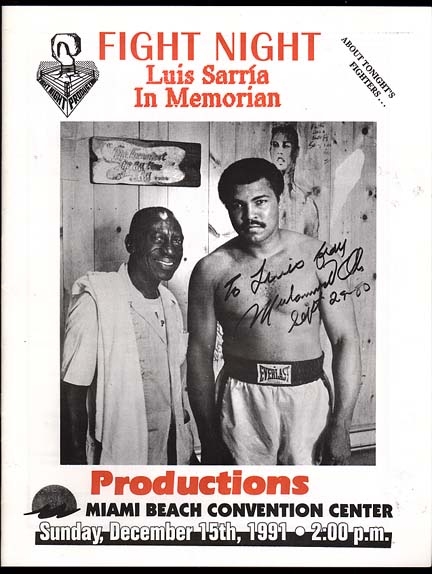
“I was training Luis…” Sarria said, “And Ali spoke to me, but I do not speak English. Then he spoke to Angelo and he told me Ali wanted me to massage him…Our friendship started that day.” Sarria’s big hands kneaded Ali’s muscles. The Cuban trainer was not licensed as a masseur but decades of gym work had taught him where every pinched nerve could be softened, how to break down the body fat, how to release tension. His large hands did their magic on the fighter from Louisville and Ali understood that the soft spoken Cuban was in a league of his own.
Sarria only learned a few phrases of English and Ali could say a few words in Spanish, but their language differences did not prevent both men from becoming friends, using their own sign language to communicate. Sarria became Ali’s conditioner, training the Great One, running him through endless hours of sit ups and knee bends, tuning his body while Dundee prepared the strategy for the upcoming bouts.
“The Ali years were unbelievable,” he said, “I worked with him for all but two of his title fights. I was there from beginning to end. Ali treated me well. He gave me a down payment for my house and paid me a good salary, but many people around him were leeches. Angelo and the sparring partners earned their money but there were many in the camp that earned high salaries and did absolutely nothing…Few cared for him as a human being.”
The sixties and early seventies were the best years of Sarria’s life. He traveled the planet with Ali, Willie Pastrano, Jimmy Ellis, Luis Rodriguez, and a squad of top talent that included top rated middleweight Florentino Fernandez and lightweight contenders Douglas Valliant and Frankie Otero. He met presidents, kings, celebrities - including The Beatles - and intellectuals including Norman Mailer and Budd Schulberg. Sarria ate at the finest restaurants in Europe and the Orient and bunked at excellent hotels in all corners of the globe. The shoe-shine prelim boy from Cumanayagua became a celebrity himself, being photographed and filmed as he worked in the gym with the Great One or stood at the corner of contenders and champions. He rode in motorcar parades in Africa, walked the ancient streets of Rome, visited the presidential mansion in Manila, felt the snow under his boots in Toronto, visited the Statue of Liberty in New York, gazed upon movie sets in Hollywood and swam at beaches in Puerto Rico, the Bahamas and Florida.
He was there - at the corner of the ring with Angelo and Ferdie - when Ali fought Frazier, Foreman, Chuvalo, Norton and Spinks. Sarria was there when Rodriguez faced George Benton, Rocky Rivero, Rubin Carter, Curtis Cokes and Emile Griffith, when Frankie Otero traded leather with Buchanan and Florentino Fernandez landed big left hooks on opponents' chins.
“It was incredible,” he once said, “I have a lot of tremendous memories… In Manila it was exciting. In the middle rounds Frazier hurt Ali very bad and he was in pain…Working the corner was a lot of pressure in that fight but Angelo is very smart at working a corner…I first met Angelo in the fifties when he went to Cuba almost every week for the fights…He was not rich or famous then. Like most trainers he was barely making a living.”
One of the sad days of his career came when Luis Rodriguez lost a title bid to Nino Benvenuti. “Luis was a great fighter,” Sarria said, “one of the greatest I ever saw, but he was shop-worn from more than a hundred fights, yet he gave the Italian a boxing lesson until Benvenuti threw that left hook. That was the hardest punch that man ever threw. It caught Luis on the side of the jaw. When I saw Luis go down, I knew he wasn’t going to stand up that time.”
In the eighties Sarria contemplated retirement. He had a home, a family and several dogs, a social security pension and Medicare, but he needed the fight game to stay alive, to feel useful. By then, the Fifth Street Gym was too far to travel for an old trainer with increasing arthritis. He needed a place closer to his North Miami home. Besides, the Fifth Street Gym had changed. Ali and the top guns of the sixties and seventies had retired, melting back into civilian life. Angelo was still active but had moved his base of operations away from Miami Beach. Ferdie Pacheco was doing TV commentary for big fights and writing books while Chris Dundee was still active with sporadic promotions and booking some fighters, but the aging Chris no longer produced the weekly fight shows that had made the gym the bubbling cauldron of pugilistic activity of its heyday.
Enter Caron Gonzalez, an old friend from the time Sarria was a prelim pug. Caron was a muscular black man who had been a sparring partner of Kid Tunero and had become a very good trainer after an unspectacular and brief pro career as a welter. Caron had worked with Benny Paret and Jose Stable and was a very good teacher of infighting. Gonzalez was opening up a gym in Miami’s Allapatah neighborhood - only a block away from where Jack Britton had owned a drugstore - and Sarria was offered a chance to earn a few bucks and stay busy. Caron and Luis ran the gym for several years. Roberto Duran trained there for the “No Mas” fiasco with Ray Leonard, as did other champions including Happy Lora and Wilfredo Vazquez. Gonzalez and Sarria kept busy working with fighters like Puerto Rican lightweight Juan Arroyo, Cuban lightweight Pedro Laza and a small army of prelim fighters hailing from all corners of the Caribbean. Sarria trained fighters, massaged bodies and worked corners. He would pace himself, taking breaks in which he sat ringside, puffing on a pipe, waiting for the arthritis to ease so he could stand again, to continue teaching the nuances of the jab or hook. Eventually, he stopped working corners, for it hurt too much to climb the few steps into the ring.
That was the beginning of the end of the Sarria story. All good things come to pass and so do good men. Luis Sarria is no longer among us, but those who knew him will never forget his big smile, his large hands, his soft manners and his bearing that Ferdie Pacheco equated with “the dignity of an African Prince.”
Not bad for a poor shoe shine boy from Cumanayagua.
He also gets a mention here.
As the end approaches, purpose overtakes him
By BILLY REED, The Courier-Journal
Aug. 13, 1978
Deer Lake, Pa. -- The day begins at 5 a.m., when The Boss shatters the quiet off his training camp by ringing the bell outside his private log cabin. Immediately, the misty darkness is punctuated by lights coming on in the other cabins on the hillside. The bell tells everyone that Muhammad Ali is up, ready to get at the business of training for what promises to be a dramatic end to his epic career.
The Boss wears a blue jogging suit with white stripes on the sleeves. After ringing the bell, he strolls past the mess hall and gymnasium toward the two-story cabin where his wife, Veronica, lives with their children. On the way, barely visible in the darkness, he shadow boxes, as if trying to sake the sleep from his 36-year-old mind and body.
One by one, he passes the huge boulders on which are painted the names of the great fighters of history -- Kid Gavilan, Willie Pep, Joe Frazier, Joe Louis, Sugar Ray Robinson. The boulders remind Ali of his own mortality, and along with the log cabins, give the camp the atmosphere of permanence and roughness and history that Ali deems so important to his frame of mind.
"This camp cost me $480,000, but it's perfect, man," says Ali. "Even if I used it only for this one fight, it would be worth the money. It's worth a half-million dollars to get ready for the fight that's going to mean something to the whole world. This is my last fight, my last time in camp. It's like my whole camp was built for this purpose, this one fight. I don't know why, but God has His purposes."
The fight in questions, of course, is the one against Leon Spinks on Friday, Sept. 15, in New Orleans Superdome. Ali says it will be his last hurrah, even if he becomes the first man ever to win the heavyweight championship three different times. Ali contends rightfully, that it will be one of the biggest sporting events ever. Besides drawing the sports first million-dollar live gate, Ali's swan song will be seen on televisions by an estimated two billion people in more than 70 countries.
But now, on this dark and humid summer morn, that all seems so far away as Ali stands beneath his wife's bedroom window and softly calls, "Veronica, Veronica." An upstairs light flickers on and Ali, satisfied that his wife is awake, walks through a gravel parking area and across an asphalt road to the little white frame building with the stained-glass windows.
This is Ali's place of worship, his mosque, and it is the first place he goes almost every day. He takes his religion just as seriously today as he did in 1967, when he cited religious grounds as justification for refusing inductions into the U.S. Army. His conversion to the Muslim faith undoubtedly was the single most important move of Ali's life. It cost him WASP fans in America, but it made him a hero, virtually a god, to the world's 800 million Muslims.
Inside the mosque's one room is paneled and carpeted, but the only furniture is a metal folding chair on which sits a copy of the Koran, the holy book. Upon entering, Ali takes off the heavy combat boots in which he runs. Then he stands meditatively, head bowed and hands clasped, before throwing himself to his knees and bowing toward the East. Finally, he rises, picks up the Koran and then sits on the floor, his back against the wall, so he can study his lesson for the day.
While The Boss is worshipping, the camp is beginning to stir. Of the 20 or so people employed by Ali during training (at a total cost of $12,000 a month), only his closest friends and advisers get up to run with him. His business manager, Gene Kilroy, and his faithful second, Drew (Bundini) Brown, pull up in the battered old car they use to follow Ali on his runs. Veronica, wearing a powder-blue running suit, comes out and gets into the car. Ali's Muslim mentor, Jerry Shabaaz, enters the mosque to meditate with The Boss.
After a half-hour, Ali turns off the light in the mosque and comes outside. As he sits on the steps, pulling on his combat boots, he still is thinking about what he has studied.
"This is where I do my reading and writing about living and dying and helping people," says Ali. "When I built the camp, I saw there was a room for everybody here, but not for God. So now God has his room, too. I start the day off right, taking time for the Creator. This is a side of me that not many people see. They see the loud boxer, the cocky person. But I'm a man of God."
After worshipping, Ali is driven to an isolated rural road so he can run at least two miles. He hates to run, but knows he must do it if he is to be ready for Spinks. Ali's handlers would prefer that he run alone, but The Boss would rather have others run with him to help relieve the tedium.
So he usually gets Veronica or Shabaaz to run with him, at least part of the way. Or sometimes he will run with any Tom, Dick or Abdul who happens to show up. Last week, for example, his running companions included an attorney from Washington, D.C.; a musician from Carnegie, Pa.; a college student from New Jersey, and a sports writer from Louisville.
At dawn's first light, Ali jogs along Pheasant Run Road, a lightly traveled two-lane blacktop that winds through the countryside, past houses and barns and barking dogs. As he trots along, Ali waves to passing cars. The sight of a flock of birds interests him. "Look," he says to Veronica, "watch 'em change direction." And then Ali begins to clap his hands and make a loud clucking noise. The birds change direction.
The last several hundred yards of the two-mile run are all uphill, so that Ali is breathing heavily and perspiring freely when he finally stops. He then walks awhile, stopping every few yards to shadowbox. Finally, he gets in the car and heads back to camp to do his calisthenics.
Ali hates the calisthenics almost as much as he hates running, so he puts them off by sitting around and chewing the fat with his friends and employees. Ali seems to enjoy these private bull sessions. Invariably, the conversation is about the subjects that interest Ali the most -- himself and Allah. Thinking out loud, The Boss tries out theories and ideas on his captive audience. At times, Ali sounds like a kid reciting his catechism. Other times, though, he shows an inquisitive mind, a raw intelligence full of depth and insight.
"The truly great men of history never wanted to be great," Ali says. "Look at Jesus, Moses, Noah, Lot, Abraham, Mohammed. God's prophets, and all they wanted was a little robe and a donkey and a chance to be closer to God, the truly great on himself. This is deep, man, this is gettin' to the heart of my being.
"When I was a little boy in Louisville, I used to lay on my bed at night cryin'. I knew I was goin' to do somethin' in life. I just didn't know what. Somethin' ain't right, I thought. Why do the white man go to his church and the black man to his church? I always knew something was wrong.
"I went to church and saw Jesus as a white man with blonde hair and blue eyes. What if Jesus was really black? What if all the angels were really black? What if everybody at The Last Supper was black? What's 300 years of looking at that white Jesus gonna do to a man's mind? Oh, man, whatcha talkin' about?"
Finally, about 8:30 a.m. Ali knows he finally must face up to the exercises. His faithful masseur, Luis Sarria, greases his body with oil, all the better to induce perspiration. Sarria, a tiny black man of indeterminate age, speaks only Spanish. He has been Ali's masseur since 1965.
Then, under the watchful eye of conditioner Lloyd Wells, formerly of the Kansas City Chiefs, Ali spends the next 45 minutes doing more than 300 sit-ups of various kinds. Lying on his training table, with Sarria holding his feet, Ali knocks off 21 conventional sit-ups. Then he does 16 more, except this time he manages to rock back and forth, touching his elbows to his knees. The table rocks beneath the weight. Beads of perspiration glisten on his body.
"The people don't see this," he says, between gulps for air. "They just see me talking. Oh, I'm gettin' ready. I'll shock the world like I did with Liston."
Another set of 21 sit-ups.
"Oh, we'll win the next fight, easy. No decision, no doubt. I didn't do any of this before the last fight. No sit-ups, no running, no boxing. This'll show him. Oh, I'm gonna be so pretty for this fight. My boxing, my dancing, my reflexes, my complexion. No belly, no jaws. I'm killin' myself for the first time in my life. Never have I worked so hard. I'm gonna go out like a champion, dancin' and movin.' I feel it now."
And so it goes, until the session is over. Ali gets on the scales. He weighs 228, which means he has to lose eight or 10 more pounds in a month.
Because this probably will be his last fight, Ali is intent on keeping a record of everything he does. Wells records every mile and sit-up in a "Spinks Murder Book." Wells also makes a television tape of Ali's afternoon workouts. The Boss, meanwhile, keeps his own record, in pencil, on a wooden closet in a corner of his dressing room. He figures the closet will be so valuable after the fight that somebody will want to put it in a museum.
After the calisthenics and rubdown, Ali slips into a blue shirt and slacks and goes to the mess hall for breakfast. His cook, Lana Shabaaz, feeds him sliced cantaloupe, a platter of fresh fruit, and fried eggs with sausage and grits. He eats only two meals a day. In the evening, the menu usually consists of steak, salad and fresh green vegetables.
The Boss goes back to his cabin at 11 a.m. to rest until about 1:30 p.m. Sometimes he sleeps; other times he watches television, plays with his children or practices the magic tricks he has recently learned. While Ali is resting, the daily horde of reporters, photographers, tourists and autograph-seekers begins arriving. By 1:30, when Ali leaves his cabin to make the short walk to the gym, it's SRO in the tiny gym. People occupy all the metal folding chairs and lean against the walls. Body heat increases the temperature in the room to 100 degrees or so.
Some days, the crowd in the gym is so big that Ali doesn't have enough room to jump rope or work out on the big bag. This upsets his handlers, but not The Boss. The crowds are good for his ego and his attitude. With people watching, he can't cheat on his training. Also, as Ali sees it, it makes it more fun to jump rope or punch a bag if people are there to applaud when he's finished.
On days that he's feeling especially good, Ali gives the crowd a monologue at the workout's end.
"If you can't get to the Superdome, watch it at home," he says. "They get four satellites to bounce it to 77 nations. I need four satellites, I'm so bad. I'm bigger than the Super Bowl, bigger than the Kentucky Derby, bigger than the World Series. It's gonna be a September to remember, and you can say you saw me in person, the greatest of all time, free of charge!"
After a workout, Ali retires to his dressing room to rest, shower, get a rubdown and meet with whatever reporters happen to be around. He has a sort of stock interview that he somehow manages to deliver with enthusiasm day after day. Finally, Ali walks outside to meet the people who have been waiting to touch him, talk with him, get his autograph.
With the public, and especially with children, Ali is incredibly patient, tolerant and kind. No other big-time athlete gives so much, so often. Because his love for people is genuine, Ali spends hours signing autographs and posing for pictures. He believes he has been invested by Allah with a sacred trust, and part of that trust is being kind to people.
"I know how big I am to these people, " he says. "When I was a kid, my hero was Sugar Ray Robinson. I finally got a chance to meet him in 1960, when I was on my way to the Olympics. He was coming out of a hotel, and I ran up and introduced myself and asked him for his autograph. But he said, 'Not now, kid, I'm busy.' I went back to my hotel and cried. I told myself I never wanted to disappoint a kid the way Sugar Ray disappointed me."
So, after his workout, Ali comes out and walks into a mob of kids. They are poor kids, ghetto kids, who have ridden the bus up from the Bronx to see Ali and forget, at least momentarily, the rats and roaches, the squalor and sadness.
In the mob was this one pretty little girl. She was, oh, maybe six years old. Her black hair was fixed in pigtails, and she had put on her best dress for Ali. But when Ali came out, and the kids rushed to him, the little girl got knocked down in the dust. Kids stumbled over her. Her dress got dirty. And she began to cry, the sobs shaking her body.
Ali heard and pushed his way through the mob so he could pick her up. He put her on his shoulder and patter her gently on the back with his huge hands, the hands that had knocked the sense out of the Sonny Listons and George Foremans of the world.
"Aw, c'mon, you're too big to cry," he whispered softly. "You're a big girl, you're a lady. Don't cry."
In a few moments, she stopped crying and began to smile.
And then Muhammad Ali gently put her down and turned to bring a moment of joy into another tiny heart.