Giancarlo wrote:It never happened outside your crazy mind, Duchess.
Of course you wouldn't know this you 'Midget Freak'.
But, Clark Bell who managed both Champion - James J. Jeffries and former Champion - Robert Fitzsimmons,
immediately gave up both fighters after the December 20, 1902 Exhibition, and immediately signed Jack Munroe
to a $500 / Week contract.
Any reason why he would do that 'Midget'.
That never happened either, Duchess, remember.
You made it up.
Like the stories about your uncle writing Ali's rhymes for him, Liberace being your dad and you and Glory Hole Gary planning a civil union.
Il Duce wrote:I shouldn't be arguing against my #5 All-Time Heavyweight
But the 'Anaconda Standard' reported that it did happen, and that Referee - Dune MacDonald
awarded the 4-Round Decision to Jack Munroe.
Of course the Decision was based upon Jack Munroe going the 4-Round distance, and 'not' winning.
Something 'good' for Jack Munroe must have happened in Butte, Montana that Saturday Night on
December 20, 1902. - Because for 18-Months after that 'Exhibition', Jack Munroe barnstormed the
country performing on stage as 'The Man Who Floored James J. Jeffries.'
It took 14 years {in 1916} before James J. Jeffries finally admitted to being knocked down by Jack Munroe.
Jeffries never "admitted" that it happened, because it didn't. None of the stories from the reporters at ringside in Butte say a word about it. But nice try.
Aye yi yi yi.......I don't get it....Ray gives you some pretty credible stuff....you cite information that practically assures it's further credibility based on sources....ok albeit in a bit of a convoluted manner...but still you should be able to follow these crumbs easy enough.....and you still end up at a dead end it seems.
Where is your journalistic competence?
If you are going to sit at the grown up table next Thanksgiving, you've got work to do son.
Denounce your own story, print a sensible retraction, and get yourself off the noose.
Or the only way you get to the table next year, is via the stuffing.
He didn’t really like boxing all that much from what I read. And he did come back for the money.
Timing is everything in boxing. Johnson got Jeff at the right time. Had Jeff fought Johnson during his title reign he may have had too much for him at that point. Jeff would then have a much higher standing.
Prime for prime I go for Johnson.
But if someone wants to rate Jeff in their top 5 or top 10 I can think of far worse opinions.
Here is what was actually published in the Anaconda Standard:
"Munroe Starts Off Strong.
"The entertainment had been so tame up to the time that Munroe entered the ring with Jeffries that the spectators felt that there was to be nothing exciting. The crowd was agreeably disappointed, however, as Munroe saved the night. When the first gong struck he opened the proceedings by pushing Jeffries' head back with a stiff right jab on the nose. The champion winced and got a left on the head. He saw he was against a foeman who meant to try to stay four rounds, and he waded in. Munroe was not to be easily found, however, and delighted the crowd by cleverly ducking vicious swings and getting away from hard leads.
"Then came a case of give and take with Munroe outpointing Jeffries all through that round and the second round. Three times did Munroe land on Jeff's jaw in the second round and in rapid succession. Jeff showed that he was not in condition and began to puff. Once in the second round Jeff showed that he was mad and sent Munroe to the floor, but not with sufficient force to make him quit.
"In the third round Jeff showed more championship form than at any time during the go. He landed on Munroe's jaw good and hard, and again the miner went to the floor.
"Twice afterwards in that round Munroe went down and wisely took the count. He was there not to whip Jeffries, but to stay four rounds, and he used his head well. Sometimes he clinched to save himself but he invariably got the worst of the clinches, as Jeff never failed to land on the body. After one of the clinches Jeff got in a right swing on the stomach and Munroe went down to stay had not the gong saved him.
"When the men came up for the fourth round the crowd was wild with excitement. From all sides came cries of "Stick to him, Jack," and Jack was sticking. He never once faltered or showed a sign of "yellow." No matter how much he was punished he was always back at the champion and he landed often. Had he not been so tired he might have hurt Jeffries, but as it was his blows lacked steam. Jeff was going it desperately and taking advice from the signs of Fitzsimmons, who was in his corner, but to no purpose. Munroe would go down from a punch, but would come back again after the count in wonderfully game fashion. At no time did he show a disposition to quit, though badly punished. When the time was called for the end of the fourth round Munroe was all in, but he was a hero, who had well won the tumultuous applause which greeted him."
Sounds similar to the Butte ringside reports. Knockdown? No, not reported.
And, BTW, the New York Times didn't have a reporter at ringside. It was a wire report. Again, nice try . . .
The Brooklyn Eagle filed their story from the Wire Report.
Several New York Newspapers {including the New York Times} had sent their men
out to Montana earlier in the week, to follow the James J. Jeffries 'Exhibition Tour'.
Wow. That's really interesting. The New York Times sent "its man" out to Montana earlier in the week. Then "their man" only filed a one paragraph story that was word-for-word identical to the one paragraph story in the Washington Post and other east coast newspapers? Upset of the year and he sends in one paragraph? Bet he got fired for that, huh?
Again, nice try . . .
(And what's The Brooklyn Eagle got to do with anything? I didn't mention the Eagle, and I don't think anybody else did either . . .)
That describes some of the various papers accounts.
They simply took the word of a fella who had a big dog in the race regarding the report, and it's worth.
You know this....I know you do....yet you doggedly hold on to what even you know are NOT the facts. and thus not the truth.
The reports from the ringside reporters are very similar,paraphrased by the eye witnesses in ways that pass the smell test.
What's with you? seriously? This neuro deficit appears to be a repeating pattern with you.
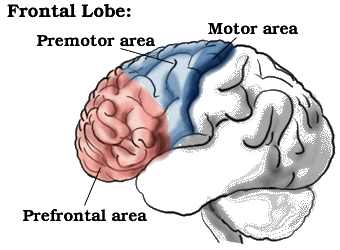
Go back and study the Toe Steppin pic I posted, then read your responses. I really want to introduce your frontal lobe to your hippocampus. You need to get to know yourself.
Controversial wrote:What's your definition of "greatest heavyweight champion"?
A 'Great Heavyweight Champion' not only wins, but totally dominates and devastates the competition.
A 'Take-No-Prisoners' type of 'Warrior'.
No games,,,,,,,,,,
One who had 'no' losses in his most important bouts, and when he was within the parameters of his 'prime'.
So, kinda like Eric Esch.
During the "parameters of his prime" from 1996-2000, Butterbean fought 49 times for 47 wins and 2 draws. So "no" losses. He also "devastated the competition", recording 37 KO's and definitely "took no prisoners".
I guess the King of the Four Rounders must come it at #6.
Controversial wrote:What's your definition of "greatest heavyweight champion"?
Facing and Defeating Stiff Competition over a long period of time. The better the competition, the more impressive the victories. When it comes to competition defeated, Muhammad Ali was the first 3x Heavyweight Champion of all time in an era that had the stiffest competition any Heavyweight Champion has ever had to face and defend against...he maintained his first 2 reigns for 3 and 4 years respectively.
Along with beating several Damn solid contenders in non-title bouts.
To me he's certainly the best Heavyweight Champion of all time. With the Legendary Joe Louis right on his heels.
Controversial wrote:What's your definition of "greatest heavyweight champion"?
A 'Great Heavyweight Champion' not only wins, but totally dominates and devastates the competition.
A 'Take-No-Prisoners' type of 'Warrior'.
No games,,,,,,,,,,
One who had 'no' losses in his most important bouts, and when he was within the parameters of his 'prime'.
So, kinda like Eric Esch.
During the "parameters of his prime" from 1996-2000, Butterbean fought 49 times for 47 wins and 2 draws. So "no" losses. He also "devastated the competition", recording 37 KO's and definitely "took no prisoners".
I guess the King of the Four Rounders must come it at #6.
#6 must be Eric or if not Eric then it can only be 'Super' Brian Nielsen, another unbeatable champ who obviously did more than that nonentity Clay!
#8 on his list is Glory Hole Gary, for sentimental reasons.
I think his 'competition' falls a wee bit short though.
Maybe a 'special division' should be started for Eric Esch.
"The Greatest Cable Television Fighter of Four-Rounders"
Well, if you're going to include level of competition as a criteria then you'd have to consider that guy who beat Joe Frazier, George Foreman, Sonny Liston and Ken Norton (and Rudi Lubbers of course).
Controversial wrote:What's your definition of "greatest heavyweight champion"?
A 'Great Heavyweight Champion' not only wins, but totally dominates and devastates the competition.
A 'Take-No-Prisoners' type of 'Warrior'.
No games,,,,,,,,,,
One who had 'no' losses in his most important bouts, and when he was within the parameters of his 'prime'.
Ok fair criteria but surely Dempsey never fought any decent black fighters, so how is he number one considering he avoided the best competition?
Aside from Harry Wills (who was avoided more by his promoter than Dempsey himself), what other black contender was the public clamoring for Jack to fight?
And Jack Johnson and Joe Louis only had one and two black challengers respectively (three for Louis is you count Walcott twice), so . . .